
Medicare Part D: Implementation of Beneficiary Premium Stabilization Demonstration
Fast Facts
The Inflation Reduction Act of 2022 significantly changed the Medicare Part D drug benefit. These changes shifted costs from beneficiaries to the private insurance companies providing the benefit.
The federal Medicare agency determined that the act's limits on monthly premium increases wouldn't have been enough to mitigate increases in 2025. This would have caused some Part D premiums to nearly double.
To prevent potential increases—and subsequent changes in enrollment—Medicare spent $9.8 billion to stabilize premiums. Medicare subsidized premiums and took on more financial risk to give insurance companies time to adjust to the changes.

Non-proprietary prescription medication bottle and spilled pills with a stethoscope.
Highlights
What GAO Found
The Centers for Medicare & Medicaid Services (CMS) implemented the voluntary Medicare Part D Premium Stabilization Demonstration (Demonstration) in 2025 to stabilize beneficiary monthly premiums and enrollment in Part D standalone prescription drug plans. Nearly all plan sponsors opted to participate. Without the Demonstration, GAO’s analysis of CMS data showed that, if beneficiaries in standalone drug plans in 2024 remained in their plan in 2025, their monthly premium would have nearly doubled, on average. In addition, monthly premiums for 37 percent of these beneficiaries would have increased by more than $40 (see figure). If these premium increases had taken effect, CMS officials expected widespread changes in enrollment for beneficiaries in standalone drug plans, which could disrupt beneficiaries’ access to their medications.
Potential Monthly Part D Standalone Premium Increases for Beneficiaries from 2024 to 2025, Absent Part D Demonstration
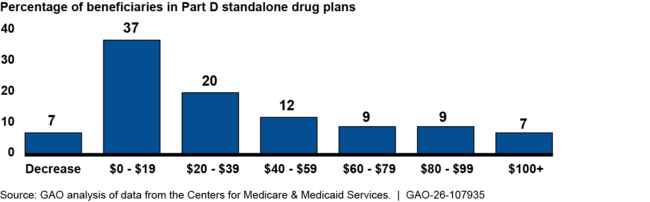
Notes: Results indicate how premiums could have changed if beneficiaries in standalone Part D plans in 2024 had remained in the same plan or were transferred to another one in 2025. Results are weighted based on 2024 enrollment of beneficiaries who were not eligible for the low-income subsidy.
To stabilize premiums with the goal of stabilizing enrollment in standalone drug plans, CMS (1) reduced beneficiary premiums in 2025 by up to $15 and then (2) limited each plan’s premium increases to $35 from 2024 to 2025. CMS also provided additional protection for plan sponsors in 2025. For 2026, CMS provides smaller premium reductions and allows for greater premium increases. Collectively, CMS officials estimated that the Demonstration would cost a total of $9.8 billion in 2025 and 2026.
The Department of Health and Human Services’ Office of the Assistant Secretary for Planning and Evaluation (ASPE), through an agreement with CMS, designed an evaluation framework to be used to determine whether the Demonstration achieved its goals. GAO’s analysis of CMS data showed that average premiums in standalone drug plans increased from $42 in 2024 to $43 in 2025 under the Demonstration for beneficiaries not eligible for the low-income subsidy. In addition, enrollment in these plans increased by 2 percent from 2024 to 2025, while the percentage of all Part D enrollees in standalone plans remained at 42 percent. However, an evaluation is necessary to determine the extent to which changes such as these were due to the Demonstration and not to other factors, such as changes to the Part D drug benefit. ASPE officials told GAO that they plan to continue their evaluation efforts in fiscal year 2026. GAO received a copy of the finalized evaluation framework in January 2026.
Why GAO Did This Study
The Medicare Part D program provides voluntary outpatient prescription drug coverage to beneficiaries, including those enrolled in standalone drug plans. The Inflation Reduction Act of 2022 required significant changes to the Part D drug benefit, some of which took effect in 2025.
CMS reported in July 2024 that increased variation in plan sponsors’ expected costs for providing drug coverage in 2025 could lead to substantial premium increases for beneficiaries. CMS subsequently announced in July 2024 the Demonstration for standalone drug plans, using its authority under section 402 of the Social Security Amendments of 1967 as amended. GAO was asked to review the legality of the Demonstration and issued a legal decision in May 2025 concluding that this Demonstration, as implemented for 2025, was consistent with this statutory authority.
GAO was also asked to review other aspects of the Demonstration. This report describes CMS’s (1) implementation of the Demonstration, and (2) plan to evaluate the Demonstration.
GAO reviewed CMS documents, such as those about the development and evaluation of the Demonstration, and CMS data on premiums for Part D standalone drug plans. In its analysis of standalone drug plan premiums, GAO focused on beneficiaries who were not eligible for the low-income subsidy and, therefore, were required to pay plan premiums. GAO also interviewed CMS and ASPE officials, Part D plan sponsors, and organizations representing Medicare beneficiaries.
For more information, contact John E. Dicken at dickenj@gao.gov.