
Navy Contracting: Sea Systems Command Actively Manages Labor Cost Increases for Professional Support Services
Fast Facts
The Naval Sea Systems Command builds and supports the Navy’s fleet. It spends billions of dollars annually for professional support services, such as engineers.
The Command generally uses the "best value tradeoff" process when contracting for these services. This means that it may pay more if additional benefits, such as retaining personnel with more qualifications, justify the higher cost.
We found that the Command had processes in place to manage cost increases. For example, it uses a system to monitor changes in labor rates. When the rate the Command is actually charged is more than 15% of its estimated rate, it takes action to control costs.

Overhead view of people pointing to technical drawing
Highlights
What GAO Found
The Naval Sea Systems Command (NAVSEA) builds and supports the Navy’s fleet. Using its SeaPort contract, NAVSEA spent about $21 billion over 6 years to acquire professional support services, such as systems engineering. Consistent with Department of Defense (DOD) guidance, NAVSEA generally uses the “best value tradeoff” process for awarding task orders for professional support services. Using this process means that the Navy might pay more if additional benefits justify the higher cost.
To actively manage labor costs for professional support services, NAVSEA
- developed a system to track labor costs after it awards the task order, and
- established enhanced oversight when the actual labor rate exceeds 15 percent above the estimated rate for the task order, referred to as a “tripwire.”
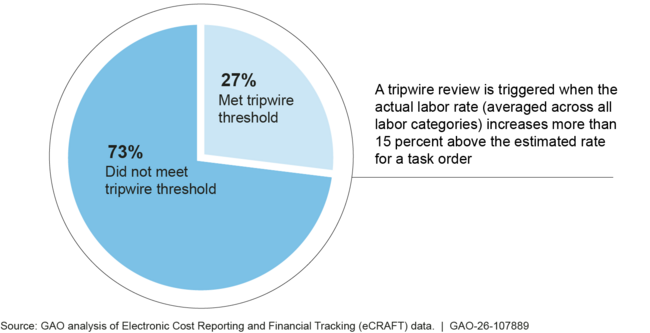
GAO found that more than a quarter (106 of 389) of ongoing task orders for fiscal years 2019 through 2024 triggered the tripwire review.
Percentage of Ongoing Naval Sea Systems Command Task Orders That Met Tripwire Threshold, Fiscal Years 2019–2024
Across the 10 task orders that GAO reviewed in detail, actual labor costs increased by $152 million as of April 2025. This is about a 60 percent increase from their estimates at the time of award. Common drivers of these increases include changes in NAVSEA requirements or the need to use higher-priced labor categories to complete the work. For example, NAVSEA officials told GAO that requirements for uncrewed surface combatant ships were more complex and labor intensive than planned. This resulted in the need for additional senior personnel with more qualifications and experience to perform the work, but at higher labor cost. For five task orders that triggered the tripwire review, NAVSEA took or plans to take actions to address labor cost increases. For example, NAVSEA worked with the contractor to adjust its labor mix between more and less experienced personnel to control future cost growth.
Why GAO Did This Study
The Navy generally requires its commands, including NAVSEA, to first consider using its SeaPort contract when buying professional support services. The SeaPort contract identifies prequalified vendors that can provide these services, such as engineering and program management support, among others, needed to meet the Navy’s requirements. The labor cost for professional support services typically comprises a significant component of the overall contract costs.
A Senate report includes a provision for GAO to review NAVSEA’s professional support service contracts and associated labor costs. GAO’s report describes how NAVSEA (1) awards task orders for professional support services, and (2) manages increases in labor rates for professional support services.
To conduct this review, GAO analyzed ongoing NAVSEA task orders from fiscal years 2019 through 2024. GAO analyzed labor cost data for 389 task orders, and from those task orders selected a nongeneralizable sample of 10 for further review. GAO selected the 10 orders based on the labor rate increases, number of labor categories, and period of performance. GAO reviewed relevant federal, DOD, and Navy regulations; NAVSEA policy; and contract documentation. GAO also interviewed cognizant contracting and policy officials at DOD and NAVSEA.
For more information, contact Timothy J. DiNapoli at DiNapoliT@gao.gov.