
Semiconductors: Information on Projects Funded to Strengthen U.S. Supply Chain
Fast Facts
Semiconductors (or chips) are critical to nearly all industries, and most are made overseas. To ensure a reliable U.S. supply, the Department of Commerce was authorized to finance projects to build or improve domestic manufacturing facilities.
We looked at the projects Commerce selected, how it chose them, and how it determined funding amounts. As of July 2025, Commerce had awarded $30.9 billion across 40 projects. Many of the companies that received project funds also got workforce development funds as part of their awards.
Companies expect to complete these projects by 2033. This report is the first in a series.

Image of a person holding a semiconductor (or chip).
Highlights
What GAO Found
As of July 2025, the Department of Commerce has provided incentive awards to 19 companies for 40 projects to construct, expand, or modernize semiconductor facilities. Thirteen of the 19 companies received funding for workforce development activities associated with the projects. In total, Commerce awarded the 19 companies with $30.9 billion in direct funding and two of them with $5.5 billion in loans through the incentive awards.
Commerce awarded projects that collectively aim to address gaps and vulnerabilities at various stages of the supply chain, from materials production to packaging. Nearly 40 percent of projects are intended to produce leading-edge logic chips, which process data for emerging technologies such as artificial intelligence. Commerce estimates that these projects will bring the U.S. share of global leading-edge logic chip manufacturing from 0 percent in 2022 to 20 percent by 2030.
Each project includes unique milestones, which span from November 2024 through October 2033. Commerce officials stated that companies have submitted milestone completion reports for 24 of 161 milestones, as of July 2025. One project, a new leading-edge logic chip manufacturing facility in Arizona, was certified as complete in June 2025.
Semiconductor Projects’ Anticipated Completion Dates, as of July 2025
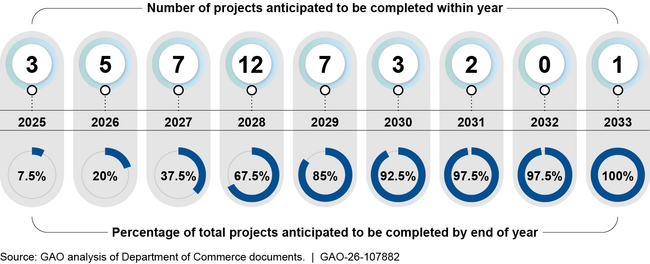
Note: For more details, see figure 6 in GAO-26-107882.
Officials weighed six criteria to select projects, giving the greatest consideration to projects’ potential impact on economic and national security objectives. For projects selected for an award, officials found that economic and national security benefits outweighed any downsides or risks.
Commerce set award funding amounts to incentivize project completion and distribute funds across a portfolio of projects throughout the supply chain. To ensure that funding amounts would not result in profits that significantly exceed company projections, Commerce negotiated upside sharing agreements for 27 of the 40 projects. Under these agreements, companies share profits with the federal government if their profits exceed a specific threshold.
Why GAO Did This Study
Semiconductors, also called chips, are small electronic devices that are critical to nearly all industries. A global semiconductor shortage occurring from 2020 through 2023 exposed long-term risks in the supply chain. For example, manufacturing facilities are concentrated in a few regions globally.
The William M. (Mac) Thornberry National Defense Authorization Act for Fiscal Year 2021 (as amended, the FY21 NDAA) authorized Commerce to provide financial assistance to entities undertaking semiconductor facility or equipment projects. The CHIPS Act of 2022 appropriated $39 billion for these purposes. In response, Commerce issued the first award in September 2024 after establishing a new office, soliciting input from stakeholders, developing a strategy for the program, and reviewing applications.
The FY21 NDAA also includes a provision for GAO to issue a series of reports on the semiconductor incentives program. This report, the first in the series, examines (1) key characteristics and anticipated timelines of selected projects and (2) how Commerce selected projects and set funding amounts.
This report covers awards made by Commerce from September 2024 through July 2025. GAO analyzed Commerce documents, including notices of funding opportunity, evaluation and selection documents, and awards. In addition, GAO reviewed relevant requirements in the FY21 NDAA and compared Commerce’s efforts to those requirements. GAO also interviewed Commerce officials.
For more information, contact Candice N. Wright at WrightC@gao.gov.