
Coast Guard: Additional Actions Needed to Address Reports of Community Discrimination Against Service Members
Fast Facts
The Coast Guard is responsible for ensuring its members are supported as they rotate between different duty stations. This includes investigating reports of local community hostility, harassment, and discrimination against Coast Guard members or their families. For example, a Coast Guard member might report that they were refused service in a restaurant because of their race.
In this Q&A, we found that Coast Guard commands interpreted policies differently and weren't always aware of tools to track reported incidents. The Coast Guard also doesn't have a standard process to collect related documents.
Our recommendations address these issues.
Service members speak to residents during a Coast Guard community day event.
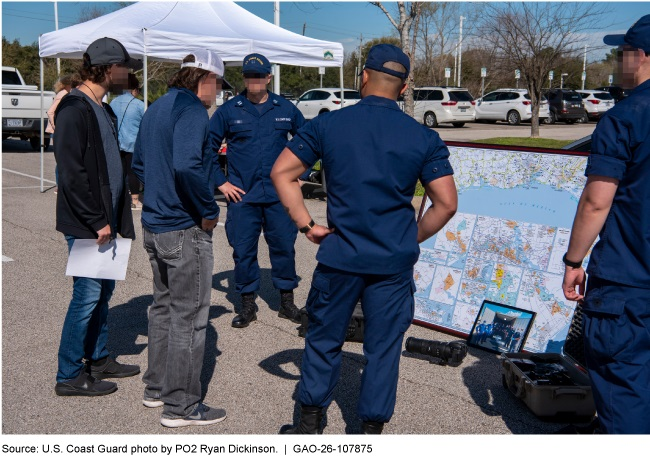
A group of people gathered on an outside parking lot on a sunny day. Coast Guard personnel in dark blue uniforms are talking to people. A large map is propped up on the ground.
Highlights
What GAO Found
The Coast Guard has over 40,000 active-duty military personnel who often reside in communities near their Coast Guard duty stations. Coast Guard units are often situated along major waterways and coastlines in remote or high vacation rental areas. Coast Guard members and their families may experience incidents of hostility, harassment, and discrimination from members of their community.
Coast Guard members reported 112 incidents of community hostility, harassment, or discrimination directed towards them or their family from fiscal years 1998 through 2024. Most of these incidents, which the Coast Guard calls social climate incidents, were perceived to be motivated by race or ethnicity. More than half of these incidents were reported from fiscal year 2019 through fiscal year 2024. For example, in one incident a Coast Guard member reported that a restaurant refused to provide them service because of their race. In another incident, a service member reported that they were subjected to racial slurs by a community member in a grocery store.
Reported Perceived Motivation in Coast Guard Social Climate Incidents From Fiscal Years 1998 through 2024

GAO found that Coast Guard commands have generally followed the social climate incident policies outlined in the Coast Guard Civil Rights Manual. However, district commands reported different interpretations of the definition, specifically as to whether social climate incidents are limited to legally protected classes. As a result, the Coast Guard may not have implemented its definition of a social climate incident consistently.
By clarifying its definition of these incidents, the Coast Guard could better ensure commands apply policies consistently. Furthermore, the Civil Rights Directorate (CRD) was unable to locate any documentation for six of the 30 reported social climate incidents from fiscal years 2020 through 2024 that GAO selected to review. Developing and implementing a standardized process for the collection and retention of documents would help the CRD better oversee and manage the response to social climate incidents.
The CRD provides Coast Guard members access to an internal website that tracks all reported social climate incidents and displays incident trends, including the location and type of incident. However, seven of the nine Coast Guard district commands GAO interviewed were not aware of this tool. By ensuring that all commands are consistently made aware of available tools, the Coast Guard could better prepare them to prevent and respond to incidents related to the social climate in the communities they serve.
Why GAO Did This Study
The Coast Guard mandates that all personnel be treated fairly and with respect to successfully carry out its missions, including within the communities in which they live. According to the Coast Guard, social climate incidents can have a negative impact on service members and their families. Under the Coast Guard’s Civil Rights Manual, the CRD is the headquarters office responsible for overseeing the management of reported social climate incidents. According to the Manual, one of the CRD’s strategic goals is to conduct activities and develop tools that assist and support commands in proactively preventing unlawful discrimination.
GAO was asked to examine policies and procedures that the Coast Guard has in place to track, monitor, and address social climate incidents. This report provides information on available data on social climate incidents, the extent to which the Coast Guard follows social climate incident policies and procedures, and how the Coast Guard responds to social climate incidents.
GAO reviewed relevant laws and Coast Guard policies and procedures, analyzed Coast Guard data, and interviewed agency officials. Specifically, GAO interviewed CRD officials, including Civil Rights Service Providers. GAO also interviewed commands from all nine Coast Guard districts as well as commands from four of 36 Coast Guard sectors and selected units within those sectors. GAO reviewed available Coast Guard data on social climate incidents reported from fiscal years 1998 through 2024 and analyzed the underlying documentation for a non-generalizable sample of 25 social climate incidents reported from fiscal years 2020 through 2024.
Recommendations
GAO is making three recommendations, including that the Coast Guard clarify its definition of a social climate incident, implement a standardized process for the collection and retention of required social climate incident documentation, and ensure that all commands are consistently made aware of social climate incident tools. The Department of Homeland Security agreed.
Recommendations for Executive Action
| Agency Affected | Recommendation | Status |
|---|---|---|
| United States Coast Guard | The Commandant of the Coast Guard should ensure that the CRD reviews and clarifies the definition of a social climate incident and ensure that the term is defined the same way in all agency policies, including its Civil Rights Manual and Assignments Manual. (Recommendation 1) |
DHS agreed with this recommendation. In August 2026, Coast Guard officials reported that the CRD had confirmed the definition of a social climate incident and was coordinating internally to update all agency policies with the clarified definition. Officials said that they expected these efforts to be completed by the end of December 2026. We will continue to monitor the implementation of this recommendation.
|
| United States Coast Guard | The Commandant of the Coast Guard should ensure that the CRD develops and implements a standardized process for the collection and retention of required social climate incident documentation. (Recommendation 2) |
DHS agreed with this recommendation. In August 2026, Coast Guard officials reported that in January 2026 the CRD had established a repository to centralize the collection and retention of required social climate incident documentation. Officials said that the CRD was in the process of collecting and uploading the required documentation. We will continue to monitor the progress of these efforts and the implementation of this recommendation.
|
| United States Coast Guard | The Commandant of the Coast Guard should ensure that the CRD consistently makes all commands aware of the CRD's social climate incident tools, including the incident reporting data provided through the internal SharePoint website. (Recommendation 3) |
DHS agreed with this recommendation. In August 2026, Coast Guard officials reported that the CRD was developing a civil rights training for commands and supervisors that would incorporate information on social climate incidents, including the CRD's social climate incident tools. We will continue to monitor the implementation of this recommendation.
|