
Wearable Technologies: Potential Benefits and Challenges in Clinical Decision-Making
Fast Facts
Wearable devices with health-related features, such as glucose monitors and smartwatches, are growing in popularity. In this technology assessment, we reviewed how clinicians can use data from wearables to help diagnose and treat patients—and how AI might expand what such devices can achieve.
Wearables rely on sensors to collect data on users. This data may allow clinicians to give patients more timely and personalized treatment. Wearables may also help underserved populations by expanding remote patient care.
But devices vary in reliability and can be difficult to integrate into clinical work. We offer three policy options that could help.
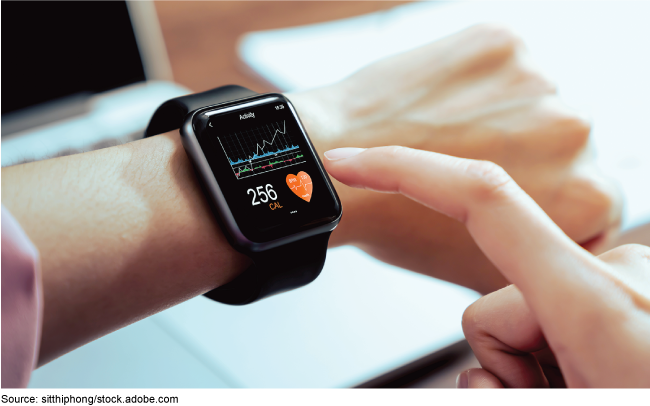
A closeup of a smartwatch on someone's wrist displaying heartrate and other data.
Highlights
What GAO Found
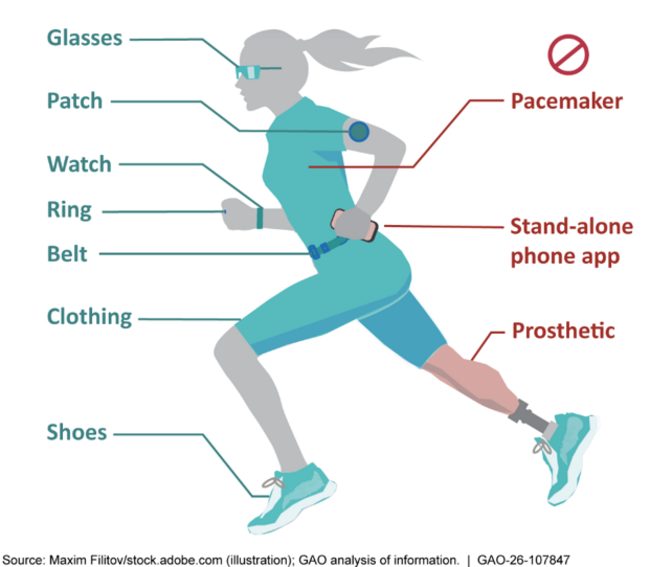
Wearable devices (wearables) with health-related features have the potential to be used in clinical decision-making (see figure). Wearables can be either medical or wellness devices, and their features can be augmented by artificial intelligence (AI). Wearables use sensors to track vital signs and establish patient health baselines; alert users, caregivers, or clinicians of medical events or suggested lifestyle changes; and provide additional assessments of user data that can be sent to a clinician for interpretation. Clinicians could use such data as a source of information when diagnosing and treating patients.
Examples of wearables that could be used in clinical decision-making
Wearables increase the amount of information considered during clinical decision-making, which may allow for quicker diagnoses by clinicians, more personalized care plans, and improved patient compliance. Wearables may also benefit underserved populations by expanding remote patient monitoring. However, wearables vary in accuracy and reliability.
AI has the potential to increase the capabilities of wearables by, for example, improving autonomous decision-making. However, the extent to which wearables will be able to make clinical decisions autonomously is unclear at this time.
GAO identified challenges to using wearables for clinical decision-making, including challenges related to ensuring wearables benefit patients as intended, integrating wearables into clinical workflows, and navigating the health technology market.
GAO developed three policy options that could help address the challenges and enhance the benefits of using wearables in clinical decision-making. The first is the status quo, whereby policymakers would continue with current efforts and activities in the field. The other two policy options identify possible new actions by policymakers, which may include legislative bodies, government agencies, standards-setting organizations, industry, and other groups. See below for details of the policy options and relevant opportunities and considerations.
Policy Options Help Address Challenges with Use of Wearables in Clinical Decision-Making
|
|
|
|---|---|
|
Continue the status quo (report page 24) Policymakers could continue ongoing digital health technology activities, and policymakers outside of government could continue voluntarily testing the use of wearables for clinical purposes.
|
Opportunities
|
|
Considerations
|
|
|
|
|
|
Integration of wearables into clinical workflows (report page 26) Policymakers could refine the clinical workflows and technology infrastructure of medical facilities to support the integration of wearables into clinical decision-making.
|
Opportunities
|
|
Considerations
|
|
|
|
|
|
Improvements to wearables performance (report page 27) Policymakers could incentivize manufacturers to improve the performance of wearables by building and maintaining a comprehensive public database of recommended wearables that have completed a selected, independent certification process. Clinicians and patients could then use the database to help find certified devices.
|
Opportunities
|
|
Considerations
|
|
Source: GAO. | GAO-26-107847
Why GAO Did This Study
Because wearables may facilitate more timely and personalized patient care, manufacturers and medical association representatives have suggested increasing their integration into clinical decision-making. In addition, in 2025 leaders at the Department of Health and Human Services announced support for increasing the use of wearables in health care.
GAO was asked to review the potential role of wearables in clinical decision-making. This report examines (1) the potential benefits and challenges of using wearables in clinical decision-making, (2) the potential benefits and challenges of using AI to augment the decision-making capabilities of such wearables, and (3) what policy options might help address challenges and enhance benefits associated with the use of wearables in clinical decision-making.
To conduct this engagement, GAO reviewed scientific literature, federal agency guidance, and other documents; interviewed a wide range of stakeholders and agency representatives; and conducted site visits to laboratories, medical and research centers, and manufacturers to better understand these technologies.
For more information, contact Sarah Harvey at HarveyS@gao.gov.