
National Science Foundation: Schedule Delays Continue for Some Major and Midscale Research Infrastructure Projects
Fast Facts
The National Science Foundation supports the design, construction, and operations of science and engineering research infrastructure. We report annually on these NSF-funded projects. As of July 2025, it had 21 projects underway.
NSF has reported delays of up to 27 months across its construction projects since our June 2024 report. NSF cited budget uncertainty and labor shortages as some reasons for the delays.
NSF also reduced the scope of some projects. For example, 6 buildings were originally planned for construction in the Antarctic. NSF reduced it to only 1 building due to scheduling issues and design problems, among other factors.
Rendering of the Giant Magellan Telescope NSF Project
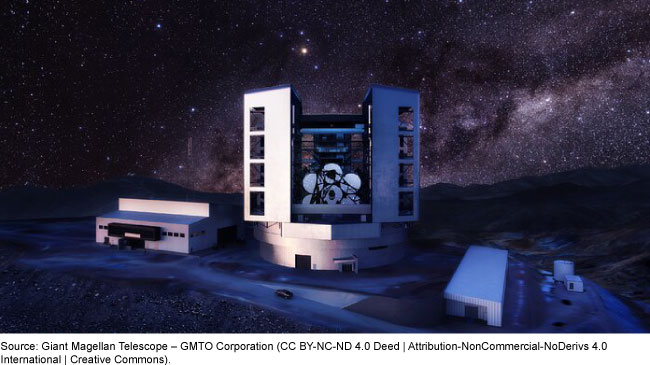
A variety of buildings and telescopes under a star-filled sky.
Highlights
What GAO Found
The National Science Foundation (NSF) has 21 research infrastructure projects funded through its Major Research Equipment and Facilities Construction (MREFC) and Research and Related Activities accounts, as of July 2025. This includes 13 major projects ($100 million or more) and eight midscale projects ($20 million to $100 million) at various stages of design, construction, and implementation.
While all of these research infrastructure projects remained within their NSF-authorized total cost since GAO’s June 2024 report, several have experienced schedule delays or scope changes. Specifically, as of July 2025, four of the seven major projects in construction reported delays of 4 to 27 months relative to schedules GAO reported in June 2024 (see table below). NSF attributed delays to numerous factors, such as labor shortages, contractor underperformance, and budgetary uncertainty. Further, NSF reported reductions in scope for two of these projects, as well as three of eight midscale projects.
Status of NSF’s Major Research Infrastructure Projects Under Construction, as of July 2025
|
Project |
Authorized cost |
Estimated completion |
Scope reduction |
|---|---|---|---|
|
Antarctic Infrastructure Recapitalization Program |
$155.4 million |
August 2029
|
-
|
|
Vera C. Rubin Observatory |
$571 million |
January 2026 ▲ 10 months |
- |
|
Antarctic Infrastructure Modernization for Science |
$410.4 million |
May 2027 ▲ 4 months |
✓ |
|
Regional Class Research Vessels |
$400 million |
April 2029 ▲ 27 months |
✓
|
|
Large Hadron Collider High Luminosity Upgrade Program |
|
|
|
|
ATLAS Detector |
$82.8 million |
December 2028 ▲ 5 months |
- |
|
CMS Detector |
$88 million |
June 2028 ▼ 1 month |
- |
|
Leadership-Class Computing Facility |
$457.4 million |
March 2028 |
- |
|
Total |
$2,165 million |
|
|
Legend: ATLAS = A Toroidal Large Hadron Collider Apparatus; CMS = Compact Muon Solenoid; ▲ = increase since June 2024; ▼ = decrease since June 2024; ✓ = scope reduced since June 2024.
Source: GAO analysis of National Science Foundation (NSF) information. | GAO-26-107842
NSF considers several factors when selecting and awarding new research infrastructure projects. Specifically, NSF examines the scale and maturity of the proposed project, the availability and stability of annual appropriations, and external economic conditions. NSF has two separate processes for selecting major and midscale projects. Major facilities undergo an extensive, multiphase review and selection process, including consultation with the National Science Board. Midscale projects undergo a merit review and selection process led by NSF.
Why GAO Did This Study
Modern and effective research infrastructure, including facilities and equipment, is critical to maintaining U.S. global leadership in science and engineering. NSF provides funding for the design, construction, and operations of this infrastructure. This infrastructure spans a wide range of projects, from oceanographic research vessels to telescopes and supercomputers.
The Consolidated Appropriations Act, 2024 includes a provision for GAO to review projects funded from NSF's MREFC account.
This is the eighth report in this series and builds on GAO’s previous work. This report describes (1) the cost and schedule performance for NSF’s major and midscale projects funded through the MREFC account and (2) NSF’s process for selecting which projects receive MREFC funding and the key factors that contribute to NSF’s ability to select new projects.
GAO examined NSF policies and documents for projects that were in design, construction, and implementation and interviewed agency officials.
For more information, contact Hilary Benedict at benedicth@gao.gov.