
Ukraine Funding: HHS Allocation and Oversight of Refugee Assistance
Fast Facts
Millions fled Ukraine after Russia’s 2022 invasion. The Department of Health and Human Services received $3.78 billion for refugee assistance, including for Ukrainians who were granted temporary permission to stay in the U.S.
In this Q&A report, we looked at this assistance. HHS gave grants to state, local, and other organizations to provide cash aid, medical care, housing assistance, and more. From FY 2022 through 2024, about 135,000 Ukrainians received assistance from grantees. The number of recipients varied widely across states.
To oversee assistance, HHS generally reviewed grantee reports and reviewed programs on-site and remotely.
This page has been updated with a new photo.

A person in a corner of an apartment kitchen, standing next to a glass stovetop, with countertop appliances on either side. A cardboard box filled with groceries and paper towels is sitting on the countertop in the foreground.
Highlights
What GAO Found
From fiscal years 2022 through 2024, the Department of Homeland Security (DHS) granted humanitarian parole—temporary permission to stay in the United States—to approximately 259,000 Ukrainians and their eligible family members. The Department of Health and Human Services (HHS) received $3.78 billion across three Ukraine supplemental appropriations in fiscal years 2022 through 2024 to provide refugee assistance to Ukrainians granted humanitarian parole and other eligible populations. Refugee assistance can include short-term cash and medical assistance, as well as supports like employment services and language training.
Nationwide, about 135,000 Ukrainian parole beneficiaries received refugee assistance through programs administered by HHS in fiscal years 2022 through 2024 based on the most recent data available. The number served in each state ranged from fewer than 50 to over 24,000.
Number of Ukrainians Granted Humanitarian Parole That Received HHS Refugee Assistance by State, Fiscal Years 2022–2024 Combined
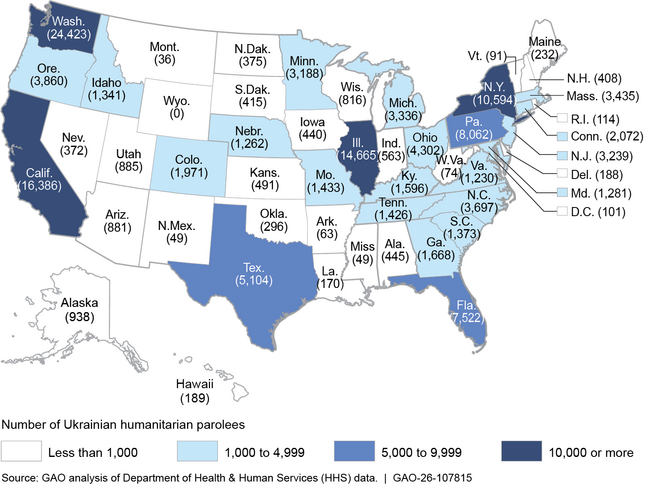
Selected state agencies and other HHS grantees GAO interviewed reported conducting outreach to Ukrainians and providing assistance with initial resettlement, housing, and legal services. Grantees also reported expanding service availability to underserved geographic areas and sometimes providing remote services.
HHS allocated almost half of the appropriated funds ($1.79 billion) based on population estimates of Ukrainians granted humanitarian parole and the remaining funds ($1.99 billion) based on estimates of other populations eligible for services from HHS, such as certain eligible Cubans and Haitians. It allocated most of the funds to state-administered programs that provide cash and medical assistance and refugee support services, such as employment services, language training, and case management.
HHS generally oversaw grantees serving Ukrainians within its existing framework for program oversight. HHS required grantees to report certain program and financial information, reviewed grantee reports and data, and conducted program monitoring reviews. GAO searched 31 selected monitoring reports from fiscal years 2022 through 2024 for findings specific to Ukrainian beneficiaries or instances of fraud overall. Across the selected reports, GAO identified one corrective action specific to serving Ukrainians, in which HHS required the grantee to update its eligibility training curriculum.
Why GAO Did This Study
Russia’s February 2022 full-scale invasion of Ukraine has caused devastating loss of life and a humanitarian crisis. Almost 6 million people have fled Ukraine as of December 2025, according to the United Nations High Commissioner for Refugees.
The Consolidated Appropriations Act, 2023, includes a provision for GAO to conduct oversight of refugee assistance provided under Ukraine supplemental appropriations. This report addresses who Ukrainian parole beneficiaries are, the HHS refugee assistance they received, how HHS allocated refugee assistance funds from Ukraine supplemental appropriations, and how HHS provided related technical assistance to and oversight of states and other grantees.
GAO reviewed relevant federal laws and regulations, including the Ukraine supplemental appropriations. GAO also reviewed related HHS policy guidance, monitoring reports, and other documents. GAO analyzed HHS financial data from fiscal years 2022 through 2025 and program data from fiscal years 2022 through 2024, based on availability. GAO also analyzed available DHS data on the number of Ukrainians and their eligible family members paroled into the United States in fiscal years 2022 through 2024. Additionally, GAO interviewed HHS officials, officials from three states, and representatives from five national resettlement agencies that served large numbers of Ukrainian beneficiaries.
For more information, contact Kathryn A. Larin at larink@gao.gov.