
Suicide Prevention: DOD Should Improve Monitoring and Assessment of Training
Fast Facts
Suicide Prevention: DOD Should Improve Monitoring and Assessment of Training
Suicide rates for active-duty service members have been increasing since 2011. Providing training on suicide prevention can help the Department of Defense ensure service members are aware of suicide risk factors and warning signs, as well as available resources for help and support.
But we found issues with how DOD and the military services monitor and assess their suicide prevention training.
For example:
- DOD doesn't require the military services to report data on training completion rates to its suicide prevention office
- The services haven't fully assessed whether their training is effective
Our recommendations address these issues and more.

Hands from a person wearing a military uniform hold a yellow ribbon, symbolizing hope and military support.
Highlights
What GAO Found
The Department of Defense’s (DOD) Defense Suicide Prevention Office (DSPO) is responsible for suicide prevention efforts across the department, but it lacks information to monitor DOD-wide completion of required suicide prevention training. Specifically, a DSPO official told GAO the office does not receive data from the military services on whether they are completing the training. Requiring the services to report their training completion rates would give DSPO data needed to make informed decisions as it oversees training and develops DOD-wide suicide prevention policies.
In addition, the military services’ headquarters suicide prevention offices generally do not effectively monitor training completion for their service members. The Army, Navy, and Marine Corps offices do not regularly track required annual training completion and only the National Guard Bureau takes action to help ensure training completion. Addressing these issues would help the service headquarters offices ensure training and service-specific learning objectives are reaching the military community as intended.
Examples of Learning Objectives from Military Services’ Suicide Prevention Trainings, as of 2025
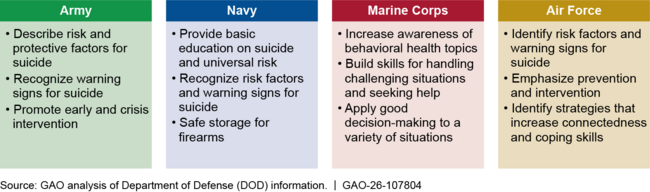
The military services have also not fully assessed the effectiveness of their suicide prevention training. Most of the services have taken steps to do so. For example, the Army, Marine Corps, and Air Force have surveys for some annual trainings. But these and other efforts have not fully assessed training effectiveness, such as by identifying the extent to which expected outcomes have been achieved. Developing and implementing evaluation plans would help the services ensure a systematic approach to assessment and determine if trainings are achieving intended outcomes, such as recognizing risk factors for suicide.
DOD has made progress implementing certain training-related recommendations from the Suicide Prevention and Response Independent Review Committee, but uncertainties exist for future efforts. DOD has begun addressing the committee’s recommendations, including 18 on nonclinical training. However, GAO found that DOD’s ability to continue these efforts is uncertain given recent changes in staffing levels and pending decisions on combining suicide prevention training with other trainings. By using an iterative process to regularly update its project plans to account for and mitigate these uncertainties, DOD would be better positioned to effectively assess risks and manage resources.
Why GAO Did This Study
Suicide rates for active-duty service members have gradually increased since 2011, according to DOD. DOD’s latest data show that in 2024, 471 service members died by suicide. Suicide prevention training can increase awareness of risk factors and provide resources for intervention, among other things. However, recent GAO and DOD reports have identified gaps in DOD’s implementation of suicide prevention activities, including training.
House Report 118-125 includes a provision for GAO to assess DOD’s suicide prevention training. This report examines (1) DSPO and the military services’ monitoring of suicide prevention training completion; (2) the military services’ assessment of training effectiveness; and (3) DOD’s steps to address an independent review committee’s training-related recommendations.
GAO reviewed DOD policies, procedures, and other documentation on suicide prevention training; analyzed fiscal years 2020–2024 data on training completion; assessed DOD-wide evaluation procedures against federal standards; and interviewed officials.
Recommendations
GAO is making 17 recommendations, including for DOD to issue guidance requiring the services to report suicide prevention training completion data to DSPO; the Army, Navy, and Marine Corps to regularly monitor training completion; the services to develop training evaluation plans; and for DOD to update project plans addressing the independent review committee recommendations. DOD agreed with nine recommendations, partially agreed with six, and did not agree with two. GAO clarified two recommendations and maintains all recommendations remain valid.
Recommendations for Executive Action
| Agency Affected | Recommendation | Status |
|---|---|---|
| Department of Defense | The Secretary of Defense should ensure that the Under Secretary of Defense for Personnel and Readiness develops and issues guidance to require the military services to report annual nonclinical suicide prevention training completion data to DSPO. (Recommendation 1) |
DOD disagreed with our recommendation and stated that the department requires the military service chiefs to provide suicide prevention training, but that frequency is not specified. Therefore, developing and issuing guidance to require reporting of annual training is not appropriate, according to DOD. However, as we noted in this report, each of the military service chiefs have implemented DOD's requirement through annual nonclinical suicide prevention training. If DOD does not issue guidance requiring the military services to report their annual suicide prevention training completion rates, DSPO will not have the necessary data to make informed decisions about suicide prevention training and policy guidance throughout the department. Therefore, we continue to maintain that our recommendation is valid. If the military services change the frequency of the required training in the future, reporting the completion rates at that frequency would also meet the intent of our recommendation. We will update the status of this recommendation as new information becomes available.
|
| Department of the Army | The Secretary of the Army should ensure that the Director, Prevention, Resilience, and Readiness regularly monitors service members' completion of annual nonclinical suicide prevention training. (Recommendation 2) |
DOD partially agreed with our recommendation and stated that the Army would coordinate with other appropriate offices in addition to the Director, Prevention, Resilience, and Readiness, to ensure the recommendation is implemented. We support DOD's actions to include additional offices as needed to implement the recommendations. We will update the status as more information becomes available.
|
| Department of the Army | The Secretary of the Army should ensure that the Director, Prevention, Resilience, and Readiness notifies the prevention personnel at the appropriate level within commands when annual nonclinical suicide prevention training is not completed. (Recommendation 3) |
DOD partially agreed with our recommendation and stated that the Army would coordinate with other appropriate offices in addition to the Director, Prevention, Resilience, and Readiness, to ensure the recommendation is implemented. We support DOD's actions to include additional offices as needed to implement the recommendations. We will update the status as more information becomes available.
|
| Department of the Army | The Secretary of the Army should ensure that the Director, Prevention, Resilience, and Readiness, in coordination with the Transformation and Training Command, standardizes how to record approved annual nonclinical suicide prevention training in the Army's central training database. (Recommendation 4) |
DOD partially agreed with our recommendation and stated that the Army would coordinate with other appropriate offices in addition to the Director, Prevention, Resilience, and Readiness, to ensure the recommendation is implemented. We support DOD's actions to include additional offices as needed to implement the recommendations. We will update the status as more information becomes available.
|
| Department of the Navy | The Secretary of the Navy should ensure that the Chief of Naval Operations, Navy Culture and Force Resilience Office, Suicide Prevention regularly monitors service members' completion of annual nonclinical suicide prevention training. (Recommendation 5) |
DOD agreed with our recommendation and stated it would take actions to implement it. We will update the status as more information becomes available.
|
| Department of the Navy | The Secretary of the Navy should ensure that the Chief of Naval Operations, Navy Culture and Force Resilience Office, Suicide Prevention notifies the prevention personnel at the appropriate level within commands when annual nonclinical suicide prevention training is not completed. (Recommendation 6) |
DOD agreed with our recommendation and stated it would take actions to implement it. We will update the status as more information becomes available.
|
| Department of the Navy | The Secretary of the Navy should ensure that the Chief of Naval Operations, Navy Culture and Force Resilience Office, Suicide Prevention standardizes how to record approved annual nonclinical suicide prevention training in the Navy's central training database. (Recommendation 7) |
DOD agreed with our recommendation and stated it would take actions to implement it. We will update the status as more information becomes available.
|
| Department of the Navy | The Secretary of the Navy should require commanders to record annual nonclinical suicide prevention training in the Navy's central training database. (Recommendation 8) |
DOD agreed with our recommendation and stated it would take actions to implement it. We will update the status as more information becomes available.
|
| Department of the Navy | The Secretary of the Navy should ensure that the Commandant of the Marine Corps requires the Deputy Commandant for Manpower and Reserve Affairs to regularly monitor service members' completion of annual nonclinical suicide prevention training. (Recommendation 9 |
DOD agreed with our recommendation and stated it would take actions to implement it. We will update the status as more information becomes available.
|
| Department of the Navy | The Secretary of the Navy should ensure that the Commandant of the Marine Corps requires the Deputy Commandant for Manpower and Reserve Affairs to notify prevention personnel at the appropriate level within commands when annual nonclinical suicide prevention training is not completed. (Recommendation 10) |
DOD agreed with our recommendation and stated it would take actions to implement it. We will update the status as more information becomes available.
|
| Department of the Air Force | The Secretary of the Air Force should ensure that the Director, Integrated Resilience, notifies the prevention personnel at the appropriate level within commands when annual nonclinical suicide prevention training is not completed. (Recommendation 11) |
DOD partially agreed with our recommendation and stated that in the future, suicide prevention training may not be annual, and therefore our recommendations are not appropriate. However, in its comments, DOD identified actions it will take to implement the recommendation. We will update the status as more information becomes available.
|
| Department of the Army | The Secretary of the Army, in coordination with the Director of DSPO, should develop and implement evaluation plans for the Army's approved annual nonclinical suicide prevention trainings in accordance with DOD policy outlining the requirements for nonclinical suicide prevention evaluation plans. (Recommendation 12) |
DOD partially agreed with our recommendation and stated that the Army would coordinate with other appropriate offices in addition to the Director, Prevention, Resilience, and Readiness, to ensure the recommendation is implemented. We support DOD's actions to include additional offices as needed to implement the recommendations. We will update the status as more information becomes available.
|
| Department of the Navy | The Secretary of the Navy, in coordination with the Director of DSPO, should develop and implement evaluation plans for the Navy's approved annual nonclinical suicide prevention trainings in accordance with DOD policy outlining the requirements for nonclinical suicide prevention evaluation plans. (Recommendation 13) |
DOD agreed with our recommendation and stated it would take actions to implement it. We will update the status as more information becomes available.
|
| Department of the Navy | The Secretary of the Navy should ensure that the Commandant of the Marine Corps, in coordination with the Director of DSPO, develops and implements evaluation plans for the Marine Corps's approved annual nonclinical suicide prevention trainings in accordance with DOD policy outlining the requirements for nonclinical suicide prevention evaluation plans. (Recommendation 14) |
DOD agreed with our recommendation and stated it would take actions to implement it. We will update the status as more information becomes available.
|
| Department of the Air Force | The Secretary of the Air Force, in coordination with the Director of DSPO, should update and implement evaluation plans for the Air Force's approved annual nonclinical suicide prevention trainings in accordance with DOD policy outlining the requirements for nonclinical suicide prevention evaluation plans. (Recommendation 15) |
DOD partially agreed with our recommendation and stated that in the future, suicide prevention training may not be annual, and therefore our recommendations are not appropriate. However, in its comments, DOD identified actions it will take to implement the recommendation. We will update the status as more information becomes available.
|
| Department of Defense | The Secretary of Defense should ensure that the Chief of the National Guard Bureau, in coordination with the Director of DSPO, develops and implements evaluation plans for the National Guard's approved annual nonclinical suicide prevention trainings in accordance with DOD policy outlining the requirements for nonclinical suicide prevention evaluation plans. (Recommendation 16) |
DOD agreed with our recommendation and stated it will take actions to implement it. We will update the status as more information becomes available.
|
| Department of Defense | The Secretary of Defense should ensure the Director of DSPO, in coordination with the military services, uses an iterative process to regularly update project plans for implementing the Suicide Prevention and Response Independent Review Committee recommendations for nonclinical suicide prevention training. (Recommendation 17) |
DOD disagreed with our recommendation and stated that our recommendation, as written, did not provide an actionable requirement and that, in its view, some of our language was unclear. As we state in our report, since the time DSPO developed project plans for implementing the Suicide Prevention and Response Independent Review Committee's recommendations, changes to DOD's approaches to personnel and training have created uncertainty and situational ambiguity around its ability to implement the recommendations. For example, DSPO and the military services have experienced reductions in their civilian staff that may affect the implementation plans. An iterative process to regularly review and revise the plans based on updated information, such as a reduction in civilian staff, would help DOD ensure that risks, opportunities, and resources are managed effectively. We revised the wording of the recommendation to make clear that DOD needs to use an iterative process to regularly update its project plans specific to implementing independent review committee recommendations for nonclinical suicide prevention training. We believe that updating project plans in this way is a clear and specific action that would help DSPO, along with the military services, respond to a changing environment. We will update the status as more information becomes available.
|