
Street Drug Analysis: Factors Affecting the Detection and Identification of Emerging Substances
Fast Facts
The U.S. is facing a public health crisis as street drugs are rapidly changing. Quickly detecting and identifying new drugs could save lives.
Current analysis methods and technologies can often detect and identify new drugs. And, from FY 2019-2024, about $12.5 million in federal grants were awarded to develop new methods and technologies.
But other challenges make it hard for law enforcement and public health officials to keep up with emerging street drugs. For example, short-staffed forensic labs may not be able to implement new testing methods or technology without taking time away from routine casework.
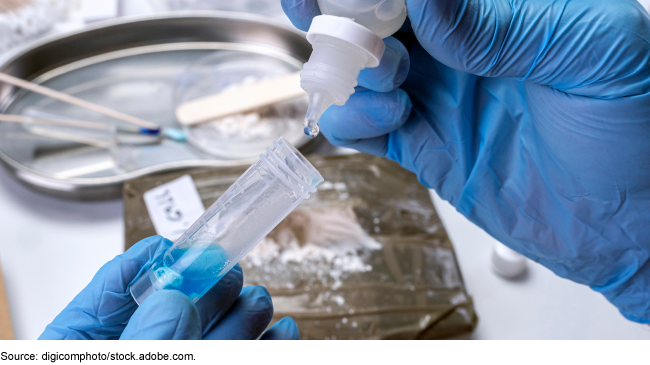
A person wearing blue medical gloves using a dropper to put a substance into a small transparent tube.
Highlights
What GAO Found
Agencies at the federal, state, and local levels have facilities capable of analyzing emerging street drugs—psychoactive substances newly circulating in the drug market. For example, the Drug Enforcement Administration and U.S. Customs and Border Protection have forensic laboratories that can analyze seized drugs and identify emerging substances. Current laboratory-based technologies can detect and identify emerging street drugs when appropriate methods (protocols) and reference standards are available. Portable technologies can detect drugs at the point of seizure but face accuracy challenges due, in part, to user error. Technology manufacturers told GAO they are developing more lay-friendly user interfaces and operational methods.
From fiscal year 2019 through 2024, the Departments of Justice and Health and Human Services awarded a combined total of about $12.5 million in grants for the development of new methods and technologies for analyzing emerging street drugs. New methods and technologies may make laboratory processes more consistent, among other enhancements. Method development can be done on faster timelines than technology development.
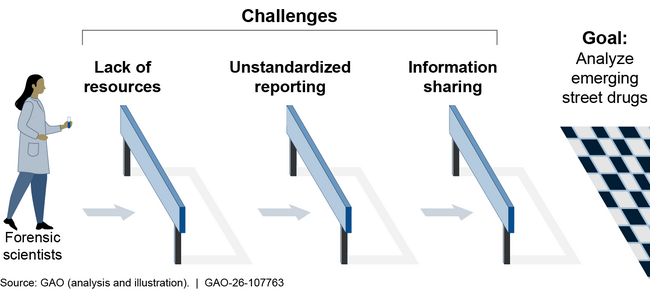
While new methods and technologies could enhance some capabilities, forensic scientists face key challenges with analyzing emerging street drugs, including:
- Lack of resources. Laboratories GAO spoke to consistently referenced insufficient staffing and time.
- Unstandardized reporting. According to stakeholders, varying reporting requirements at thestate and local levels can lead to gaps in data.
- Limited information sharing. Law enforcement may not always share up-to-date information about emerging drugs with medical examiners and hospitals.
If these challenges could be addressed, laboratories could be in a better position to meet the nation’s needs for emerging drug analysis. However, GAO is not making recommendations to address these challenges because they are primarily faced by state and local laboratories.
Illustration of Challenges Faced by Forensic Laboratories
Why GAO Did This Study
The U.S. is facing a public health crisis with the rapidly changing and increasingly complex landscape of emerging street drugs. Overdose deaths related to fentanyl mixed with veterinary tranquilizers, such as xylazine and medetomidine, have increased in recent years according to agency data. This mixture can be fatal because opioid overdose reversal medication does not affect these tranquilizers. The ability to rapidly identify new street drugs as they emerge could save lives.
The Testing, Rapid Analysis, and Narcotic Quality Research Act of 2023 (Pub. L. No. 118-23, 137 Stat. 125, 126-27, § 3) includes a provision for GAO to review the capabilities of the federal government and state and local agencies to detect, identify, and analyze new psychoactive substances, which GAO refers to as “emerging street drugs” in this report. This report addresses (1) methods and technologies that are available or in development for emerging street drug analysis at federal and selected state and local laboratories and in the field, (2) timelines for developing new methods and technologies for the identification of emerging street drugs, (3) federal grant programs funding the development of new methods and technologies, and (4) federal and selected state and local facilities that analyze emerging street drugs and the key challenges they face.
GAO interviewed officials and reviewed documents from 16 components of seven federal agencies that have ongoing efforts in drug analysis. GAO also visited or interviewed officials from 15 state and local laboratories from three different regions in the U.S. Further, GAO reviewed scientific literature and interviewed additional stakeholders, including technology manufacturers and grantees.
For more information, contact: Karen L. Howard at HowardK@gao.gov or Triana McNeil at McNeilT@gao.gov.