
COVID-19: Federal Efforts to Support Behavioral Health Programs During the Pandemic
Fast Facts
Behavioral health conditions—including mental health and substance use disorders—affect millions of Americans. The COVID-19 pandemic increased the need for behavioral health services and made these services harder to deliver and access.
The Substance Abuse and Mental Health Services Administration awards grants for treatment and prevention programs. It also awarded extra funding to support pandemic needs.
We reviewed how grantees provided behavioral health services during COVID-19, including through telehealth. We also described how SAMHSA supported its grantees during the pandemic, such as by allowing more time to finish projects.

A person sitting in a chair with a laptop in their lap looking at the computer screen with a surprised-happy expression
Highlights
What GAO Found
The Substance Abuse and Mental Health Services Administration (SAMHSA) leads federal efforts to advance behavioral health. This includes providing grant funding and technical assistance to states and behavioral health providers to implement behavioral health prevention and treatment programs. Selected SAMHSA state and provider awardees said they made various changes to continue delivering behavioral health services during the COVID-19 pandemic.
Examples of Selected State and Provider Awardees’ Changes to Behavioral Health Services During the COVID-19 Pandemic
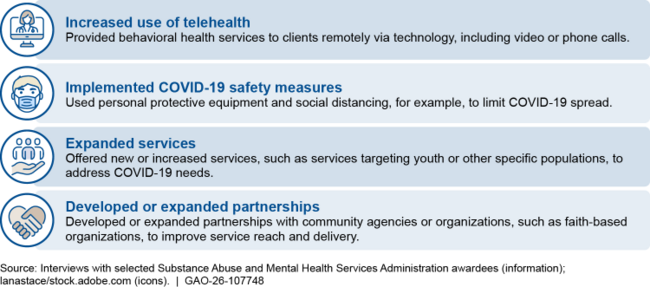
SAMHSA also provided technical assistance and flexibilities to assist awardees with grant administration and program implementation during the COVID-19 pandemic, according to agency documentation, as well as agency officials, selected state and provider awardees, and national associations. For example:
- SAMHSA provided one-on-one assistance, connected awardees with one another and with partners, and disseminated resources including webinars and published documents; nearly all selected awardees found this support helpful during the COVID-19 pandemic.
- SAMHSA provided grant administration flexibilities to help awardees meet pandemic needs. For example, SAMHSA extended COVID-19 supplemental funding project periods for its mental health and substance use block grants to allow awardees additional time to complete grant-funded activities.
- SAMHSA, in partnership with other federal agencies, provided program flexibilities to help awardees deliver services during the COVID-19 pandemic. Such flexibilities included allowing clinicians to prescribe certain medication to treat opioid use disorder via telehealth.
Why GAO Did This Study
Behavioral health conditions, which include mental and substance use disorders, affect millions of people in the U.S. and these numbers continue to grow. The COVID-19 pandemic exacerbated needs for behavioral health services and affected service availability and delivery.
In fiscal years 2020 through 2023, SAMHSA awarded over $32 billion in grant funding to support behavioral health services. This included approximately $8.3 billion in COVID-19 supplemental funding that SAMHSA awarded to help grant awardees address behavioral health needs due to the pandemic.
The Consolidated Appropriations Act, 2023, includes a provision for GAO to review SAMHSA programs and activities to support the continued provision of behavioral health services during the COVID-19 pandemic. Among other topics, this report describes how selected SAMHSA awardees provided services during the COVID-19 pandemic and how SAMHSA assisted awardees to support their response to the pandemic.
GAO reviewed documentation and interviewed officials from seven states and one territory (which we refer to collectively as selected states) and 16 behavioral health providers about experiences during the COVID-19 pandemic from January 2020 through May 2023. GAO selected states to obtain a mix of geographic regions, among other criteria, and selected two providers from each state to reflect receipt of certain SAMHSA grants. GAO also reviewed agency documentation, interviewed SAMHSA officials, and interviewed representatives from four national associations with behavioral health expertise.
For more information, contact Alyssa M. Hundrup at HundrupA@gao.gov.