
Nuclear Waste Cleanup: DOE Needs to Better Use End State Contracts to Achieve Intended Results
Fast Facts
The Department of Energy employs contractors to conduct nuclear waste cleanup at its U.S. sites. Since 2019, DOE has used an "end state" contracting model that breaks up cleanup work into smaller contracts—called task orders—within the main contract. This model was meant to provide more reliable costs, faster cleanup, and better results.
But we found the model didn't consistently meet expectations. For example, DOE didn't perform oversight to ensure that goals were achieved. Some task orders also changed after the contract was awarded, resulting in over $500 million in extra costs.
Our recommendations address these issues and more.
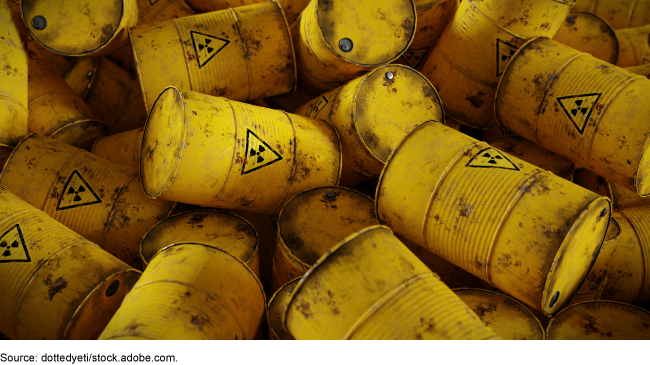
Hazardous waste barrels
Highlights
What GAO Found
As of March 31, 2025, the Department of Energy’s (DOE) Office of Environmental Management (EM) awarded 57 task orders across nine contracts since implementing the End State Contract Model (ESCM) in fiscal year 2020. The ESCM uses task orders for contractors to achieve a stated outcome, or “end state,” to move sites toward completion, manage cost and schedule performance, and reduce DOE’s environmental liability. About half (29) included defined end states and the remainder were for support work or cleanup work that did not yet have a defined end state.
EM has not consistently achieved intended results for selected task orders GAO reviewed. Of the nine selected task orders completed as of March 31, 2025, three did not define end states and six defined them but were inconsistent in achieving them. For example, three task orders with defined end states reduced or carried over scopes of work post-award, resulting in contractors completing less work to achieve modified end states. The extent to which EM reduced costs for these task orders is unclear because of inconsistent documentation. Further, EM headquarters did not provide adequate oversight to ensure task orders achieved end states. Without this oversight, EM cannot assess how well it is meeting program goals.
EM did not fully use contract incentives to manage costs. As a result, post-award changes to task order requirements led to over $500 million in cost growth.
Selected Task Orders with Greatest Cost Growth, as of March 31, 2025
|
Dollars in thousands |
|||
|---|---|---|---|
|
Cleanup site |
Task order (TO) |
Total cost growth |
Total cost growth, percent |
|
Idaho National Laboratory
|
TO 3 Integration and Mission Continuity (Phase 1) |
$42,054 |
6.29% |
|
TO 3.2 Integration and Mission Continuity Hybrid Task Order (Phase 2) |
$75,553 |
11.74% |
|
|
Nevada National Security Site |
TO 2 Environmental Operations |
$75,793 |
149.61% |
|
Oak Ridge Reservation
|
TO 3 End States Phase-In |
$216,661 |
45.17% |
|
TO 6-1 Y-12 Operations and Cleanup End States |
$23,871 |
6.05% |
|
|
TO 8-1 Environmental Management Disposal Facility Early Site Prep |
$1,559 |
6.48% |
|
|
TO 9-2 Outfall 200 Mercury Treatment Facility Construction and Commissioning End State |
$25,811 |
138.89% |
|
Source: GAO analysis of Federal Procurement Data System and Strategic Integrated Procurement Enterprise System data and Office of Environmental Management information. | GAO-26-107745
Note: Dollar amounts are rounded to the nearest thousand. For the purposes of this review of task orders, GAO analyzed cost growth based on increases in contract value.
EM’s task orders have different incentives for cost performance, some of which can reduce risk of cost growth. Of the task orders reviewed, those types that put more risk on the contractor generally had the lowest cost growth. EM more frequently used contract types that put more risk on EM, and these experienced the greatest cost growth. Until EM takes steps to address task orders’ cost performance, EM may miss opportunities to better manage cost growth.
Why GAO Did This Study
EM is responsible for cleaning up 15 sites across the U.S. that are contaminated from decades of nuclear weapons production and energy research. To conduct this work, EM has awarded ESCM contracts since fiscal year 2020. GAO previously found that EM experienced challenges implementing end state task orders and that stakeholders had concerns about fair pricing for cleanup work because of lack of competition among contractors. Since 1990, GAO has designated DOE contract management as a high-risk area.
A congressional committee report includes a provision for GAO to evaluate EM’s implementation of the ESCM. This report examines (1) the status of ESCM task orders issued since fiscal year 2020 and the role of contractors in defining end states, (2) the extent to which selected ESCM task orders have achieved intended results, and (3) the extent to which EM is using selected ESCM task orders to manage contract cost performance.
GAO reviewed data for all ESCM task orders awarded as of March 31, 2025, evaluated contract documents for 19 selected task orders, and interviewed EM officials. GAO also conducted site visits to the Hanford and Savannah River cleanup sites.
Recommendations
GAO is making six recommendations to DOE, including to provide better oversight to help ensure sites define and achieve end states and to take actions to improve the cost performance of task orders. DOE concurred with five out of six recommendations and partially concurred with one recommendation, as discussed in the report. GAO continues to believe DOE should fully implement all recommendations.
Recommendations for Executive Action
| Agency Affected | Recommendation | Status |
|---|---|---|
| Department of Energy | The Assistant Secretary of EM should ensure sites using Approach B report contract modification data at the individual subtask level in procurement data systems and correct existing and future data discrepancies. (Recommendation 1) |
As of July 2026, DOE concurred with this recommendation and said it would take steps to implement it. Specifically, DOE said that EM, in collaboration with the Office of Management (MA), will ensure accurate reporting of data through STRIPES to SAM.gov for future contract actions. DOE said that while SAM.gov is not configured to display subtask or contract line-item number level data, EM will strive to ensure this information is publicly available via the respective EM site's conformed contract website. DOE also said that EM, in conjunction with MA, will correct any remaining data discrepancies and post contract line-item number (CLIN) level data on EM's conformed contract sites. When we confirm what actions DOE has taken in response to this recommendation, we will provide updated information.
|
| Department of Energy | The Assistant Secretary for EM should strengthen how EM headquarters oversees cleanup work under ESCM task orders to better ensure sites consistently define and achieve end states. (Recommendation 2) |
As of July 2026, DOE concurred with this recommendation and said it would take steps to implement it. Specifically, DOE said that EM will strengthen Headquarters oversight of cleanup work under ESCM task orders to better ensure sites consistently define and achieve end states. DOE said that EM will develop an implementation plan to better define and achieve ESCM task order end states. When we confirm what actions DOE has taken in response to this recommendation, we will provide updated information.
|
| Department of Energy | The Assistant Secretary of EM should direct sites to follow requirements for 10-Year Strategic Task Order Plans to discuss the reduction to environmental risk and financial liability as a result of completing work under proposed task orders. (Recommendation 3) |
As of July 2026, DOE concurred with this recommendation and said it would take steps to implement it. Specifically, DOE said that EM will reinforce existing guidance for 10-Year Strategic Task Order plan development with all EM sites that are currently administering end state contracts, which includes a requirement to discuss reductions in environmental risk and financial liability. When we confirm what actions DOE has taken in response to this recommendation, we will provide updated information.
|
| Department of Energy | The Assistant Secretary for EM should ensure that EM headquarters identifies, analyzes, and addresses the root causes for task order cost growth. (Recommendation 4) |
As of July 2026, DOE partially concurred with this recommendation and said it would take steps to implement it. Specifically, DOE said that for ESCM task orders that experience cost control performance below a satisfactory level (as reported in the Contractor Performance Assessment Reporting System (CPARS)), EM will identify, analyze, and address root causes. DOE also said that contractors will be held accountable in both their fee and CPARS ratings as warranted. We continue to believe that DOE should identify, analyze, and address the root causes for task order cost growth for all task orders where cost growth is present and not just a subset based on contractor ratings in CPARS. When we confirm what actions DOE has taken in response to this recommendation, we will provide updated information.
|
| Department of Energy | The Assistant Secretary of EM should ensure sites implement steps to improve the accuracy of cost data including better incorporating changes to scopes of work in task order IGCEs during negotiations. (Recommendation 5) |
As of July 2026, DOE concurred with this recommendation and said it would take steps to implement it. Specifically, DOE said that EM will develop an implementation plan to ensure that IGCEs are updated, as warranted, when material changes to scopes of work are identified up to and during negotiations. DOE said that for each ESCM task order, EM will continue to thoroughly document a comprehensive pre-negotiation plan to incorporate a detailed cost analysis, a technical evaluation, and the IGCE. When we confirm what actions DOE has taken in response to this recommendation, we will provide updated information.
|
| Department of Energy | The Assistant Secretary of EM should direct EM headquarters to implement a process to ensure all task orders awarded as UCAs are definitized by the regulatory deadline. (Recommendation 6) |
As of July 2026, DOE concurred with this recommendation and said it would take steps to implement it. Specifically, DOE said that MA will reinforce guidance to EM sites that task orders awarded as UCAs should be minimized to the extent practicable, and that any task orders awarded as UCAs shall be definitized by the regulatory deadline. When we confirm what actions DOE has taken in response to this recommendation, we will provide updated information.
|