
Economic Development Administration: Actions Needed to Assess Disaster Recovery Outcomes
Fast Facts
After natural disasters, the Economic Development Administration helps communities recover by coordinating federal agencies and funding projects. In FY 2014–2024, the agency awarded $2.1 billion for economic recovery projects. Projects included flood mitigation at ports, and programs like business incubators—which provide entrepreneurship support.
But it's unclear how these efforts affect local economies because the agency doesn't have a process or effective measures to assess them. For example, it measures job gains, but doesn't capture the agency's contributions to disaster recovery.
Our recommendations address this and other issues we found.
Damaged Business in Downtown Sulphur, Oklahoma, about a Year After 2024 Oklahoma Tornadoes
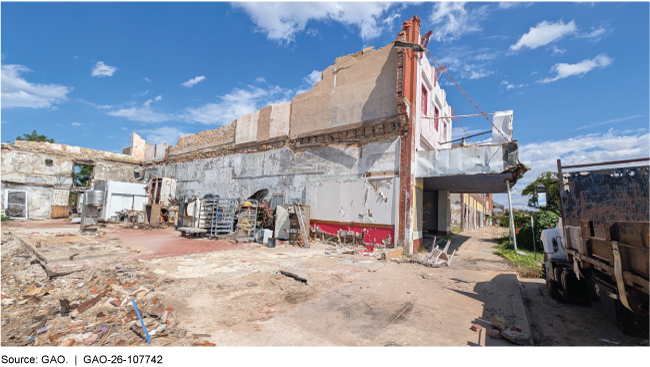
A building with damage to its roof and exterior. Next to the damaged building is land containing debris from a second building that was torn down. A work truck is parked in front of the empty lot.
Highlights
What GAO Found
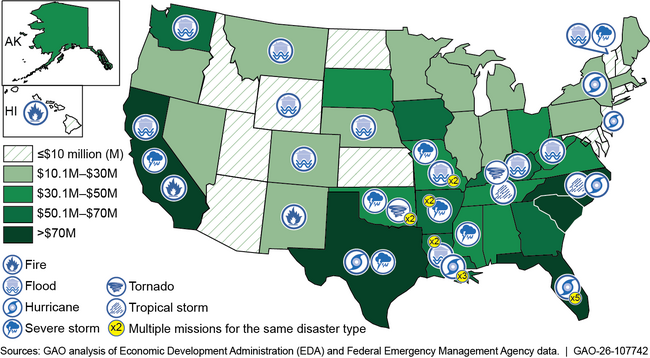
The Economic Development Administration’s (EDA) role in disaster recovery involves awarding grants and coordinating federal agencies through the Economic Recovery Support Function (RSF). In fiscal years 2014–2024, EDA awarded about $2.1 billion in disaster recovery grants, which primarily funded infrastructure and construction projects, such as mitigating flood risks to commercial and industrial areas. In 2013–2025, EDA also coordinated 45 Economic RSF missions following severe storms, floods, and other disasters.
EDA Awarded $2.1 Billion in Disaster Recovery Grants (Fiscal Years 2014–2024) and Coordinated 45 Economic Recovery Missions (2013–2025)
EDA has incorporated several leading practices for interagency collaboration to coordinate the Economic RSF, including having clear roles and responsibilities. Stakeholders in disaster-affected communities highlighted the value and recent performance of the Economic RSF but noted challenges in its capacity to provide assistance. EDA is implementing a required disaster recovery office and team that can help address this challenge. However, EDA has not developed a way for the RSF to ensure accountability by monitoring and communicating progress toward its strategic outcomes, such as increasing the capacity of local stakeholders to implement economic recovery strategies. Fully adopting the leading practices would enhance accountability and help demonstrate progress.
EDA’s 26 performance measures incorporated several key attributes of successful measures but could not be used to assess whether its disaster recovery work accomplished its intended outcomes. Using measures that better assess the performance of its disaster recovery work would help EDA determine if it has achieved the outcomes Congress intended, such as mitigating flood risk. In addition, the reliability of the measures is unknown because EDA suspended the steps it previously took to validate grantee-reported data on job creation or retention. By resuming procedures to validate these data, EDA would improve confidence that its reported outcomes accurately reflect progress toward agency goals and provide useful information for decision-making.
Why GAO Did This Study
EDA, part of the Department of Commerce, has taken on an increasingly important role in disaster recovery. In fiscal years 2018–2025, Congress provided EDA with $3.2 billion in disaster supplemental appropriations. Senate Report 118-62 includes a provision for GAO to evaluate EDA’s role in disaster recovery.
Among its objectives, this report examines the extent to which EDA’s coordination of the Economic RSF has incorporated leading practices for interagency collaboration, how EDA has invested in disaster-affected communities, and the extent to which EDA’s performance measures incorporated key attributes of successful measures.
GAO analyzed EDA documentation, performance measures, and data on appropriations, grant awards, disbursements, and RSF missions generally in 2013–2025, as available; interviewed officials from EDA and five other federal agencies; and conducted site visits to seven EDA grant projects. GAO interviewed stakeholders from state and local governments and regional economic development organizations in three disaster-affected communities (Florida, Hawaii, and Oklahoma), selected to reflect variation in disaster type and region.
Recommendations
GAO is making four recommendations, including that EDA implement a way to assess the Economic RSF’s outcomes, implement disaster recovery performance measures, and implement procedures to validate grantee-reported performance data. EDA generally agreed with the recommendations.
Recommendations for Executive Action
| Agency Affected | Recommendation | Status |
|---|---|---|
| Economic Development Administration | The Secretary of Commerce should ensure that EDA, in coordination with Economic RSF participating agencies, implements a way to periodically monitor, assess, and report on progress toward the Economic RSF's strategic outcomes. (Recommendation 1) |
When we confirm what actions the agency has taken in response to this recommendation, we will provide updated information.
|
| Economic Development Administration | The Secretary of Commerce should ensure that EDA, in coordination with Economic RSF participating agencies, updates the Economic RSF operating documents in a timely manner. (Recommendation 2) |
When we confirm what actions the agency has taken in response to this recommendation, we will provide updated information.
|
| Economic Development Administration | The Secretary of Commerce should ensure that EDA implements performance measures that specifically address its disaster recovery work and intended outcomes. (Recommendation 3) |
When we confirm what actions the agency has taken in response to this recommendation, we will provide updated information.
|
| Economic Development Administration | The Secretary of Commerce should ensure that EDA resumes procedures for validating grantee-reported performance data. (Recommendation 4) |
When we confirm what actions the agency has taken in response to this recommendation, we will provide updated information.
|