
Federal Research: Agencies Should Better Manage Anticipated Publishing Cost Increases Amid Shift to Public Access
Fast Facts
The U.S. government funds billions of dollars in research each year. However, results of the research are often behind expensive paywalls. This makes it harder for others to read and build on it.
In 2022, the Office of Science and Technology Policy told agencies to make new federally funded research immediately public for free. But without subscription revenue, publishers need to charge fees to make research publications accessible.
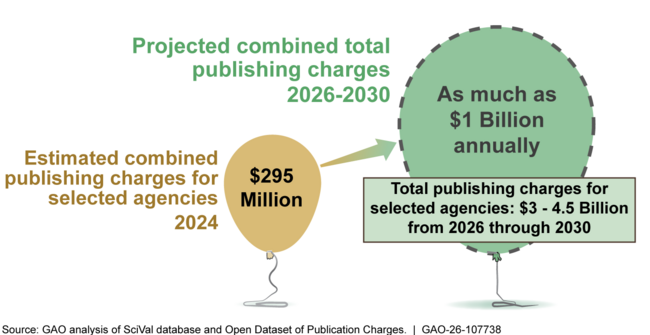
Agencies can cover these fees. We estimate the fees could cost the government up to $1 billion a year, but most agencies aren't ready for these costs.
We made recommendations to address this and other issues.
A laptop's web browser visiting the PubMed landing page on the National Institutes of Health website.
Highlights
What GAO Found
In 2022 The Office of Science and Technology Policy (OSTP) directed federal agencies to make research results freely accessible to the public immediately when published. In response, seven of the nine agencies GAO reviewed issued updated plans or policies. The Department of Transportation and the Nuclear Regulatory Commission were still drafting updated plans and policies at the time of our review. Five agencies’ plans or policies fully met OSTP’s guidance. The National Science Foundation’s and U.S. Department of Agriculture’s plans did not fully address OSTP’s guidance for reuse rights. These rights describe how others can share, modify, or use the research. Better alignment with OSTP’s guidance could help ensure this research can be built upon by others.
Amid the federal shift to public access, publishers are changing their business models to remain viable without subscription revenue and will require authors to pay to have their publications made open access. Agencies allow grant funds to cover these charges. Assuming historical patterns continue, the new policies and publishers' responses may result in significant agency cost growth. This would mean less money for research (see figure). However, only the National Institutes of Health has planned to manage these potential costs. Additional analysis could help other agencies better manage costs, which may triple annually.
Estimated Spending on Publishing Charges for Selected Agencies
Increased public access can improve the visibility of research and enable readers to identify problems with specific publications more quickly. However, according to stakeholders GAO spoke with, pay-to-publish models may encourage publishers to lower publication standards to publish more articles.
In 2024, OSTP published an economic analysis on expanding public access, but it did not fully reflect all five of GAO’s key elements of an economic analysis. Notably, the scope did not address the goal of estimating the potential costs and other effects. Ensuring that future analyses are consistent with the key elements can help agencies better understand the cost implications of their new policies.
Why GAO Did This Study
The U.S. government is one of the largest funders of scientific research globally. The results of federally funded research are ordinarily shared through scholarly publications. But many of these publications were restricted to paid subscribers. GAO was asked to examine agencies’ efforts to implement OSTP’s 2022 guidance.
This report examines: (1) the extent to which selected agencies' public access plans and policies are consistent with federal guidance, (2) how the scholarly publishing industry is responding to the federal shift to public access and how this affects selected agencies and journal market dynamics, (3) the potential effects of expanding public access to federally funded research, and (4) the extent to which OSTP’s 2024 economic analysis of public access followed GAO’s key elements for an economic analysis.
GAO selected nine agencies with a mix of research funding levels and assessed their public access plans and policies against OSTP guidelines. GAO reviewed available literature and data and interviewed nongovernmental stakeholders, such as publishers and universities. Further, GAO assessed OSTP’s economic analysis against GAO’s key elements that serve as a framework for assessing an economic analysis.
Recommendations
GAO is making 11 recommendations to nine agencies to ensure public access plans meet federal requirements and assess budgetary and economic effects of expanding public access. Four of these agencies concurred with GAO’s recommendations and five agencies had no comments.
Recommendations for Executive Action
| Agency Affected | Recommendation | Status |
|---|---|---|
| National Science Foundation | The Director of NSF, in finalizing the public access policy, should ensure that the policy addresses: (1) the prerequisites needed to make publications publicly available by default, (2) use or re-use rights, and (3) which restrictions, such as attribution, apply to publicly accessible scholarly publications funded by the agency. (Recommendation 1) |
When we confirm what actions the agency has taken in response to this recommendation, we will provide updated information.
|
| Department of Agriculture | The Secretary of Agriculture, in finalizing the agency's public access policy, should ensure that the policy addresses use or re-use rights for its funded scholarly publications. (Recommendation 2) |
When we confirm what actions the agency has taken in response to this recommendation, we will provide updated information.
|
| Department of Defense | The Secretary of Defense should conduct an analysis of how the agency's research efforts and budget may be affected by expected expenditure increases resulting from its December 2024 public access plan and update the plan as appropriate. (Recommendation 3) |
When we confirm what actions the agency has taken in response to this recommendation, we will provide updated information.
|
| Department of Energy | The Secretary of Energy should conduct an analysis of how the agency's research efforts and budget may be affected by expected expenditure increases resulting from its October 2024 public access policy and update the policy as appropriate. (Recommendation 4) |
When we confirm what actions the agency has taken in response to this recommendation, we will provide updated information.
|
| Department of Transportation | The Secretary of Transportation should conduct an analysis of how the agency's research efforts and budget may be affected by expected expenditure increases resulting from its forthcoming public access policy and update the policy as appropriate. (Recommendation 5) |
When we confirm what actions the agency has taken in response to this recommendation, we will provide updated information.
|
| National Aeronautics and Space Administration | The Administrator of NASA should conduct an analysis of how the agency's research efforts and budget may be affected by expected expenditure increases resulting from its November 2024 public access plan and update the plan as appropriate. (Recommendation 6) |
When we confirm what actions the agency has taken in response to this recommendation, we will provide updated information.
|
| National Science Foundation | The Director of NSF should conduct an analysis of how the agency's research efforts and budget may be affected by expected expenditure increases resulting and ensure its forthcoming public access policy reflects the results of the analysis. (Recommendation 7) |
When we confirm what actions the agency has taken in response to this recommendation, we will provide updated information.
|
| Nuclear Regulatory Commission | The Chairman of NRC should develop a plan to analyze how the agency's research efforts and budget may be affected by its forthcoming public access plan. (Recommendation 8) |
When we confirm what actions the agency has taken in response to this recommendation, we will provide updated information.
|
| Social Security Administration | The Commissioner of SSA should conduct an analysis of how the agency's research efforts and budget may be affected by expected expenditure increases resulting from its December 2023 public access plan and update the plan as appropriate. (Recommendation 9) |
When we confirm what actions the agency has taken in response to this recommendation, we will provide updated information.
|
| Department of Agriculture | The Secretary of Agriculture should conduct an analysis of how the agency's research efforts and budget may be affected by expected expenditure increases and ensure its forthcoming public access policy reflects the results of the analysis. (Recommendation 10) |
When we confirm what actions the agency has taken in response to this recommendation, we will provide updated information.
|
| Office of Science and Technology Policy | The Director of OSTP should conduct an analysis on the potential effects of its 2022 guidance and ensure this analysis aligns with GAO's key elements of an economic analysis. OSTP should update its 2022 guidance based on the findings of this analysis, as appropriate. (Recommendation 11) |
When we confirm what actions the agency has taken in response to this recommendation, we will provide updated information.
|