
Child Labor: DOL Action Needed to Better Protect Working Children
Fast Facts
Many children under age 18 work to learn new skills or make money. Each year, the Department of Labor identifies thousands of labor violations that could endanger these children, such as employers allowing them to work late at night or in hazardous occupations.
DOL is working to improve its enforcement of child labor laws. However, the agency has struggled to identify data that provides useful investigative leads. DOL is also trying to increase outreach to the public about child labor laws, but it's unclear if its efforts are working.
Our recommendations address these and other issues.

Teenage grocery worker wearing an apron, near boxes of red peppers.
Highlights
What GAO Found
An estimated 2.8 million children worked in the U.S. in 2023, according to GAO’s analysis. The Department of Labor (DOL) publishes statistical data that provide information on working children’s fatalities, injuries, and illnesses. These data are used to develop workplace safety strategies and policies, but data limitations and discontinued data sets have contributed to information gaps. For example:
- In DOL’s dataset on workplace fatalities, some data on the cause of death or industry in which the child worked are not publicly available.
- DOL changed how it collects data on working children’s injuries and illnesses, so data since 2021 cannot be compared to earlier years.
- Between 2015 and 2023, one DOL survey and two other federal datasets that contained child labor injury data ended.
By mitigating child labor data gaps, DOL would be better positioned to identify and respond to dangerous working conditions for children.
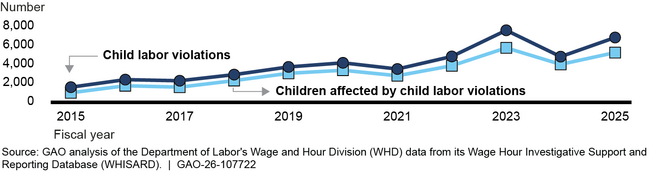
Since fiscal year 2015, the number of annual child labor violations that DOL cited and the number of children affected by their employers’ violations has generally increased, according to GAO’s analysis (see figure). Examples of violations include children working later than allowed or doing hazardous work such as operating meat processing machines.
Cited Child Labor Violations and Children Affected, Fiscal Years 2015−2025
DOL recently launched an initiative to enhance its enforcement of child labor laws, but it faces some challenges. For example:
- DOL regional and district officials expressed concern with the data DOL recommended for targeting egregious child labor violations, including that the data were not detailed enough to provide useful investigation leads. DOL does not have a process to identify and evaluate additional data sources.
- DOL officials described persistent knowledge gaps among employers and the public on child labor laws. DOL implemented a communications strategy to raise awareness, but taking steps to measure and assess its outreach would help DOL understand whether its efforts are achieving its goals.
In 2023 and 2024, DOL’s interagency collaboration on child labor did not fully follow leading collaboration practices, according to GAO’s analysis. Although DOL works with other agencies to protect children, it discontinued its interagency task force in 2025. Strengthening future collaboration and ensuring key information is shared could enhance DOL’s efforts to protect working children.
Why GAO Did This Study
The Fair Labor Standards Act of 1938 included provisions to protect the safety and health of working children under 18. Almost 90 years later, DOL continues to find numerous child labor law violations.
GAO was asked to review child labor data and enforcement. Among other things, this report addresses (1) information gaps in data about fatalities, injuries, and illnesses among working children; (2) trends in child labor violations; (3) recent changes DOL has made in its child labor enforcement practices, and how DOL has addressed related challenges; and (4) the extent to which DOL has collaborated with other federal agencies on child labor.
GAO analyzed federal data on working children from 2023; child labor fatalities, injuries, and illnesses since 2013; and cited child labor violations from 2015 to 2025 (the most recent data available). GAO reviewed relevant federal laws, regulations, and agency documentation on enforcement and collaboration. To gather information on enforcement and challenges, GAO interviewed officials at DOL’s Wage and Hour Division, including at five regional and six district offices selected to capture a variety of enforcement experiences. GAO also analyzed information from DOL and seven other agencies on child labor collaboration.
Recommendations
GAO is making five recommendations to DOL, including that DOL mitigate child labor data gaps, develop a process to evaluate data for targeting investigations, and assess its employer outreach. DOL generally disagreed with the data gaps recommendation, neither agreed nor disagreed with the outreach recommendation, and agreed with the three other recommendations. GAO maintains DOL should fully implement its recommendations.
Recommendations for Executive Action
| Agency Affected | Recommendation | Status |
|---|---|---|
| Department of Labor | The Secretary of Labor should ensure that the Wage and Hour Division Administrator and the Bureau of Labor Statistics Commissioner assess and mitigate the information gaps we identified in child labor fatality, injury, and illness data, including considering the need for increased or improved data collection. (Recommendation 1) |
DOL's WHD disagreed with this recommendation. The agency disagreed with this recommendation. Legal and other requirements limit the detailed statistical data it can publish. Nevertheless, the agency noted steps it is taking to publish more child labor data, which could reduce information gaps and continue seeking ways to improve its statistical products. We acknowledge the legal requirements the agency faces. However, these statutory restrictions do not preclude exploring ways to mitigate information gaps within the confines of the current legal framework. For example, DOL could try to ensure that future years of SOII data are comparable to the current data, so the agency and others can once again examine trends over time in child worker injuries and illnesses. Moreover, the information gaps we identified go beyond the limitations contained in the CFOI and SOII. It is important to reevaluate data needs when changes in the availability of other data sources occur, as has happened over time with federal datasets on child labor fatalities, injuries, and illnesses that were discontinued. Less is known than in the past about whether and how this vulnerable population is getting injured or killed at work. We continue to believe that DOL should assess and mitigate these information gaps to be better positioned to assess, prevent, and respond to dangerous conditions. The agency noted it is exploring ways to publish more fatal injury counts while protecting confidential information. While we support these efforts, we also believe DOL could consider taking additional steps to increase or improve data on the safety of working children, such as developing or identifying new sources of data, or collaborating with other agencies to address data gaps.
|
| Department of Labor | The Secretary of Labor should direct the Wage and Hour Division Administrator to develop a systematic process to identify and evaluate potential data sources, including by obtaining and documenting input from regional- and district-level staff, as it considers adding new sources of data to target investigations under its National Strategic Enforcement Initiative on Child Labor. (Recommendation 2) |
DOL agreed with this recommendation. The agency said it would take steps to address it by strengthening its agency-wide planning process. We encourage that such a process be tailored to child labor investigations to explore different data sources to target investigations under the National Initiative. A systematic process that includes gathering input from regional- and district-level staff on potential targeting strategies will help ensure that the initiative is useful and appropriate for the field. We will monitor the agency's efforts to address this recommendation.
|
| Department of Labor | The Secretary of Labor should ensure that the Wage and Hour Division assesses its outreach efforts to educate employers and the public about child labor laws, including by (1) setting goals for long-term outcomes and assessing progress by breaking them into measurable performance goals, (2) collecting relevant data through related performance measures, and (3) using that information to inform the agency's future outreach strategies. (Recommendation 3) |
DOL neither agreed nor disagreed with this recommendation. We will monitor the progress of agency efforts to address it.
|
| Department of Labor | The Secretary of Labor should direct the Wage and Hour Division Administrator to establish procedures to track and analyze the questions it receives from field offices related to applying the hazardous occupations orders, as well as the technical assistance it provides, and use the analysis to regularly update guidance, as appropriate. (Recommendation 4) |
DOL agreed with this recommendation. We will monitor the agency's efforts to address it.
|
| Department of Labor | The Secretary of Labor should strengthen its collaboration with other federal agencies to prevent and detect illegal child labor, including by incorporating GAO's eight leading collaboration practices and ensuring continuity of information sharing to sustain efforts during agency transitions and other changes. (Recommendation 5) |
DOL agreed with this recommendation. We will monitor the agency's efforts to address it.
|