
West Bank And Gaza: State's Reporting on UN Efforts to Address Problematic Textbook Content Had Gaps Before Funding Ended
Fast Facts
In the West Bank and Gaza, thousands of Palestinian children go to United Nations Relief and Works Agency for Palestine Refugees (UNRWA) schools that use Palestinian Authority textbooks. After the October 7, 2023, Hamas attack, concerns have increased that these textbooks contain material that some believe is antisemitic and radicalizes students.
Before the State Department stopped funding these schools in 2024, State provided input into how UNRWA identified and addressed problematic content. State reported to Congress on UNRWA's progress, but we found that these reports were often late or did not include all the information Congress required.
Palestinian students at a UN school in the West Bank
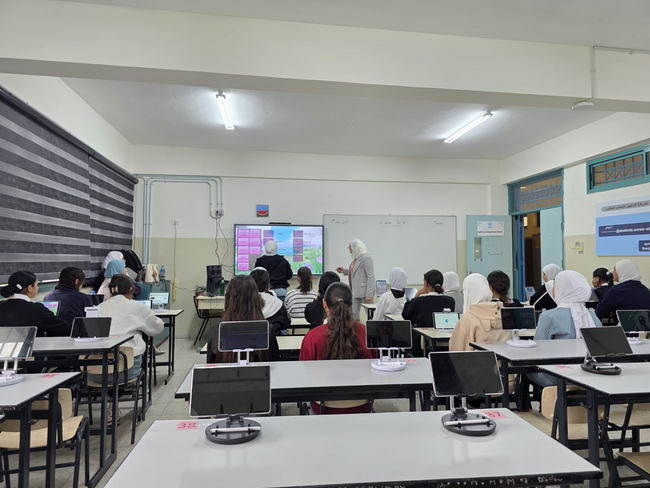
Teachers provide a lesson on an electronic board to a classroom full of Palestinian students.
Highlights
What GAO Found
Between 2018 and 2024, the U.S. Department of State (State) provided an estimated $375 million to support the United Nations Relief and Works Agency for Palestine Refugees in the Near East’s (UNRWA) educational activities in the West Bank and Gaza. These funds supported UNRWA’s education system, including teacher salaries, facilities, and maintenance. Because the Palestinian Authority provides textbooks to UNRWA free of charge, no U.S. funds went toward the purchase of textbooks. Until July 2025, the U.S. Agency for International Development (USAID) also supported education-related projects in the West Bank and Gaza, such as providing vocational training handbooks.
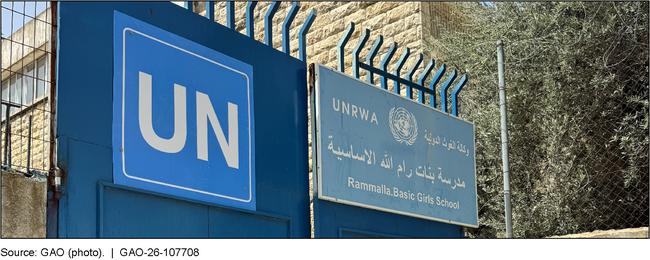
United Nations Relief and Works Agency for Palestine Refugees in the Near East (UNRWA) School in the West Bank
UNRWA and State took steps to identify and address problematic content in educational materials used in UNRWA schools. UNRWA reviewed textbooks and provided guidance to teachers on addressing identified content that did not align with UN values. However, UNRWA has faced some challenges in implementing its approach to address problematic content, such as teacher and community resistance. In addition, audits have found weaknesses in UNRWA’s educational activities and use of Palestinian textbooks, while also noting its commitment to principles such as neutrality. UNRWA has taken certain steps to address the issues raised in these audits. In the years that State provided funding to UNRWA, it monitored UNRWA’s actions to identify and address problematic content such as reviewing UNRWA reports and conducting field visits to schools.
Since 2018, annual appropriations acts required State to report on certain UNRWA issues, including steps UNRWA took to ensure its educational materials are consistent with the values of human rights, dignity, and tolerance, and do not induce violence. State submitted six reports since 2018, three of which were submitted after the statutory deadline. This includes the 2019 report, which was submitted 92 days late. State also did not always address all the reporting requirements that Congress established. For example, in its 2022 report, State did not report on steps that UNRWA took to ensure that its educational materials did not induce incitement. Finally, although State developed standard operating procedures for ensuring report accuracy in response to a 2019 GAO recommendation, it did not always follow these procedures. Given the U.S. no longer funds UNRWA and State is no longer required to report to Congress on UNRWA, GAO is not making recommendations for improving State’s reporting.
Why GAO Did This Study
In the West Bank and Gaza, UNRWA schools use textbooks developed by the Palestinian Authority to educate students and prepare them for post-secondary education. However, UNRWA has identified problematic content in these textbooks, such as material that is counter to UN values of neutrality, nonviolence and nondiscrimination. The October 7, 2023 Hamas attack on Israel heightened concerns about UNRWA, including Israeli allegations that the textbooks radicalized youth and that UNRWA employees had connections to Hamas and other terrorist organizations. The U.S. is historically the largest source of funds to UNRWA, but additional funding was paused in January 2024 and subsequently all funding ended.
In June 2019, GAO reported that State had taken actions to address potentially problematic content in UNRWA educational materials but that its reporting to Congress omitted required information and contained inaccurate information. GAO was asked to update these findings. This report addresses (1) U.S. funding for educational assistance in the West Bank and Gaza for calendar years 2018 through 2024, (2) the extent to which UNRWA and State identified and addressed potentially problematic educational materials, and (3) the extent to which State submitted required related reports, and how it developed the reports and ensured their accuracy.
To address these objectives, GAO analyzed State and UNRWA financial data, reviewed relevant documents, analyzed State’s annual reports to Congress, and interviewed U.S. government officials. GAO also conducted fieldwork in Israel, the West Bank, and Jordan to visit an UNRWA school and interview Israeli, Palestinian Authority, and UNRWA officials, among others.
For more information, contact Latesha Love-Grayer at LoveGrayerL@gao.gov.