
Artificial Intelligence: A Framework to Assess U.S. Competitiveness and Inform Policy Options
Fast Facts
The potential for artificial intelligence to spur economic growth, enhance social well-being, and improve national security has led to a global AI race.
How can the U.S. find out if its AI abilities stack up? And what can the U.S. do to improve its standing in the AI competition?
We created a framework that analysts can use to assess U.S. AI competitiveness, which could include comparing to other nations or analyzing the nation's AI progress over time.
The framework helps analysts identify policy options that policymakers could use to improve U.S. competitiveness in AI.

The letters A I sitting on top of a zoomed in microchip with lots of metallic colors and many intricate pathways.
Highlights
How to Use the Framework
GAO’s framework is a method for assessing AI capabilities and capacity in the U.S. and its competitiveness. A nation’s competitiveness in AI is how well it develops or deploys AI technologies compared to other nations. Policymakers may be interested in knowing how the U.S. compares to other nations in the AI race. GAO developed this framework to help analysts from government, industry, academia, and elsewhere obtain and provide structured information to policymakers about AI competitiveness.
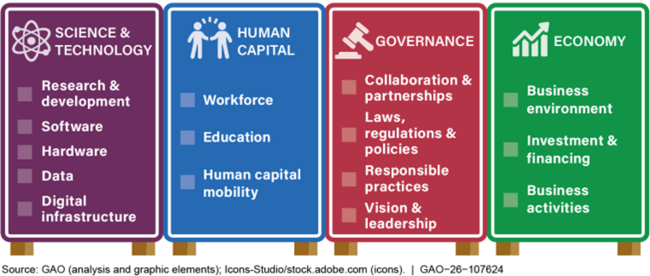
The complexity of factors affecting AI competitiveness makes it difficult to decide which factors are more important than others. The framework organizes relevant factors into four pillars: Science & Technology, Human Capital, Governance, and Economy. Each pillar is further divided into subpillars, such as R&D; laws, regulations and policies; workforce; and investment and financing. Analysts can use these pillars and subpillars to systematically consider the breadth of factors relevant to the needs of policymakers seeking information on our nation’s AI capabilities and capacity versus those of other nations.
Factors Affecting AI Competitiveness
Analysts can use the framework for different purposes and policymaker needs. For example, if U.S. policymakers express interest in helping U.S. companies export AI technologies, analysts can use the framework to rank the U.S. and its peers in their progress toward outcomes of AI competitiveness, such as the ability to influence global technology standards. These rankings can in turn inform policies to help the U.S. improve its AI capabilities, capacity, and competitiveness.
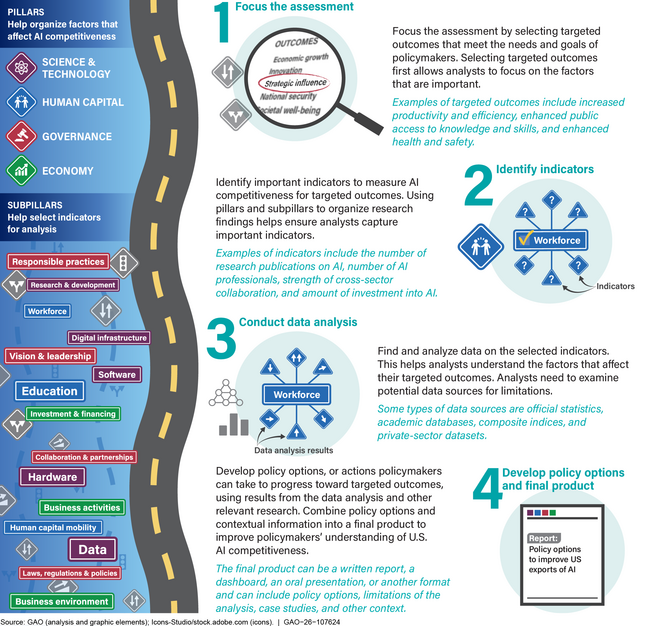
The framework involves four steps that allow analysts to tailor their assessment:
- Focus the assessment by selecting targeted outcomes of AI competitiveness.
- Identify indicators for measurement or evaluation.
- Conduct data analysis.
- Develop policy options and final product.
Framework for Assessing AI Competitiveness
Why GAO Developed This Framework
Artificial intelligence (AI) could spur economic growth, enhance societal well-being, and improve national security. These possibilities have led to a global AI competition, in which nations that fall behind risk losing economic advantages and global influence. To be competitive, the U.S. needs to consider risks of AI deployment, such as job dislocation and increased energy consumption.
Assessing U.S. competitiveness in AI presents challenges. The ability of the U.S. to successfully develop and deploy AI technologies depends on a broad mix of factors, including private and public investment, talent attraction, regulatory environments, and computing infrastructure. GAO was asked to develop a framework to assess U.S. AI capabilities, capacity, and competitiveness compared to other nations. GAO developed this framework to help analysts prioritize among the many factors that affect AI competitiveness. The framework is also designed to help analysts develop policy options to improve U.S. competitiveness.
To develop this framework, GAO conducted a literature search to find articles on frameworks and measurements to evaluate AI capabilities and capacity and reviewed key reports on AI competitiveness and assessment methods. GAO also interviewed, surveyed, and met with experts from government agencies, academia, industry, nonprofit organizations, and more.
For more information, contact Candice Wright at WrightC@gao.gov or Sterling Thomas at ThomasS2@gao.gov.