
Sexual Health Education: HHS Could Improve Efforts to Assess Grantee Performance
Fast Facts
Unintended pregnancies and sexually transmitted infections among youth can affect their health and financial well-being. The Department of Health and Human Services offers grants to states and organizations to provide sex education for youths aged 10 to 19, with a focus on abstaining from sexual activity.
HHS reviews grantees’ programs for medical accuracy and cultural appropriateness, among other things. But it doesn't have a way to know if its efforts are improving youth outcomes, such as whether a participant intends to abstain from sex after the program.
We recommended a way to assess whether those aspects of the programs are working.

A classroom setting with young people sitting at desks looking at an adult holding a piece of paper at the front of the room.
Highlights
What GAO Found
The Department of Health and Human Services (HHS) administers sexual risk avoidance education (SRAE) grants to states and other entities, such as community organizations. SRAE is a type of sexual health education that focuses on abstaining from non-marital sexual activity and other risky behaviors, such as alcohol use. SRAE programs are typically provided to youths aged 10 to 19 in schools during the day. Stakeholders, such as sexual health educators GAO interviewed, had various perspectives on whether SRAE was effective, medically accurate and complete, or culturally appropriate. GAO identified one peer-reviewed study on SRAE, which concluded it was effective for some outcomes.
HHS collects and reviews information of sufficient coverage and quality to assess SRAE grantees’ adherence to medical accuracy and cultural appropriateness program requirements. For example, HHS has a contractor-led process in place to review the medical accuracy of proposed program curricula. HHS also reviews information in grant applications that describe how grantees plan to serve certain populations and ensure program materials are culturally and linguistically appropriate.
HHS’s Medical Accuracy Review Process for Sexual Risk Avoidance Education Grantees’ Selected Curricula
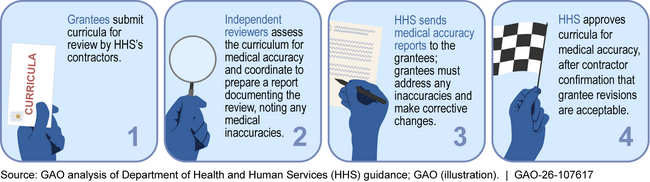
HHS has assessed SRAE program results through a number of studies. For example, one study examined if implementation features—such as a non-school setting—were associated with intentions to delay sexual initiation. HHS also uses performance measures to assess whether grantees are meeting program objectives. However, HHS only has near-term goals for three of its performance measures. These are related to program reach and implementation. For example, its near-term goal for measuring the number of youth who attend a program session is to maintain the previous year’s number.
HHS does not have near-term goals related to measuring youth outcomes and program experiences, such as the percent of participants that plan to abstain from sex. According to HHS officials, it is piloting additional near-term goals for another pregnancy prevention program it manages and intends to adapt them for SRAE programs. However, the early results of this effort had not identified any near-term goals for performance measures related to youth outcomes and experiences. Setting near-term goals for these measures will help HHS more effectively assess the performance of SRAE grantees in influencing participants’ behavior intentions and their experiences in the programs over time.
Why GAO Did This Study
Preventing unintended pregnancies and sexually transmitted infections among youth is an important public health goal. Although the overall U.S. birth rate for youth aged 15 to 19 years has steadily declined since the early 1990s, it has remained higher than that of comparable high-income countries. Youth pregnancy can have high health and economic costs for the parents, their children, and society more generally. Sexual health education aims to provide youth with the knowledge and skills they need to protect themselves from these potential health and economic risks.
GAO was asked to examine issues related to SRAE. This report examines perspectives on the effectiveness, medical accuracy, and cultural appropriateness of SRAE; HHS’s use of information to assess grantee adherence to statutory and HHS requirements regarding medical accuracy and cultural appropriateness; and how HHS assesses the results of its SRAE programs.
GAO reviewed relevant published literature and HHS documentation, including procedures, grant applications, and performance measure documentation. GAO also interviewed HHS officials, and non-generalizable samples of 14 SRAE grantees in five states and eight stakeholders, including national advocacy organizations, professional medical or health associations, sexual health educators, and an academic researcher.
Recommendations
GAO is making one recommendation to HHS to identify and implement appropriate near-term goals for performance measures related to youth outcomes and program experiences in SRAE programs. HHS concurred with the recommendation.
Recommendations for Executive Action
| Agency Affected | Recommendation | Status |
|---|---|---|
| Administration for Children and Families | The Administrator of ACF should identify and implement appropriate near-term goals with specific targets and time frames for the performance measures related to youth outcomes and program experiences for the SRAE programs. (Recommendation 1) |
When we confirm what actions the agency has taken in response to this recommendation, we will provide updated information.
|