
Federal Debt Management: Treasury Is Meeting Borrowing Needs but the Deteriorating Fiscal Outlook Poses Risks
Fast Facts
It's projected that continued federal deficits will add an average of $2 trillion to U.S. debt each year through 2036. The Treasury Department is responsible for financing this borrowing and seeks to do so at the lowest cost over time.
Treasury has strategies for managing risks to the nation's finances. For example, it issues debt on a regular and predictable schedule to minimize investor uncertainty. But Congress needs to address other risks, such as unsustainable levels of debt leading to higher interest rates.
We continue to recommend that Congress develop a strategy to address the nation's unsustainable fiscal path.

An illustration of the U.S. Capitol with U.S. currency
Highlights
What GAO Found
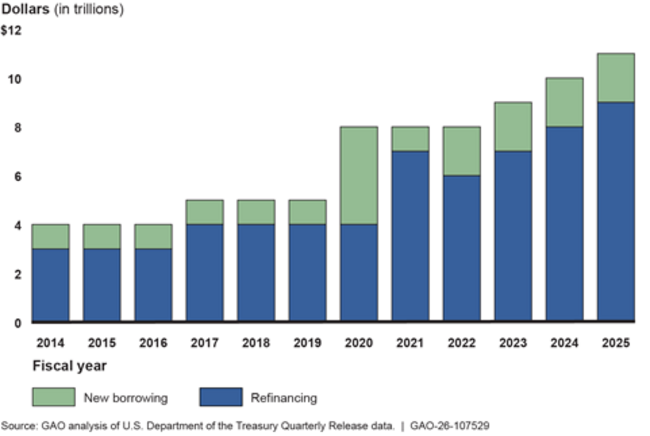
Since fiscal year 2014, the Department of the Treasury has increased the size and frequency of its debt auctions to finance persistent government deficits and refinance existing debt. In fiscal year 2025, Treasury held 444 auctions of bills, notes, and bonds to borrow $1.9 trillion for government operations and refinance $9.1 trillion of maturing debt. Treasury issues debt on a regular and predictable schedule to minimize investor uncertainty. It also uses other strategies to help keep borrowing costs lower than they might otherwise be.
New Borrowing and Refinancing of Treasury Securities, Fiscal Years 2014–2025
Treasury auctions continue to attract sufficient demand from a variety of investors. As of September 30, 2025, domestic investment funds—such as money market funds, mutual funds, and hedge funds—were the largest buyers at auctions, followed by broker-dealers and foreign investors.
Treasury’s debt management practices alone cannot address important risks that could reduce investor demand for Treasury securities and raise government borrowing costs. In some cases, Congress would need to take action to address the underlying causes of these risks.
- Unsustainable federal debt levels could cause investors to demand higher interest rates to compensate for increased risk—adding to growing federal interest costs.
- Debt limit impasses increase the risk of a government default, which would diminish the perception of Treasury securities as safe assets.
- A potential diminished international role for the U.S. dollar would weaken demand for Treasury securities among foreign investors that hold dollars as reserves, use them for global trade, or use them for other financial transactions.
Why GAO Did This Study
As of February 2026, debt held by the public was over $31 trillion. The Congressional Budget Office projects that federal deficits will average over $2 trillion annually through 2036, further adding to U.S. debt.
To finance federal borrowing, Treasury must sell large amounts of Treasury securities at auction. The interest rates that investors are willing to accept at these auctions determines the government’s borrowing costs. Thus, Treasury’s issuance decisions and auction results are important to monitor as Treasury seeks to borrow at the lowest cost over time.
GAO was asked to review Treasury’s debt management practices. This report describes debt management challenges and assesses Treasury’s strategies to manage them, describes changes in debt composition, auctions, and investor demand from fiscal years 2014 through 2025, and describes other debt management risks facing Treasury.
GAO analyzed Treasury data, reviewed Treasury documents and market analyses, and interviewed Treasury officials and market participants.
Recommendations
GAO has previously recommended that Congress (1) have a strategy to address the nation’s unsustainable fiscal path (GAO-20-561) and (2) replace the current debt limit process with an approach that clearly links decisions on debt to decisions on revenue and spending (GAO-15-476).
Addressing these risks would help ensure the continued broad-based demand for Treasury securities and support Treasury’s goal of financing the government at the lowest cost over time. As of February 2026, Congress has not yet taken the recommended actions.