
Homelessness: Agency Actions Could Improve Data on Shelter Program Use
Fast Facts
Record numbers of people have become homeless in recent years, and the federal government spends billions of dollars per year on shelter and prevention programs.
Each year, HUD uses data from shelters across the country to estimate how many people used homelessness services. These published estimates are critical for understanding how the programs are working and where additional resources are needed. However, we found that some of the data that HUD used had data quality issues that could potentially impact the reliability of the estimates.
We made recommendations to address this and other issues.
Homelessness Data Collection

A service provider collets data from someone using an emergency shelter.
Highlights
What GAO Found
The Department of Housing and Urban Development (HUD) reports national estimates of the number and characteristics of people using homeless shelters. These estimates are based on data from about 400 Continuums of Care (CoC), which are planning bodies that coordinate homelessness services within a defined geographic area. CoCs manage shared databases that service providers in their area use to collect data on the people they serve. Each year, CoCs submit aggregated data from these databases to Abt Associates, a consulting firm that processes and analyzes the data for HUD. Abt works with CoCs to identify and resolve data quality issues and determines whether the data meet HUD’s standards (see figure). For CoCs with unusable data and shelters that do not collect data, Abt uses statistical methods to generate estimates.
HUD’s Process for Collecting Data on Shelter Use
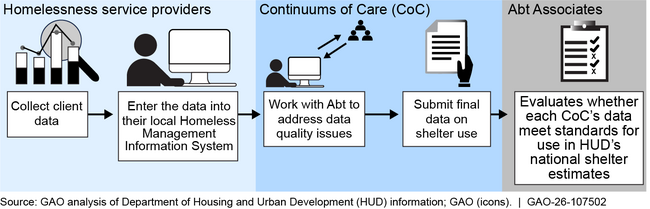
HUD’s process for assessing data quality lacks transparency, making it difficult to assess the reliability of its estimates. Abt staff review each CoC’s data to determine whether they should be included in national estimates of people using shelter programs. However, HUD has not defined which specific data quality issues render a CoC’s data unusable. Instead, according to Abt staff, these decisions are based on their professional judgment. The Office of Management and Budget’s guidelines issued in response to the Information Quality Act require agencies to provide sufficient transparency about their data and methods so that published information can be substantially reproduced. GAO reviewed HUD and Abt data and documentation and was unable to replicate HUD’s data usability determinations. Greater transparency in HUD’s review process could increase confidence in the reliability of its homelessness data.
HUD has taken steps to improve the quality of aggregated CoC data by offering tools and technical assistance directly to CoCs. Staff at most of the 14 CoCs GAO interviewed said these resources were helpful and that their data quality was improving. However, when HUD determines that a CoC’s data are not usable, it does not communicate the rationale to the CoC. As a result, CoCs may be unsure about how to best improve their data and may devote limited resources to issues that may not result in better data quality.
Why GAO Did This Study
Hundreds of thousands of people experience homelessness in the U.S. each year, but developing quality data on homelessness has long been a challenge. High-quality information on homelessness can help policymakers and service providers more effectively target programs and allocate resources.
GAO was asked to review how HUD collects and analyzes data on people experiencing sheltered homelessness.This report (1) describes HUD's process for estimating the number and characteristics of people who use shelter programs, (2) examines HUD’s process for assessing data quality and creating estimates, and (3) assesses HUD’s efforts to address data quality issues that may affect those estimates.
GAO reviewed HUD data from fiscal years 2021 and 2022 (the most recent available) and documentation and interviewed agency officials. GAO also reviewed HUD guidance and interviewed staff from a nongeneralizable sample of 14 CoCs (out of about 400), selected to reflect variation in location and data quality, and conducted site visits to two of these CoCs.
Recommendations
GAO is making three recommendations, including that HUD improve transparency in how data quality is assessed for national homelessness estimates and communicate the rationale for its data usability determinations to CoCs. HUD concurred with GAO’s recommendations.
Recommendations for Executive Action
| Agency Affected | Recommendation | Status |
|---|---|---|
| Department of Housing and Urban Development | The Secretary of HUD should increase the transparency of HUD's usability determinations by adopting clear criteria for how data quality flags should be applied in those decisions. To the extent that subjective judgment is used, HUD should document the reasons for its decisions. (Recommendation 1) |
When we confirm what actions the agency has taken in response to this recommendation, we will provide updated information.
|
| Department of Housing and Urban Development | The Secretary of HUD should reevaluate the statistical methods used to estimate shelter use to assess whether alternative imputation methods could more accurately reflect the uncertainty of its estimates. (Recommendation 2) |
When we confirm what actions the agency has taken in response to this recommendation, we will provide updated information.
|
| Department of Housing and Urban Development | The Secretary of HUD should communicate the rationales for HUD's usability determinations to Continuums of Care, such as by providing information on which data quality flags are considered higher or lower priority. (Recommendation 3) |
When we confirm what actions the agency has taken in response to this recommendation, we will provide updated information.
|