
Criminal Justice: Data on Noncitizen Incarcerations, Convictions, Removals, and Costs
Fast Facts
Noncitizens—including those lawfully in the U.S.— who are convicted of a crime may be incarcerated by federal, state, or local authorities, depending on the offense.
We found:
The Federal Bureau of Prisons incarcerated 44% fewer noncitizens for federal crimes in FY 2024 than in FY 2017. Most incarcerations were for immigration crimes.
Among noncitizens released from federal incarceration during that time, 76% were removed from the U.S.
There is no comprehensive data on the citizenship of people incarcerated by state and local authorities. But some trends suggest that such incarcerations of noncitizens decreased from 2016 through 2022.
A hand unlocking a jail cell door.
Highlights
What GAO Found
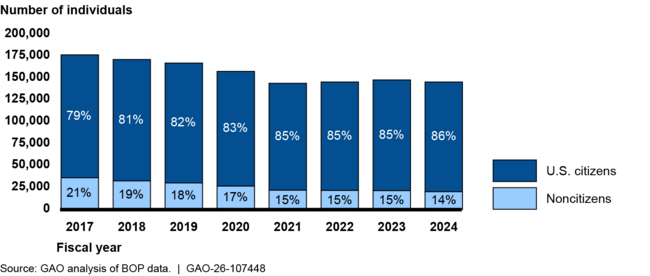
The average number of noncitizens incarcerated by the Federal Bureau of Prisons (BOP) each year decreased 44 percent from fiscal year 2017 (approximately 36,300) through fiscal year 2024 (approximately 20,300). This includes noncitizens with lawful immigration status. During this time, noncitizens, as a proportion of all BOP-incarcerated individuals, also decreased. Immigration-related offenses accounted for more than half of the offenses for which BOP-incarcerated noncitizens were convicted; another 30 percent were drug-related. U.S. Immigration and Customs Enforcement removed approximately 84,800 (76 percent) of the 111,200 noncitizens who completed, at least one term of BOP incarceration from fiscal years 2017 through 2024, as of December 2025.
Individuals Incarcerated by the Federal Bureau of Prisons by U.S. Citizenship Status, Fiscal Years 2017 – 2024
There are no reliable comprehensive data on all noncitizens incarcerated by states and localities. GAO analyzed data from the State Criminal Alien Assistance Program (SCAAP). SCAAP is a Department of Justice (DOJ) program that reimburses jurisdictions for a portion of the eligible costs attributable to incarcerating noncitizens who meet program requirements. Though SCAAP data represent only a portion of all noncitizens incarcerated by states and localities, it provides valuable insights. In state fiscal year 2022, there were a total of approximately 73,500 SCAAP-eligible incarcerations, a decrease of 43 percent from state fiscal year 2016 when there were approximately 128,000 such incarcerations. SCAAP-eligible noncitizens incarcerated by the five state prison systems with the greatest number of SCAAP-eligible incarcerations were convicted of various offenses, including sex crimes, homicide, and drug offenses.
DOJ spent more than $9 billion incarcerating noncitizens from fiscal years 2016 through 2023 (the most recent cost information available at the time of our audit work). This includes approximately $8 billion for BOP’s incarceration of noncitizens from fiscal year 2016 through fiscal year 2023 and approximately $1.44 billion for SCAAP reimbursements to states and localities for incarcerations in state fiscal years 2016 through 2022. This does not reflect costs paid by state and localities that were not reimbursed by the federal government.
Why GAO Did This Study
Depending on the nature of the offense, noncitizens who are arrested and convicted of crimes may be incarcerated by federal, state, or local authorities. These entities each bear the costs of incarcerating them. Following their incarceration, noncitizens may be subject to removal from the U.S. Since 2005, GAO has periodically reported available information on noncitizens incarcerated in the U.S. GAO was asked to update its body of work on this topic (including, GAO-18-433).
This report addresses, among other things, the number and citizenship of noncitizens incarcerated in the U.S., and the cost of incarcerating them.
Noncitizens, in the context of this report, refers to all individuals who are not U.S. citizens, regardless of their immigration status. GAO analyzed data separately for noncitizens incarcerated by BOP and for SCAAP-eligible noncitizens incarcerated by states and localities.
GAO analyzed the most recent data available for each group at the time of our audit work. Generally, analyses of BOP-incarcerated noncitizens span fiscal years 2017 through 2024; analyses of SCAAP-eligible noncitizens incarcerated by states and localities span state fiscal years 2016 through 2022. To calculate the costs of incarcerating noncitizens, GAO analyzed BOP data and information on the annual per person cost of incarcerating an individual in various types of BOP facilities. GAO also analyzed data from the Bureau of Justice Assistance and information collected directly from selected states and localities.
For more information, contact Gretta L. Goodwin at GoodwinG@gao.gov.