
Human Trafficking: Challenges and Opportunities Associated with Anti-Trafficking Projects in Conflict-Affected Countries
Fast Facts
Armed conflict increases the risk of human trafficking and makes it harder to combat.
The Department of State and U.S. Agency for International Development provided about $436 million for anti-trafficking projects between FY 2020-2024 in conflict-affected countries such as Ukraine, Moldova, Romania, and Ethiopia.
Refugees, such as these fleeing the war in Ukraine, may be more vulnerable to human trafficking.
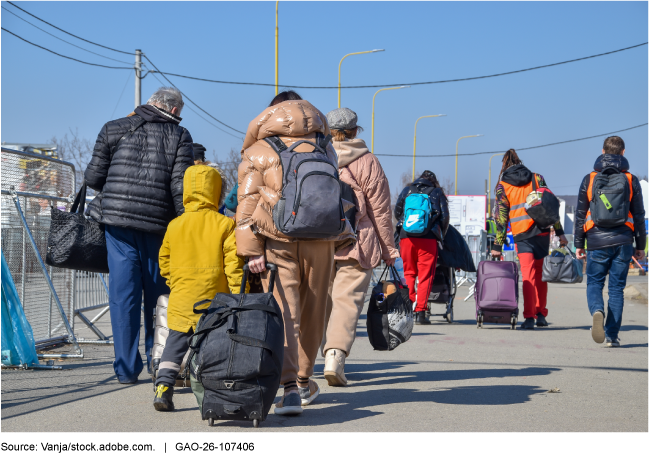
A group of people, including a child, walk away from the camera carrying suitcases and backpacks.
Highlights
What GAO Found
The Department of State and U.S. Agency for International Development (USAID) have funded and implemented projects to combat forced labor and sex trafficking, including some projects in countries affected by armed conflict. From fiscal year 2020 through fiscal year 2024, State and USAID obligated about $437 million for anti-trafficking projects. This included funding for projects in conflict-affected countries such as Ukraine, Moldova, Romania, and Ethiopia. However, a January 2025 executive order paused U.S. foreign development assistance. In April 2025, State began a reorganization, and in July 2025, the Secretary of State announced that USAID had ceased providing foreign assistance. As a result, during the first two quarters of fiscal year 2025, State had no new obligations and de-obligated $1.4 million and USAID obligated $1 million and de-obligated about $1.1 million from anti-trafficking projects. As of September 2025, some of State’s anti-trafficking programming remained. Agency officials said that, going forward, State planned to focus on producing its required annual Trafficking in Persons Report—a report describing the anti-trafficking efforts of the United States and foreign governments.
Officials from agencies and implementing partner organizations identified challenges affecting anti-trafficking project implementation in conflict-affected countries. They also identified opportunties to strengthen project implementation in any future efforts.
Stakeholders Identified Challenges and Opportunities to Strengthen Implementation of Anti-Trafficking Projects in Conflict-Affected Countries
|
Challenges to Implementation |
Opportunities to Strengthen Implementation |
|---|---|
|
· Prioritization of humanitarian aid over anti-trafficking efforts · Increased vulnerabilities to trafficking in conflict-affected countries · Changing trafficking patterns in conflict-affected countries · Impaired prevention and awareness among vulnerable populations · Interrupted access to conduct protection activities · Limited program management flexibility to adapt to changing circumstances in conflict · Difficulties in coordinating and partnering with local and international stakeholders · Limited local partner capacity to conduct anti-trafficking efforts · Corruption and evidence requirements for prosecuting trafficking cases |
· Continue U.S. policy emphasis on anti-trafficking efforts · Build local partner capacity through training, technology, and best practices · Allow implementing partners greater flexibility to adapt when conflict interrupts planned anti-trafficking activities · Facilitate coordination among international and local anti-trafficking partners · Provide additional funding for anti-trafficking programming |
Source: GAO analysis of discussion group responses. | GAO-26-107406
Note: We held eight discussion groups with a total of 47 stakeholders from December 2024 to March 2025. Stakeholders included U.S. agency officials managing anti-trafficking projects and representatives of organizations implementing projects in Ukraine, Romania, Moldova, and Ethiopia.
Why GAO Did This Study
Human trafficking is a global threat that armed conflict exacerbates. Russia’s invasion of Ukraine in 2022 prompted widespread concern about trafficking in Ukraine and other conflict-affected countries. This report is one of several engagements GAO initiated in response to a provision in the Consolidated Appropriations Act, 2023.
This report describes State and USAID funding for anti-trafficking projects globally and in four conflict-affected countries—Ukraine, Moldova, Romania, and Ethiopia. Among other objectives, this report also describes challenges and opportunities to strengthen implementation of anti-trafficking projects in conflict-affected countries.
GAO analyzed agency documentation and funding data and interviewed and analyzed discussion responses from 47 agency officials and representatives from implementing partner organizations from eight discussion groups held from December 2024 to March 2025.
For more information, contact Chelsa Kenney at kenneyc@gao.gov.