
Medicare Part D: Payments and Contracts Between Pharmacies and Plan Sponsors That Are Vertically Integrated
Fast Facts
The government contracts with private companies, known as plan sponsors, to provide Medicare Part D prescription drug coverage. These plan sponsors work with pharmacy benefit managers to pay pharmacies for drugs.
Some plan sponsors are "vertically integrated"—under common ownership with pharmacy benefit managers and pharmacies.
We found that for some of the largest vertically integrated sponsors, about 25% of Part D prescriptions were dispensed by pharmacies they owned, often mail-order pharmacies. And these sponsors often charged beneficiaries less for prescriptions at their own pharmacies, encouraging beneficiaries to use those pharmacies.
Prescription drug bottles in a line on a shelf
Highlights
What GAO Found
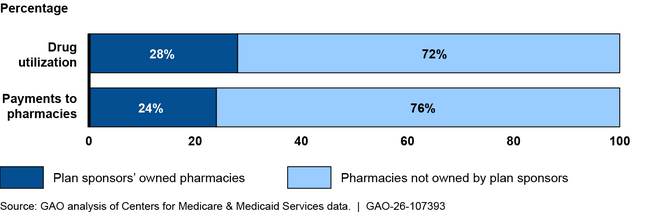
The insurance plan sponsors that provide Medicare Part D drug coverage have increasingly become vertically integrated—that is, under common ownership—with pharmacy benefit managers and pharmacies. GAO found that, for four large Part D plan sponsors, the pharmacies they owned accounted for about 24 percent of the Part D drugs they provided to their enrollees (drug utilization) and about 28 percent of the total payments to pharmacies in 2023 (see figure). Payments included both reimbursement from plan sponsors and cost sharing paid by or on behalf of beneficiaries. When these vertically integrated plan sponsors’ own pharmacies provided drugs to their enrollees, they primarily did so through mail-order pharmacies. In contrast, other (non-owned) pharmacies primarily provided drugs through retail pharmacies.
Percentage of Drug Utilization and Payments at Owned and Non-Owned Pharmacies for Four Selected Medicare Part D Plan Sponsors, 2023
When these plan sponsors paid pharmacies for a 30-day supply of the 100 most commonly used prescription drugs, payments and cost sharing for at least 94 percent of these drugs were lower for owned pharmacies than for non-owned pharmacies. These 100 drugs with the highest total utilization in 2023 were primarily generic drugs, and average payments to owned and non-owned pharmacies for a 30-day supply of most were $10 or less. Lower cost sharing at plan sponsors’ own (primarily mail-order) pharmacies gives beneficiaries a financial incentive to use these pharmacies instead of non-owned (primarily retail) pharmacies, though beneficiaries may consider other factors when choosing a pharmacy to fill a prescription.
Payments to pharmacies and cost sharing were also generally lower at owned pharmacies for the 100 drugs with the highest total payments in 2023, which were primarily brand-name drugs. For some of these drugs, however, payments or cost sharing were higher at owned pharmacies. For example, cost sharing across the four selected plan sponsors was up to about $340 higher at owned pharmacies for about half of the 20 drugs with the highest payments per 30-day supply.
Why GAO Did This Study
Medicare Part D spent $150 billion on prescription drug coverage for 54 million beneficiaries in 2025. Vertically integrated plan sponsors may encourage beneficiaries to fill prescriptions at—or utilize—their own pharmacies, a practice known as steering.
GAO was asked to review vertical integration among Part D plan sponsors, pharmacy benefit managers, and pharmacies. This report describes drug utilization at and payments to selected vertically integrated Part D plan sponsors’ own pharmacies compared to non-owned pharmacies, among other issues.
GAO selected four vertically integrated Part D plan sponsors from among the 15 plan sponsors with the largest Part D enrollment in 2023. These four large, vertically integrated plan sponsors accounted for over 40 percent of total Part D enrollment in 2023. GAO analyzed the Centers for Medicare & Medicaid Services Part D utilization and payments data for 2023 (the data most recently available at the time of GAO’s analysis). Our results for the four selected plan sponsors for 2023 are not generalizable to other plan sponsors or years. For example, Part D benefit changes since 2023 could have affected plan sponsors’ Part D drug utilization and payments at owned and non-owned pharmacies.
For more information, contact John Dicken at dickenj@gao.gov.