
Bureau of Prisons: Actions Needed to Better Achieve Financial and Other Benefits of Moving Individuals to Halfway Houses on Time
Fast Facts
The Federal Bureau of Prisons is responsible for the care and custody of incarcerated people. Some people nearing the end of their sentences may be transferred to a halfway house that can help them prepare to re-enter their communities.
But the Bureau:
Doesn't know how many people are eligible to be transferred to a halfway house or should have been transferred already
Doesn't have the halfway house capacity to accommodate all people who may be eligible to transfer
Paid halfway houses late about 70% of the time, spending millions of dollars in late fees
Our recommendations address these and other issues.
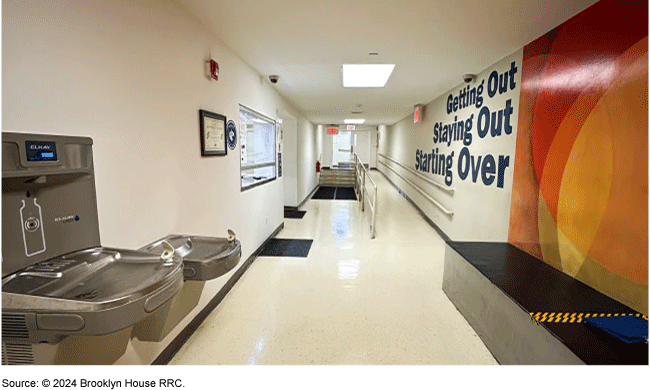
Hall with a door, a ramp, a window and water fountains. The words getting out, staying out, and starting over on the wall.
Highlights
What GAO Found
The Federal Bureau of Prisons (BOP) does not know how many individuals are currently in prison that could have already transferred to home confinement or a residential reentry center (RRC), also known as a halfway house. BOP officials said they do not know because the dates individuals are eligible to transfer are not readily available. GAO found that some individuals have remained in federal prisons despite being eligible to relocate to home confinement or an RRC. For instance, GAO found that BOP did not apply all the earned time toward placement in RRCs and home confinement for 21,190 of 29,934 individuals reviewed, for reasons such as insufficient RRC capacity and court orders. However, the full scale of this issue is unknown due to the lack of readily available data on eligibility dates. Until BOP maintains and monitors such data, it cannot ensure individuals transfer on time and take corrective action when timely transfers do not occur. As a result, BOP cannot ensure individuals receive the services and have the opportunities available at an RRC or home confinement, such as finding employment and long-term housing and reconnecting with the community. BOP has reported that such services can also help reduce recidivism.
Limited capacity in BOP contracted RRCs and home confinement spaces was a reason that individuals did not transfer on time, according to BOP officials. However, BOP does not know the full extent of this shortage because it has not comprehensively assessed its capacity and related budgetary needs. Without these assessments, BOP cannot ensure it has enough space for incarcerated individuals to transfer on time. BOP could also miss opportunities to increase revenues and decrease costs to the federal government. For instance, BOP said that individuals who have resided in an RRC are less likely to return to prison.
GAO also found that BOP made roughly 65,000 late payments to contractors, including RRCs, from fiscal year 2022 through March 2025. As a result, the agency paid $12.5 million in interest penalties as part of $2.8 billion in payments to contractors. In addition, GAO found that BOP paid RRCs late about 70 percent of the time, from fiscal years 2023 through 2024. RRC staff said they face hardships due to the late payments—needing private loans to pay staff. One RRC representative said late payments have made some RRCs reluctant to bid for new BOP contracts, which can further complicate BOP’s plans to expand capacity. By implementing a corrective action plan to address its late payments, BOP could save federal funds and better position itself to expand RRC capacity.
BOP’s Late Payments to RRCs and Other Contractors, October 2021–March 2025

Why GAO Did This Study
BOP contracts with roughly 150 RRCs across the U.S. to help incarcerated individuals reenter their communities upon completion of their sentences. RRCs facilitate reentry services (e.g., employment services, drug treatment, and classroom education) to individuals who reside in RRCs or who are on home confinement. RRCs can help individuals rebuild ties to their community and reduce the likelihood that they will commit future crimes.
GAO was asked to review BOP’s use of RRCs. This report examines, among other things, how many individuals in BOP custody are eligible to transfer to RRCs and home confinement; the extent BOP knows its RRC capacity needs across the U.S.; and the extent BOP has paid RRCs and other contractors on time.
GAO reviewed relevant federal laws, BOP policies and documents, and BOP data on RRCs, including payments to contractors. In addition, GAO selected seven RRCs and three BOP field offices and interviewed residents and staff. GAO selected locations based on criteria such as geographic dispersion and the size of RRCs within an area. GAO also interviewed BOP officials responsible for residential reentry management and oversight.
Recommendations
GAO is making seven recommendations to BOP, including to maintain and monitor readily available data on RRC and home confinement eligibility dates, assess its RRC and home confinement capacity and budgetary needs, and implement a corrective action plan to address the causes of late payments. BOP concurred with our recommendations.
Recommendations for Executive Action
| Agency Affected | Recommendation | Status |
|---|---|---|
| Bureau of Prisons | The BOP Director should maintain readily available data on the dates incarcerated individuals are eligible to transfer to RRCs or home confinement, across the bureau. This includes the eligibility date pursuant to the First Step Act, Second Chance Act, and any other incentives or benefits available to incarcerated individuals regardless of the availability of RRC and home confinement space. (Recommendation 1) |
We will update the status of this recommendation when the Bureau of Prisons provides its 180-day letter (expected in late summer 2026).
|
| Bureau of Prisons |
Priority Rec.
The BOP Director should monitor, across the bureau, whether individuals transfer to RRCs and home confinement on time, and if not, take corrective action. (Recommendation 2) |
We will update the status of this recommendation when the Bureau of Prisons provides its 180-day letter (expected in late summer 2026).
|
| Bureau of Prisons | The BOP Director should more comprehensively assess its RRC capacity needs, including locations and number of RRC spaces. The assessment should consider all time available to incarcerated individuals for prerelease custody, including time under the First Step Act, Second Chance Act, and the Residential Drug Abuse Program. (Recommendation 3) |
We will update the status of this recommendation when the Bureau of Prisons provides its 180-day letter (expected in late summer 2026).
|
| Bureau of Prisons | The BOP Director should, after determining RRC capacity needs, determine the related budgetary needs. (Recommendation 4) |
We will update the status of this recommendation when the Bureau of Prisons provides its 180-day letter (expected in late summer 2026).
|
| Bureau of Prisons | The BOP Director should develop and implement a plan—including timeframes, roles, and responsibilities—for addressing known challenges in reaching a sufficient level of prerelease custody capacity. (Recommendation 5) |
We will update the status of this recommendation when the Bureau of Prisons provides its 180-day letter (expected in late summer 2026).
|
| Bureau of Prisons | The BOP Director should ensure its market analysis for RRC contracts is aligned with leading practices for developing and assessing models. (Recommendation 6) |
We will update the status of this recommendation when the Bureau of Prisons provides its 180-day letter (expected in late summer 2026).
|
| Bureau of Prisons |
Priority Rec.
The BOP Director should develop and implement a corrective action plan that addresses the root causes of BOP's late payments to contractors. The implementation plan should include timeframes and identify individuals responsible for taking corrective actions. (Recommendation 7) |
We will update the status of this recommendation when the Bureau of Prisons provides its 180-day letter (expected in late summer 2026).
|