
High Risk Research: HHS Should Publicly Share More Information on How Risk Is Assessed and Mitigated
Fast Facts
Research that alters pathogens to better study diseases, especially those with pandemic potential, is considered risky. If mishandled by accident or on purpose, altered pathogens may cause harm.
The Department of Health and Human Services conducts this type of research and provides some funding for it within current federal limitations. We found that HHS doesn't consistently disclose important details about its process for weighing the risks and benefits of this research or reveal how many projects involve these potentially dangerous pathogens.
We recommended HHS address this issue to ensure public trust in federally funded research.

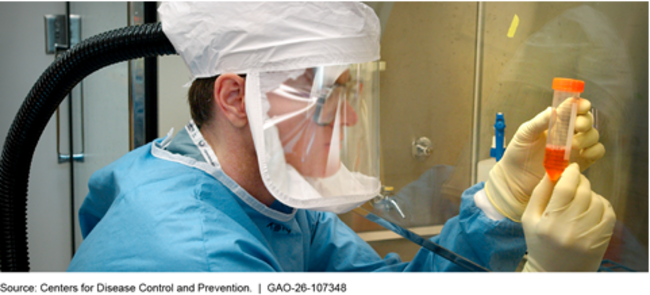
Photo of a lab worker in personal protective equipment (mask, hairnet, gloves, safety glasses, lab coat) using a large pipette to put something in a petri dish.
Highlights
What GAO Found
Research that involves modifying pathogens that have the potential to cause a pandemic—sometimes referred to as “gain-of-function research of concern”—has been a topic of debate. Based on GAO’s review of literature and other sources, this research has advanced scientific knowledge of how pathogens infect humans and transmit and cause disease. However, there is no broad agreement on the extent to which this research has directly led to the development of vaccines and therapeutics, such as for COVID-19. There was broad consensus that gain-of-function research of concern can pose biosafety and biosecurity risks. This is because this research can involve enhancing the transmissibility or virulence of pathogens that have the potential to cause widespread and uncontrollable disease, resulting in significant morbidity and mortality if they were to be accidentally or deliberately released from a lab.
Scientist Conducting Pathogen Research
As part of its effort to lead the federal public health and medical response to potential biological threats and emerging infectious diseases, the Department of Health and Human Services (HHS) provides funding for, and conducts research on, pathogens of varying risk level. GAO found that HHS procedures for reviewing research—including research that can be considered gain-of-function research of concern—generally include identifying and assessing the risks of the pathogen and the proposed experiment and assessing the adequacy and appropriateness of proposed risk mitigation strategies. If risks cannot be mitigated, HHS agencies can decide not to fund or conduct the research. However, GAO also found that HHS does not always share key information on these risk reviews with the public. For example, HHS reports to federal stakeholders about the number of research projects involving certain higher risk pathogens and the related risks and associated mitigation measures but does not report more widely. Some HHS officials told GAO they supported sharing general information about their risk reviews with the public. HHS has also reported that transparency helps to ensure public trust in federally funded scientific research. Sharing such information would help provide greater assurance to the public, science community, and Congress that HHS has procedures to manage risks.
Why GAO Did This Study
Recently introduced legislation and executive actions have aimed to restrict or ban federal departments and agencies, like HHS, from conducting or funding gain-of-function research of concern.
GAO was asked to review the outcomes of gain-of-function research of concern and related risk mitigation strategies. This report (1) describes findings from literature and reports that discuss outcomes of gain-of-function research of concern and (2) examines HHS’s procedures for reviewing risk and risk mitigation strategies for research involving pathogens.
GAO identified outcomes of gain-of-function research of concern by reviewing literature and other sources published from 2019 to 2024. GAO reviewed HHS procedures for reviewing risks and risk mitigation strategies and federal policies and guidance for the oversight of higher-risk pathogen research and interviewed HHS officials. GAO also interviewed eight biosafety and biosecurity experts selected because they authored relevant articles and had experience with gain-of-function research of concern.
Recommendations
GAO is recommending that HHS ensure that key information on its risk reviews of research involving pathogens are publicly shared, as appropriate, with researchers, Congress, and the public, including steps taken to mitigate risk. HHS neither agreed nor disagreed with the recommendation, but noted it will work in the future to ensure public transparency about the scope of research involving higher-risk pathogens and actions taken to mitigate risks.
Recommendations for Executive Action
| Agency Affected | Recommendation | Status |
|---|---|---|
| Department of Health and Human Services | The Secretary of Health and Human Services should work with HHS funding agencies to ensure that key information on the agencies' risk reviews of extramural research and intramural projects involving pathogens are publicly shared with researchers, Congress, and the public, as appropriate. Such information should be regularly updated and include the outcomes of risk reviews, steps HHS funding agencies and researchers took to mitigate risk, and the total number of research projects involving higher-risk pathogen research that agencies support. (Recommendation 1) |
When we confirm what actions the agency has taken in response to this recommendation, we will provide updated information.
|