
Tribal Programs: Information on Freedmen Descendants of the Five Tribes
Fast Facts
After the Civil War, the U.S. entered treaties with the Cherokee, Chickasaw, Choctaw, Muscogee (Creek), and Seminole Nations that abolished slavery in the Tribes. The formerly enslaved people living among these Tribes are known as the “Freedmen.”
Freedmen descendants are eligible to enroll as citizens in some of these Tribes. Once enrolled, they can access certain federal services meant for Tribes and their citizens, such as health care, education, and housing assistance.
But some enrolled Freedmen descendants had trouble accessing or were denied these services.
We estimate there were hundreds of thousands of Freedmen descendants as of 2022.
Highlights
What GAO Found
Before the Civil War, the Cherokee, Chickasaw, Choctaw, Muscogee (Creek), and Seminole Nations—known as the Five Tribes—had citizens who enslaved people. In 1866, each Tribe entered a treaty with the U.S. that abolished slavery and addressed tribal citizenship rights of the formerly enslaved people living among the Tribes. Historically, these people are referred to as “Freedmen.”
Territories of the Five Tribes and Oklahoma, 1890
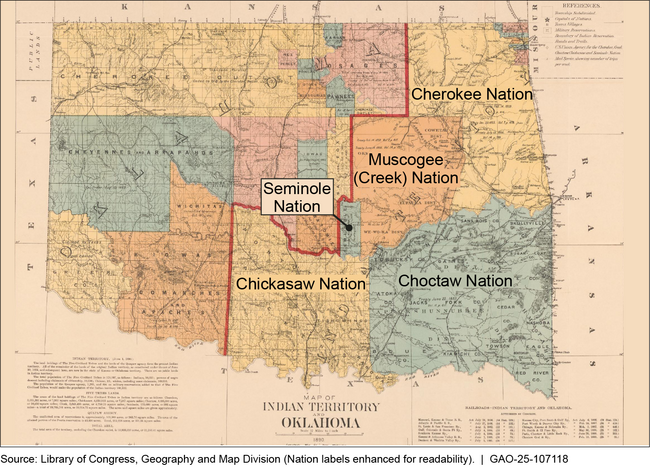
GAO estimates that the population of descendants of the Freedmen could have ranged from 146,400 to 395,400 in 2022. Since the 1800s, several courts have considered whether the Freedmen and their descendants are entitled to tribal citizenship or other rights under the 1866 treaties. In part because of those cases, Freedmen descendants are eligible to enroll as tribal citizens in the Cherokee and Seminole Nations, but not the Chickasaw or Choctaw Nations. Further, the Muscogee (Creek) Supreme Court recently ruled that the Muscogee (Creek) Nation must begin to permit its Freedmen descendants to enroll.
Federal agencies administer a range of services, such as health care, education, and housing assistance, for the benefit of Tribes and their citizens, including enrolled Freedmen descendants. However, most of the 19 enrolled Freedmen descendants GAO interviewed said they encountered barriers accessing such services. Agencies have taken some actions to address these barriers, such as by clarifying enrollment eligibility. In addition, enrolled Freedmen descendants are regarded differently than other tribal citizens under certain federal statutes concerning land ownership and criminal jurisdiction.
Why GAO Did This Study
To better understand the status of Freedmen descendants, the Senate Committee on Indian Affairs held a hearing in 2022 on selected provisions of the 1866 treaties between the U.S. and the Five Tribes. The committee subsequently requested that GAO provide related information.
This report (1) estimates the population of Freedmen descendants of the Five Tribes, (2) describes key court decisions on Freedmen descendants’ eligibility for tribal citizenship, (3) describes barriers to certain federal services identified by enrolled Freedmen descendants and agency actions to address them, and (4) describes how Freedmen descendants are regarded differently than other citizens of the Five Tribes under certain federal statutes.
GAO conducted demographic modeling to estimate the population of Freedmen descendants of the Five Tribes as of 2022, the most recent year for which data were available.
GAO reviewed the 1866 treaties, the Five Tribes’ constitutions, federal statutes, and key court cases from tribal and federal courts related to the tribal citizenship rights of the Freedmen descendants.
GAO interviewed officials from the Cherokee Nation, an association that represents Freedmen descendants, 19 Freedmen descendants enrolled as tribal citizens in the Cherokee and Seminole Nations, and federal agency officials.
For more information, contact Anna Maria Ortiz at ortiza@gao.gov.