
Drug-Free Communities Support Program: Actions Needed to Enhance Performance Data and Oversight
Fast Facts
The Office of National Drug Control Policy’s Drug-Free Communities Support Program provides grants to community-based coalitions focused on drug use prevention for youth under 18.
This office has consistently claimed, since 2023, that this program is reducing substance use among youth. However, we found that the program doesn't have enough performance data to make such a claim.
Without adequate data, the office can't accurately determine if the Drug-Free Community Support Program is achieving its goals.
Our recommendations address this issue and more.

Selected statements from ONDCP's National Cross-Site Evaluation Report.
Highlights
What GAO Found
The Office of National Drug Control Policy’s (ONDCP) Drug-Free Communities (DFC) Support Program provides grants for community-based coalitions focused on drug use prevention efforts for youth 18 and under. In the 2025 evaluation report, it is claimed that the DFC program is meeting its strategic goal of reducing substance use among youth. However, that report states that it is not possible to establish a causal relationship between substance use changes in communities and the DFC program.
Selected statements on the Effectiveness of the Drug-Free Communities Support Program from the June 2025 National Cross-Site Evaluation Report
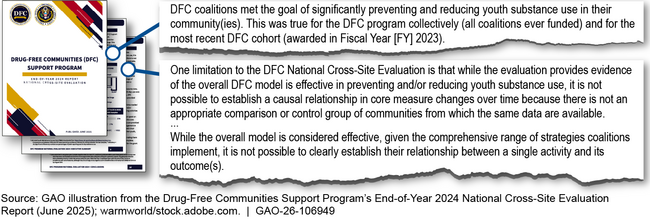
GAO found significant limitations in the program data—inconsistencies and unclear data sources. By law, coalitions have certain flexibility in how they collect data. Moreover, ONDCP’s cross-site evaluations have not transparently described its methodologies. Including the complete methodology would allow one to better understand and assess the results of the evaluation. Researchers have long reported on thechallenges for documenting causality for community-based programs. However, available data provides insights on coalitions’ efforts to reduce substance use among youth.
ONDCP has taken some steps to effectively administer the DFC program, including working to ensure new coalitions meet program requirements and have access to mandatory training. In addition, ONDCP has established an internal controls framework to help ensure grantee compliance. However, ONDCP has not consistently enforced compliance with the statutory requirement that DFC coalitions maintain the involvement of all community sectors. Establishing and maintaining community drug prevention partnerships is a critical factor to the success of the DFC program. Further, ONDCP lacks transparency in its budget process. Enhanced budget disclosures would allow appropriators and program decision-makers to develop a more comprehensive understanding of the DFC program’s financial position.
Why GAO Did This Study
The U.S. faces multiple challenges related to illicit drugs and declared the opioid epidemic as a national public health emergency since 2017. The Centers for Disease Control and Prevention data indicated 1,413 drug overdose deaths occurred among those age 18 and under in 2023. The DFC program focuses on preventing and reducing youth substance use. In 2020, GAO designated drug misuse a high-risk issue and added it to the 2021 High-Risk Series.
The SUPPORT Act includes a provision for GAO to review ONDCP’s programs and operations, including the DFC program, every 4 years. This report examines the extent to which (1) the DFC program has met key program goals; and (2) ONDCP has effectively managed the DFC program.
For this report, GAO conducted a survey and site visits selected by geography and size, and analyzed annual evaluations of the DFC program, management protocols, and budget data for fiscal years 2018 through 2025. GAO also interviewed agency officials and contractors responsible for program evaluations.
Recommendations
GAO is making six recommendations to ONDCP to develop a strategy to identify relevant data to better understand program impact, explore ways to standardize coalition data collection, document and report the methodology in its annual evaluations, enforce the community sectors involvement requirement, and increase transparency in its budget process. ONDCP concurred with each of the recommendations.
Recommendations for Executive Action
| Agency Affected | Recommendation | Status |
|---|---|---|
| Office of National Drug Control Policy | The Director of ONDCP, in consultation with the Director of the Centers for Disease Control and Prevention [or another federal statistical agency], should develop a strategy to identify relevant data to help better understand the DFC program's impact. (Recommendation 1) |
When we confirm what actions the agency has taken in response to this recommendation, we will provide updated information.
|
| Office of National Drug Control Policy | The Director of ONDCP, in consultation with the Director of the Centers for Disease Control and Prevention [or another federal statistical agency], should explore ways to standardize its data collection methodology for its four core measures to help improve the quality of program performance data submitted to the DFC program. (Recommendation 2) |
When we confirm what actions the agency has taken in response to this recommendation, we will provide updated information.
|
| Office of National Drug Control Policy | The Director of ONDCP should ensure that its annual evaluation reports of the DFC program include complete documentation of the methodology used to develop the report's findings and conclusions. (Recommendation 3) |
When we confirm what actions the agency has taken in response to this recommendation, we will provide updated information.
|
| Office of National Drug Control Policy | The Director of ONDCP should establish clearly defined performance goals and measures for the DFC program's strategic goal of collaboration among communities to prevent and reduce substance use among youth. (Recommendation 4) |
When we confirm what actions the agency has taken in response to this recommendation, we will provide updated information.
|
| Office of National Drug Control Policy | The Director of ONDCP should establish and implement enforcement procedures for DFC coalitions that do not maintain all 12 sectors in accordance with statutory requirements, and work with the coalitions to reestablish these sectors in a timely manner. (Recommendation 5) |
When we confirm what actions the agency has taken in response to this recommendation, we will provide updated information.
|
| Office of National Drug Control Policy | The Director of ONDCP should provide Congress with information on the carryover balance available for the DFC program's administrative expenses—including how any carryover funds are expected to be expended on current or future projects and activities. (Recommendation 6) |
When we confirm what actions the agency has taken in response to this recommendation, we will provide updated information.
|