
VA and DOD Health Care: Agreements to Share Services and Other Resources Should Be Evaluated
Fast Facts
The Department of Veterans Affairs and Department of Defense provide health care to over 18 million veterans and servicemembers. The two departments may share health care resources, like surgery services, through sharing agreements, which help improve access to health care and lower costs. There were 185 such agreements as of April 2025 in areas like mental health and orthopedics.
However, we found that the departments don't evaluate how well these agreements work, which could include assessing progress toward their goals. They may also miss ways to identify potential sharing opportunities.
Our recommendations address these issues and more.

Highlights
What GAO Found
The Department of Veterans Affairs (VA) and Department of Defense (DOD) have shared mutually beneficial medical and other services through 185 sharing agreements, as of April 2025. For example, veterans may receive care at DOD facilities for services including surgery, orthopedics, and mental health. These agreements can result in greater access to care for veterans and cost savings for the federal government, in part because of the discounted rate that VA and DOD pay each other for health care delivered under such sharing agreements.
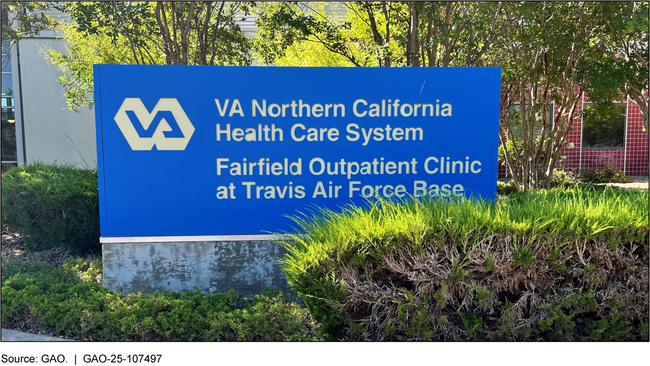
Department of Veterans Affairs Medical Clinic Located on a Military Base
VA and DOD collect information on the characteristics of all sharing agreements as well as referrals of veterans to DOD facilities made through sharing agreements; however, the departments do not evaluate the effectiveness of sharing agreements. Officials told GAO that they use the number of sharing agreements and the continuation of agreements as measures of the agreements' value. However, VA and DOD could maximize the benefits of these agreements by developing a performance management process, including establishing performance goals for the agreements, evaluating progress towards the goals, and making changes as appropriate.
VA and DOD have taken some steps to identify new or expanded sharing opportunities, including tracking space-sharing projects through a committee. However, the departments largely rely on local officials to identify potential areas for new and expanded sharing, which may result in missed opportunities for sharing. Developing a systematic, department-level process to identify and implement opportunities for new and expanded sharing agreements could help ensure the departments maximize sharing, which could in turn help improve patients' access to care as well as reducing costs.
Why GAO Did This Study
VA and DOD operate two of the nation's largest health care systems. Together, these systems serve over 18 million beneficiaries. VA's health care system includes approximately 170 medical centers and 1,200 clinics, while DOD's health care system includes more than 700 medical facilities worldwide. VA and DOD have entered into agreements to share health care services to improve access to and cost effectiveness of care.
GAO was asked to review the departments' use of sharing agreements. This report describes the number and types of sharing agreements; examines the extent to which VA and DOD assess them; and examines how VA and DOD identify opportunities for new or expanded sharing agreements, among other topics.
GAO reviewed VA and DOD documents and data, including active sharing agreements as of April 2025; conducted site visits to 12 VA and DOD facilities with active agreements, selected to represent diversity in geography and the type of sharing taking place; and interviewed VA and DOD officials.
Recommendations
GAO is making five recommendations, including that VA and DOD should evaluate the effectiveness of sharing agreements and make changes as needed, and that VA and DOD should develop a systematic process to identify and implement opportunities for new or expanded sharing agreements. The departments concurred with GAO's recommendations.
Recommendations for Executive Action
| Agency Affected | Recommendation | Status |
|---|---|---|
| Department of Defense | The Under Secretary of Defense for Personnel & Readiness should finalize procedures that include guidance on developing non-reimbursable sharing agreements, including instructions on how to develop a required justification through a business case analysis plan, and provide the procedures to its DOD facilities. (Recommendation 1). |
DOD agreed with our recommendation and has begun taking some steps to implement it. According to DOD, a utilization analysis guide and template were created to justify non-reimbursable agreements. To close the recommendation as implemented, DOD would have to provide evidence of the use of this utilization Analysis guide and template.
|
| Department of Veterans Affairs | The VA Under Secretary for Health should work with DOD to implement a process for evaluating the effectiveness of all its sharing agreements and use the results to make changes as appropriate. Such a process should include establishing performance goals, establishing performance measures, and collecting data to assess progress towards these goals. (Recommendation 2). |
VA agreed with GAO's recommendation. In March 2026, the Health Executive Committee's Shared Resource Work Group issued various tools, including a utilization assessment tool and resource sharing playbook, which according to VA officials, enables VA and DOD sharing partners to resume sharing agreement activities under a unified, data driven framework. These tools guide the sharing partners in developing performance goals and metrics, to be assessed annually. Partners have begun data collection, with the first full performance review scheduled for third quarter of fiscal year 2027. To close the recommendation as implemented VA will have to provide evidence demonstrating the use of these tools and how the tools are used in making informed adjustments to strengthen the effectiveness of sharing agreements.
|
| Department of Defense | The Assistant Secretary of Defense for Health Affairs should work with VA to implement a process for evaluating the effectiveness of all its sharing agreements and use the results to make changes as appropriate. Such a process should include establishing performance goals, establishing performance measures, and collecting data to assess progress towards these goals. (Recommendation 3). |
DOD agreed with our recommendation and has begun taking some steps to implement it. According to DOD, a utilization analysis guide and template were created to evaluate the effectiveness of new and active sharing agreements. The department plans to use the results to make changes, establish performance goals and measures, and collect data to assess the goals. To close the recommendation as implemented, DOD will have to provide evidence of how the utilization analysis guide and template has been used to establish performance goals and measures and that DOD is collecting data for assessing the goals.
|
| Department of Veterans Affairs |
Priority Rec.
The VA Under Secretary for Health should work with DOD to develop and implement a systematic process for identifying opportunities for new and expanded sharing agreements (Recommendation 4). |
VA agreed with GAO's recommendation. In March 2026, the Health Executive Committee's Shared Resource Work Group developed standardized tools, including a concept document, a utilization analysis guide, and a template that will enable facilities to assess capabilities, identify unmet needs, and evaluate opportunities for new or enhanced sharing agreements. To close the recommendation as implemented, VA will have to provide evidence demonstrating the use of these tools.
|
| Department of Defense |
Priority Rec.
The Assistant Secretary of Defense for Health Affairs should work with VA to develop a systematic process for identifying opportunities for new and expanded sharing agreements (Recommendation 5). |
DOD agreed with our recommendation and has begun taking some steps to implement it. According to DOD, DOD and VA developed a standardized concept template and utilization analysis guide and template to identify opportunities for new and expanded sharing agreements. To close the recommendation as implemented, DOD will have to provide evidence of how these tools are being used to identify opportunities for new and expanded sharing agreements.
|