
Defense Industrial Base: Actions Needed to Address Risks Posed by Dependence on Foreign Suppliers
Fast Facts
The Department of Defense relies on a global network of over 200,000 suppliers to produce weapons, as well as noncombat goods like batteries and manufacturing equipment.
DOD sees certain foreign suppliers as a national security risk because, for example, they could cut off access to critical materials.
DOD has made progress gathering supplier information and improving supply chain transparency. However, its efforts are uncoordinated and have provided little insight into the vast majority of suppliers.
We made 3 recommendations to help DOD address this challenge.
DOD Purchases Microelectronics for Weapon Systems from a Global Supply Chain

Highlights
What GAO Found
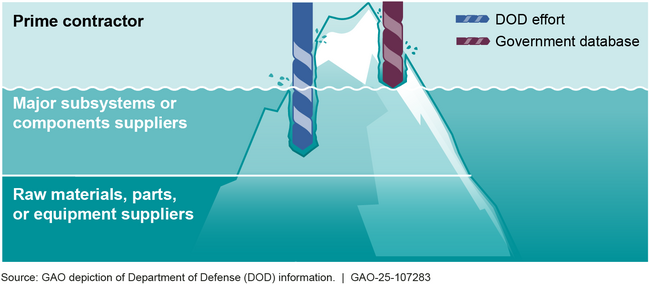
The Department of Defense (DOD) considers reliance on foreign sources for items it procures a national security risk. DOD estimates that over 200,000 suppliers help produce advanced weapon systems and noncombat goods. The primary procurement database for the federal government, however, provides little visibility into where these goods are manufactured or whether materials and parts suppliers are domestic or foreign.
DOD is pursuing several supply chain visibility efforts designed to help improve its ability to identify risks of what it refers to as “foreign dependency.” DOD has made progress gathering supplier information for major subsystems and components. However, these efforts are uncoordinated and limited in scope and provide little insight into the vast majority of suppliers, including those that provide raw materials and parts.
DOD's Limited Visibility into the Origin of Materials in Its Supply Chain
DOD identified actions it can take to improve its ability to identify and mitigate foreign dependency issues, including
- establishing an office to integrate efforts across DOD; and
- implementing leading commercial practices for supply chain visibility, such as focusing visibility efforts on high-priority programs.
However, DOD has yet to identify resources, priorities, and time frames for completing the integration. Additionally, it has not identified the organization responsible for implementing the leading commercial practices. Without doing so, DOD will be less able to identify and address foreign dependency risks.
One untested approach that DOD officials stated could give DOD more visibility into foreign dependency risks is to contractually require suppliers to provide the information. While some DOD officials assert the information is readily available, others stated this approach may be too costly or that suppliers may not be willing to provide information. Unless DOD tests the costs and challenges of requiring suppliers to provide foreign dependency information, it could be missing an opportunity to address a mounting challenge to the security of its supply chains.
Why GAO Did This Study
The January 2024 National Defense Industrial Strategy stated that DOD's dependence on adversarial sources for goods it procures is a mounting national security challenge. These suppliers may cut off U.S. access to critical materials or provide “back doors” in their technology that serve as intelligence pathways.
The Conference Report and a House Report for the National Defense Authorization Act for Fiscal Year 2024 include provisions for GAO to report on DOD's dependence on foreign entities and its processes for determining whether it is procuring goods from China. This report, among other things, (1) describes the information that government procurement data contains on the country of origin of goods that DOD procures, and (2) assesses DOD actions to collect additional data.
To conduct this work, GAO analyzed government procurement data from fiscal years 2020 through 2024, reviewed DOD documents, and interviewed DOD officials and contractor representatives.
Recommendations
GAO recommends that DOD identify resources, priorities, and time frames to implement efforts to integrate and share supply chain data; identify an organization responsible for implementing leading commercial practices; and test the use of contract requirements to obtain country-of-origin information from suppliers. DOD concurred with all three recommendations.
Recommendations for Executive Action
| Agency Affected | Recommendation | Status |
|---|---|---|
| Department of Defense | The Under Secretary of Defense for Acquisition and Sustainment, through its new Supply Chain Risk Management Integration Center, should identify resources, priorities, and time frames for integrating and sharing supply chain information across DOD that can help identify foreign dependency risks. (Recommendation 1) |
DOD concurred with the recommendation. In July 2026, DOD stated that it plans to establish a cross-functional, tiered governance structure to provide broad oversight of department-wide supply chain risks. This structure, known as the Supply Chain Risk Management Integration Cell (SCRM-IC) is expected to use an enterprise risk register to track and coordinate mitigations, a Supply Chain Illumination Playbook, and a program-level SCRM working group to facilitate communication between Program Offices and Action Officers with leadership. This cross-functional team will serve as the primary body to identify resources, set priorities, and establish timelines for integrating and sharing supply chain information across the department, aiding in the identification of foreign dependency risks. DOD expects to complete its actions for implementing this recommendation by September 2026.
|
| Department of Defense | The Under Secretary of Defense for Acquisition and Sustainment should assign responsibility to an organization to lead DOD efforts to implement leading commercial practices for supply chain visibility that were identified by the Defense Business Board. (Recommendation 2) |
DOD concurred with the recommendation and in July 2026 stated that the Supply Chain Risk Management Integration Cell (SCRM-IC) should have responsibility for implementing the leading commercial practices identified by the Defense Business Board. It noted that the SCRM-IC is actively supporting this effort through two major initiatives and is responsible for implementing many of the other recommendations identified by the Defense Business Board as well. DOD expects to complete its actions for implementing this recommendation by September 2026.
|
| Department of Defense | The Under Secretary of Defense for Acquisition and Sustainment, in coordination with the military departments, should identify the potential benefits and challenges of obtaining country-of-origin information from contractors, such as by testing the use of additional deliverables. (Recommendation 3) |
DOD concurred with the recommendation and in July 2026 stated that the SCRM-IC will be addressing this recommendation through its efforts to implement Section 849 of the Fiscal Year 2025 National Defense Authorization Act. The Act directs the Secretary of Defense to develop and implement policies, procedures, and tools to incentivize vendors to implement and use supply chain illumination and thereby uncover country of origin information. Its work is expected to culminate in a report of recommendations and implementation plans, including vendor data submission requirements, recommendations for amended statutes and policy, and expedited acceptance procedures for material with flagged risks such as foreign countries of origin in ownership, material supply, and manufacturing. DOD expects to implement this recommendation by August 2026.
|