
Indian Affairs: Additional Actions Needed to Address Long-standing Challenges with Workforce Capacity
Fast Facts
Through the Inflation Reduction Act, Congress appropriated $385 million to Indian Affairs for certain tribal programs. But receiving the funds increased workloads for some programs—further taxing a workforce troubled by vacancies and skills gaps.
Indian Affairs used administrative funds from the Act to hire staff to meet increased demands, but it hasn't yet documented how well this worked or how doing this affected other programs.
We recommended that Indian Affairs document lessons learned from its use of administrative funds, and that Congress consider using these lessons to help inform future appropriations.

Highlights
What GAO Found
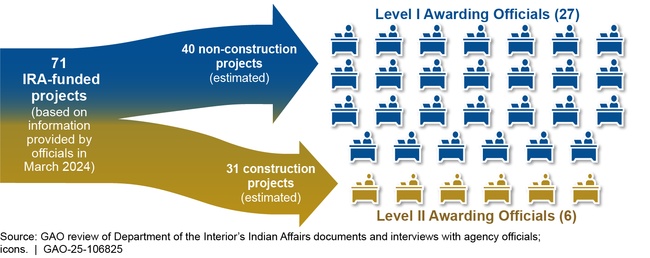
The Inflation Reduction Act of 2022 (IRA) provided appropriations of about $385 million for new and existing programs that serve Tribes and their citizens. This additional funding has increased the workload for Indian Affairs components implementing IRA programs. Indian Affairs officials said that the workload and competing priorities strain the agency's already-limited workforce capacity. For example, new funding streams increased the workload of Awarding Officials, particularly since only six can approve more complex construction projects.
Increase in Inflation Reduction Act of 2022 (IRA) Workload Across Department of the Interior's Indian Affairs Awarding Officials
Staff in several components implementing the IRA have regularly worked additional hours per pay period to meet workload demands, based on GAO's analysis of workforce data, and most of the components GAO interviewed described significant vacancies.
The IRA appropriated $9.5 million for administrative costs to implement IRA programs that serve Tribes and their citizens, usable over the entire time period when these appropriations are available. Thus far, Indian Affairs has used these administrative funds—supplemented with baseline appropriations—to hire additional staff and contractors. However, Indian Affairs has not yet documented lessons learned from its use of these funds to meet the increased workload and the impact this had on other mission needs. Documenting this information could help Indian Affairs prepare for future administrative costs. In addition, Congress could use this information to help inform decisions about future appropriations.
Indian Affairs identified opportunities to improve its capacity through, for example, training and streamlining hiring. However, efficiency challenges—such as lack of written guidance for recruitment and burdensome hiring processes—limit its capacity, and officials said that budget uncertainty impedes sustained investment in capacity-building efforts. Indian Affairs has not identified the resources it needs to pursue capacity-building opportunities. Developing a proposal for Department of the Interior or Congress that identifies these needs could help Indian Affairs improve its capacity and capitalize on legislative opportunities to ensure the agency has the resources it needs to effectively provide essential services to Tribes and their citizens.
Why GAO Did This Study
Indian Affairs provides services directly to Tribes or funding for tribally administered programs, including support for tribal government operations, law enforcement, natural resource management, and climate preparedness and resilience. GAO has previously reported on lessons learned from Indian Affairs' implementation of major legislation and long-standing challenges with the agency's capacity to manage programs that serve Tribes.
The IRA includes a provision for GAO to oversee distribution and use of IRA funds. This report examines how IRA implementation has affected Indian Affairs' capacity, actions the agency has taken to improve capacity that could help meet IRA workload, and opportunities to improve Indian Affairs' capacity.
GAO reviewed relevant laws, agency documents, and agency data. GAO interviewed federal officials, federal tribal advisory groups, and tribal organizations selected based on knowledge of Indian Affairs' work with Tribes.
Recommendations
GAO recommends that Congress, when authorizing funds for Indian Affairs' administrative costs, consider lessons learned from Indian Affairs' use of IRA funds to help determine amounts for future program implementation. GAO is also making six recommendations to Indian Affairs, including that it develops the lessons learned, and a proposal for opportunities to improve capacity and the resources needed to pursue them. Indian Affairs agreed with GAO's recommendations.
Matter for Congressional Consideration
| Matter | Status | Comments |
|---|---|---|
| Congress should consider, when appropriating funds for Indian Affairs' administrative costs outside of baseline appropriations, the lessons learned from Indian Affairs on the agency's prior use of IRA funds and additional use of baseline appropriations for IRA administrative expenses, to help determine the amount needed for program implementation. (Matter for Consideration 1) | As of February 2026, Congress has not passed legislation that would implement this matter, and we were unable to identify any bills in the 119th Congress responsive to this matter. |
Recommendations for Executive Action
| Agency Affected | Recommendation | Status |
|---|---|---|
| Bureau of Indian Affairs | The Assistant Secretary for Indian Affairs should, by March 2027, collect lessons learned regarding the use and sufficiency of funds for administrative costs associated with legislation that provides funds for Tribes outside of baseline appropriations and share these lessons with Interior and Congress. (Recommendation 1) |
Interior agreed with this recommendation. In May 2025, Interior stated that it will take steps to collect lessons learned by March 2027. We will continue to monitor Interior's progress and update the status, as appropriate.
|
| Bureau of Indian Affairs | The Assistant Secretary for Indian Affairs should track vacancy data across Indian Affairs in a systematic and centralized manner. (Recommendation 2) |
Interior agreed with this recommendation. In a December 2025 memorandum, which we reviewed, Interior summarized how Indian Affairs implemented a centralized database to systematically capture vacancy data across Bureau of Indian Affairs and Assistant Secretary for Indian Affairs programs. The system records key position attributes such as series, grade, title, and other relevant data points. We reviewed screenshots of the database which demonstrated what data was collected across Indian Affairs. Interior stated that this centralized approach improves visibility into staffing needs across the organization and enables leadership to identify critical gaps in workforce coverage. These actions meet the intent of our recommendation, and we consider it closed.
|
| Bureau of Indian Affairs |
Priority Rec.
The Assistant Secretary for Indian Affairs should identify skills, knowledge, and competency gaps in mission-critical occupations across Indian Affairs. (Recommendation 3) |
Interior agreed with this recommendation. In May 2025, Interior stated that it will take steps to identify competency gaps in mission critical occupations across Indian Affairs. We will continue to monitor Interior's progress and update the status, as appropriate.
|
| Bureau of Indian Affairs | The Assistant Secretary for Indian Affairs should develop consolidated written guidance that clarifies what hiring authorities, recruitment incentives, and workforce flexibilities can be leveraged for recruitment and retention purposes. (Recommendation 4) |
Interior agreed with this recommendation. In a March 2026 memo, which we reviewed, Interior summarized how Indian Affairs developed and finalized a formal compliance document detailing the recruitment and retention tools available to supervisors. We reviewed the document, which provided guidance for supervisors and hiring managers on hiring authorities, recruitment incentives, and workforce flexibilities that support recruitment and retention. Interior stated that this document consolidates key federal and departmental policies into a single reference to support hiring managers. These actions meet the intent of our recommendation, and we consider it closed.
|
| Bureau of Indian Affairs | The Assistant Secretary for Indian Affairs should develop a proposal that identifies capacity-building opportunities and the resources necessary to pursue them and share the proposal with Interior for consideration. (Recommendation 5) |
Interior agreed with this recommendation. In May 2025, Interior stated that the Office of Human Capital Management has been working to use the lessons learned gathered in response to Recommendation 1 to develop a proposal that identifies capacity-building opportunities and the resources necessary to pursue them. We will continue to monitor Interior's progress and update the status, as appropriate.
|
| Bureau of Indian Affairs | The Assistant Secretary for Indian Affairs should develop a proposal that identifies legislative opportunities to build capacity and the resources necessary to pursue them and share the proposal with Congress for consideration. (Recommendation 6) |
Interior agreed with this recommendation. In May 2025, Interior stated that the Office of Human Capital Management is working to build metrics on the use of lessons learned gathered in response to Recommendation 1 and the Department's feedback obtained in response to Recommendation 5 to develop a proposal that identifies legislative opportunities to build capacity and the resources necessary to pursue them. We will continue to monitor Interior's progress and update the status, as appropriate.
|