
Ukraine: State and USAID Should Improve Processes for Ensuring Partners Can Perform Required Work
Fast Facts
Congress appropriated more than $174 billion to support Ukraine since the start of the war. State and the U.S. Agency for International Development awarded a portion of this for humanitarian and development projects supporting Ukraine's needs. These funds went to 111 partners in 197 awards.
We looked at how the agencies (1) screened potential partners' past performance before awarding funds and (2) monitored their partners' screening of sub-partners—e.g., contractors—in 28 of the awards. We found weaknesses in some processes State and USAID used, but USAID's processes were more robust.
Our recommendations address issues we found.
State Department Partner Training Ukrainian Anti-Corruption Officers

Highlights
What GAO Found
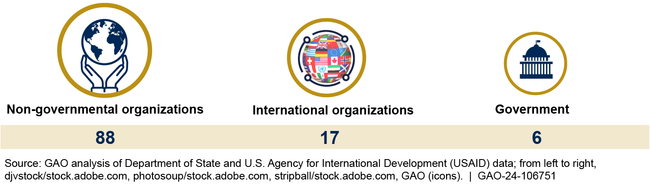
From the start of Russia's invasion of Ukraine through September 30, 2023, the Department of State and the U.S. Agency for International Development (USAID) had 111 implementing partners carrying out 197 awards that GAO defined as for Ukraine non-security assistance. About 80 percent of these partners were nongovernmental organizations (NGO), with U.S. NGOs implementing the largest number of these awards. Almost 70 percent of their 2,400 sub-partners were Ukrainian organizations with 36 sub-partners having also been primary implementing partners for Ukraine non-security assistance since the invasion.
State and USAID Implementing Partners by Category of Organization
For 26 of the 28 awards GAO reviewed in-depth, State and USAID reviewed potential partners' past performance. For the two awards GAO reviewed that were a certain type of agreement with international organizations, State did not screen for past performance. State policy does not require this screening. As a result, State has a higher risk of selecting partners for this type of agreement that may be excluded by the U.S. government from receiving an award or may not perform well in carrying out the needed assistance. For USAID's awards in the sample, USAID officials documented detailed information about applicants' past performance. In contrast, State did not record this level of detail because State does not require such detail to be documented. Detailed documentation could help other State officials understand the risks of using these partners to implement non-security assistance now and in the future.
While USAID routinely monitors its NGO implementing partners' screening of their sub-partners for past performance, it does not perform this monitoring for its international organization partners and State does not perform this monitoring for either type of partner. Without periodic monitoring of implementation, the agencies risk that partners may not have effectively screened sub-partners to help ensure they can implement assistance effectively.
Two USAID bureaus and many implementing partners reported challenges obtaining qualified partners to implement non-security assistance. According to the 106 respondents to GAO's survey of implementing partner representatives, challenges included obtaining sub-partners with human resource capacity and expertise in humanitarian assistance. Implementing partners experienced issues resulting from these challenges, such as a reduced ability to provide assistance in certain geographic areas. Survey respondents identified actions they have taken to address the challenges, such as building the capacity of sub-partners through training or guidance.
Why GAO Did This Study
Russia's invasion of Ukraine in February 2022 led to a significant humanitarian crisis. State and USAID have obligated at least $5.2 billion to support selected non-security humanitarian, stabilization, and development assistance in Ukraine and neighboring countries. Implementing partners play a key role in executing this assistance. State and USAID aim to select high performing partners to help ensure they perform the work required.
GAO was asked to review the agencies' use of partners since the invasion. This report examines (1) key characteristics of these partners, (2) agency reviews of past performance when selecting implementing partners, (3) agency monitoring of implementing partners' screening of sub-partners' past performance, and (4) any challenges agencies and implementing partners had obtaining partners.
GAO analyzed data for all 197 State and USAID awards, and reviewed award and past performance documents for a nongeneralizable sample of 28 of these awards against agency policy and internal control standards. GAO also surveyed partner representatives, conducted field work in Poland; and interviewed officials.
Recommendations
GAO is making five recommendations, including for State to screen all international organization partners for past performance, for State to improve its documentation of past performance reviews, and for State and USAID to monitor partners' screening of sub-partners for past performance. State and USAID concurred.
Recommendations for Executive Action
| Agency Affected | Recommendation | Status |
|---|---|---|
| Department of State | The Secretary of State should ensure that the Bureau of Administration, Office of the Procurement Executive establish a requirement in the Federal Assistance Directive for State award officials to conduct a verification search in the System for Award Management and screen international organizations for past performance and exclusions when selecting them for Circular-175 letters of agreement. (Recommendation 1) |
State concurred with the recommendation. In response to the recommendation, the Bureau of Administration, Office of Global Acquisition, formerly the Office of the Procurement Executive, added language to the Federal Assistance Directive. The new language clarifies that award officials must check for exclusions and past performance records in the System for Award Management for implementing partners of a grant or cooperative agreement that is sub-obligated from an initial Circular-175 letter of agreement with an international organization if the award is over $250,000. However, as of August 2025, the revisions to the Federal Assistance Directive do not require award officials to conduct a verification search in the System for Award Management and screen the international organization implementing partner for exclusions and past performance when the international organization is selected for the initial Circular-175 letter of agreement. Without requiring the screening of potential international organization implementing partners for U.S. federal suspensions and debarments or for past performance when selecting them for these types of agreements, award officials have a higher risk of selecting implementing partners that may be excluded from receiving federal awards or may not perform well in carrying out the needed assistance under these types of agreements.
|
| Department of State | The Secretary of State should ensure that the Bureau of Administration, Office of the Procurement Executive require award officials to include in the award file detailed documentation of the sources and assessments of past performance information that inform officials' decisions prior to approving implementing partners for awards. (Recommendation 2) |
The Department of State's Bureau of Administration, Global Acquisition issued policy guidance on June 18, 2025, to update the form used to document the required risk assessment for all awards. According to the policy guidance, the bureau updated the form to ensure that the risk assessment provides adequate documentation of award officials' review and analysis of the potential implementing partner's past performance. The updated form adds a field for award officials to document the sources they reviewed and their assessments of past performance information before approving implementing partners for awards. For example, the updated risk assessment form asks award officials to document their review of any audits, program and project evaluations, previous award files, monitoring and evaluation reports, or previous grant officer assessments of the potential implementing partner, and how this information informed the risk assessment. The updated form also asks award officials to document any additional information regarding the risk assessment of the potential implementing partner. In addition, for awards more than $250,000, the updated form requires award officials to describe any related information found in the responsibility and qualification integrity record in the System for Award Management and document how this information informed the risk assessment. Documenting this information allows it to be shared with other officials to inform them about any past performance issues or any risks posed by the potential implementing partner in meeting the intended purpose of the award when making decisions about selection and award implementation.
|
| Department of State |
Priority Rec.
The Secretary of State should ensure that the Bureau of Administration, Office of the Procurement Executive establish a requirement in the Federal Assistance Directive for State award officials to periodically monitor the implementation of non-governmental organization implementing partners' procedures for screening sub-partners for past performance when selecting them for sub-awards. (Recommendation 3) |
On June 17, 2025, the Department of State's Bureau of Administration, Global Acquisition updated the policy on monitoring requirements for the Federal Assistance Directive to clarify how often award officials are required to monitor non-governmental organization (NGO) implementing partners' procedures for the selection of sub-partners and the steps that award officials can take to meet these requirements. For example, the policy notes that award officials' monitoring of implementing partners should include confirming that the implementing partner is following its own procedures for screening sub-partners for sub-awards, and that the implementing partner is properly monitoring and reporting on sub-awards. The policy states that such monitoring may include, but is not limited to, reviewing the implementing partner's policy and procedures in the pre-award phase, reviewing the implementing partner's documentation of the sub-partner selection process during a post-award site visit, or conducting periodic sampling of the implementing partner's records related to sub-partner screening and selection. The policy further states that award official's monitoring of an implementing partner's compliance with its procedures for screening for past performance when selecting sub-awards should be conducted annually and upon issuance of any cost amendments. In addition, the policy states that when award officials complete the monitoring plan for an award, they are to document plans for monitoring the implementing partner's policies and procedures for selecting and screening sub-partners and the implementing partner's implementation of these policies and procedures. Such monitoring should help verify that NGO implementing partners have screened their sub-partners comprehensively to ensure they will be effective at fulfilling all the requirements and obligations of their sub-awards.
|
| Department of State |
Priority Rec.
The Secretary of State should ensure that the Bureau of Administration, Office of the Procurement Executive establish a requirement in the Federal Assistance Directive for State award officials to periodically monitor the implementation of international organization implementing partners' procedures for screening sub-partners for past performance when selecting them for sub-awards. (Recommendation 4) |
On June 17, 2025, the Department of State's Bureau of Administration, Global Acquisition updated the policy on monitoring requirements for the Federal Assistance Directive to clarify how often award officials are required to monitor implementing partners' procedures for screening sub-partners for past performance when selecting them for subawards and the steps that award officials can take to meet these requirements for all federal assistance awards. For example, the policy notes that award officials' monitoring of implementing partners should include confirming that the implementing partner is following its own procedures for screening sub-partners for sub-awards, and that the implementing partner is properly monitoring and reporting on sub-awards. The policy states that such monitoring may include, but is not limited to, reviewing the implementing partner's policy and procedures in the pre-award phase, reviewing the implementing partner's documentation of the sub-partner selection process during a post-award site visit, or conducting periodic sampling of the implementing partner's records related to sub-partner screening and selection. The policy further states that award official's monitoring of an implementing partner's compliance with its procedures for screening for past performance when selecting sub-awards should be conducted annually and upon issuance of any cost amendments. In addition, the policy states that when award officials complete the monitoring plan for an award, they are to document plans for monitoring the implementing partner's policies and procedures for selecting and screening sub-partners and the implementing partner's implementation of these policies and procedures, where applicable. Such monitoring should help verify that international organization implementing partners have screened their sub-partners comprehensively to ensure they will be effective at fulfilling all the requirements and obligations of their sub-awards.
|
| U.S. Agency for International Development | The Administrator of USAID should ensure that the Office of the General Counsel and the Bureau for Planning, Learning, and Resource Management establish a requirement in USAID's operational policy for USAID award officials to periodically monitor the implementation of public international organization implementing partners' procedures for screening sub-partners for past performance when selecting them for sub-awards. (Recommendation 5) |
In October 2024, USAID established updated policy guidance on the organizational capacity review (OCR) processes for its international organization implementing partners. The updated guidance applied to OCRs finalized in April 2025. All OCRs finalized after this date are required to include a discussion of the international organization's policies pertaining to sub-partners. OCRs, which are updated every five years, provide for a review of the international organization's procurement policies, including the quality of its policies for evaluating past performance, in accordance with USAID's operational policy. USAID's updated guidance for the preparation of OCRs requires a discussion of the transparency and quality of the international organization partner's publicly available policies pertaining to sub-partners, including consideration of any relevant information regarding the international organization's performance and adherence to such policies. Award officials will update these discussions of the international organization's policies pertaining to sub-partners as part of the overall OCR review process every five years, according to officials. Monitoring international organizations' performance and adherence to their policies pertaining to sub-partners helps verify that international organization implementing partners have screened their sub-partners comprehensively, thereby helping to ensure that these sub-partners will be effective at fulfilling all the requirements and obligations of their sub-awards.
|