
Nuclear Waste Cleanup: More Effective Oversight Is Needed to Help Ensure Better Project Outcomes
Fast Facts
The Department of Energy is responsible for treating and disposing of waste from nuclear weapons production and energy research. Its projects for building treatment facilities and demolishing old buildings have often been over budget and delayed.
DOE project management has been on our High Risk List since 1990.
We reviewed DOE oversight of 5 contracted projects. In the only project ahead of schedule and under budget, contractors maintained consistent, reliable project data in systems that oversight officials could use to find problems promptly.
We recommended ensuring contractors maintain good project data systems, and more.
Demolition Project at the Portsmouth site in Ohio

Highlights
What GAO Found
The Department of Energy (DOE) has a range of policies that seek to ensure it produces quality products and services, including capital asset projects. Further, DOE's Office of Environmental Management (EM) uses several tools to oversee quality assurance on its capital asset projects. These include sharing lessons learned and using contractor data to monitor project performance.
GAO reviewed five selected EM capital asset projects and found that for three projects with cost overruns and schedule delays, officials did not use certain quality assurance oversight processes as intended. For example, two projects did not have consistently compliant Earned Value Management Systems. These systems help measure cost and schedule performance and can alert officials to problems. Conversely, GAO found that one project that was performing ahead of schedule and under budget had a consistently compliant system.
Names and Locations of Selected Office of Environmental Management Capital Asset Projects
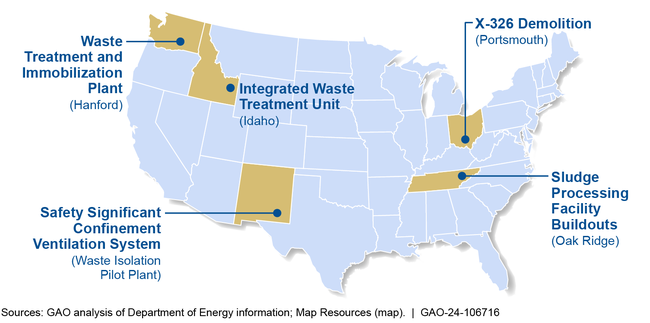
DOE has not always demonstrated a commitment to addressing the underlying causes of quality assurance issues to prevent recurrence. GAO found that EM does not consistently assess the effectiveness of its contractor oversight or identify root causes of project deficiencies related to EM's management. For example, in a 2021 root cause analysis, EM did not acknowledge its role in hiring an inexperienced contractor and not providing sufficient oversight. GAO also found that EM does not have guidance for assessing federal management performance or oversight effectiveness. By providing project review guidance for identifying management's role in project deficiencies and analyzing the effectiveness of federal oversight, DOE can help prevent recurring problems.
Further, many of EM's project reviews rely on contractors' Earned Value Management Systems data. However, DOE has allowed some contractors to operate their systems with deficiencies for years, which may result in undependable data. By holding contractors accountable for maintaining quality earned value management data, DOE will be better positioned to oversee contractor performance and ensure quality capital asset projects.
Why GAO Did This Study
EM is responsible for treatment and disposal of radioactive and hazardous waste generated in nuclear weapons production and energy research. One way EM fulfills its mission is through capital asset projects, which are generally executed by contractors. These projects include construction of new facilities to treat radioactive waste and demolition of old facilities. In the last decade, DOE's Office of Inspector General and GAO have reported on quality assurance issues on capital asset projects that have also had cost and schedule issues.
House Report 117-397 includes a provision for GAO to review EM's current quality assurance functions for capital asset projects. This report (1) describes how DOE and EM oversee quality assurance on these projects, (2) examines how use of oversight processes may have affected the performance of five selected EM projects, and (3) assesses DOE's actions to ensure quality assurance issues on EM capital asset projects do not recur. GAO reviewed DOE and EM oversight policies and project documentation for five capital asset projects ranging from $160 million to $18.5 billion in total estimated costs and interviewed DOE officials.
Recommendations
GAO is making four recommendations, including that (1) EM develop project review guidance for analyzing federal management performance and oversight effectiveness, and (2) DOE evaluate options to hold contractors accountable for maintaining compliant Earned Value Management Systems. DOE concurred with GAO's recommendations.
Recommendations for Executive Action
| Agency Affected | Recommendation | Status |
|---|---|---|
| Department of Energy | The Secretary of Energy should ensure that the Senior Advisor for the Office of Environmental Management develops or updates relevant guidance for conducting project reviews—including root cause analyses—for EM capital asset projects to include steps for analyzing federal management performance and oversight effectiveness. (Recommendation 1) |
As of September 2025, according to EM documentation, EM officials had written a new standard operating policy and procedure (SOPP) on root causes analysis and corrective action plans that standardizes the approach for conducting root cause analyses and corrective action plans to address cost overruns, schedule delays, and performance shortcomings. In our review of the SOPP, we found that the document itself does not include language about evaluating federal management performance and oversight effectiveness. However, one of the steps in the procedure directs evaluators to a causal analysis tree in the DOE standard on causal analysis, and the causal analysis tree includes options specific to management and oversight effectiveness. For example, one of the causal analysis options is, "management follow-up or monitoring of activities did not identify problems." In addition, EM reported they had revised the standard operating procedure on the project peer review process to include instructions to evaluate federal management performance and oversight effectiveness as well as performing an evaluation of the effectiveness of the corrective actions. In our review of the standard operating procedure, we found that there is language directing each project peer review to include an evaluation of federal line management oversight programs and functions.
|
| Department of Energy |
Priority Rec.
The Secretary of Energy should ensure that the Senior Advisor for the Office of Environmental Management works with the Director of the Office of Project Management to leverage existing mechanisms to hold applicable contractors accountable for maintaining a compliant EVMS, evaluate if additional mechanisms are needed to hold contractors accountable—such as withholding payment if an EVMS is not compliant—and, if necessary, request authority from Congress to use those mechanisms. (Recommendation 2) |
As of September 2025, according to EM documentation, EM officials had worked with the Director of the Office of Project Management to evaluate if additional mechanisms were needed to hold contractors accountable for maintaining a compliant EVMS. EM officials determined that its existing mechanisms were sufficient. For example, according to the documentation, EM officials compared the Contractor Business Systems clause it has used in its contracts with Defense Federal Acquisition Regulation and confirmed that EM's contracts applied identical requirements. The documentation also noted that EM officials reviewed and confirmed that either a "Withholding Payment" or a "Withholding Provisional Payment(s) of Fee" clause for significant deficiencies on contractors' business systems is included in current contracts for capital asset projects. In addition, EM officials reported that there is a mechanism during project peer reviews to identify contract issues. Officials noted that if a contract issue is identified during the review, it is documented and becomes a corrective action for the federal project director to resolve. In our review of the standard operating procedure and policy (SOPP) on project peer reviews, we found that the SOPP makes several suggestions that would result in reviewing a project's contract management as well as its EVMS. For example, one of the potential lines of inquiry listed in the SOPP is contracts and acquisitions and another is project controls and EVMS. However, DOE has not yet provided information on how they are leveraging existing mechanisms to hold current contractors accountable. We will continue to monitor progress on this recommendation.
|
| Department of Energy | The Secretary of Energy should ensure that the Senior Advisor for the Office of Environmental Management evaluates how EM capital asset project officials develop and use lessons learned to determine if new lessons learned are being adequately documented and existing lessons learned are being adequately reviewed, analyzed, and applied, or if further guidance is needed. (Recommendation 3) |
As of September 2025, according to EM documentation, EM officials had revised the standard operating policy and procedure (SOPP) on the project peer review process. In our review of the SOPP, we found a requirement for the project peer review team to assess if the federal project director is continually looking for lessons learned and incorporating them into the project as applicable. These revisions will address the portion of the recommendation to evaluate if existing lessons learned are being used adequately. EM officials also noted that there are questions in the charge memo sample to evaluate if there are lessons learned with department-wide implications and, if there are, to evaluate if they are recorded as required. However, as this is a sample memo, it is not clear to us if these questions are a requirement for all project peer reviews. Therefore, this action does not fully meet the intent of the recommendation to determine if new lessons learned are being adequately documented. In addition, there is no language that addresses the portion of the recommendation to evaluate if additional guidance is needed. We will continue to monitor implementation of this recommendation.
|
| Department of Energy | The Senior Advisor for the Office of Environmental Management should ensure that the Director of EM's Office of Project Management develops a process to determine if EM capital asset projects that meet certain criteria—such as those that are particularly high risk or complex—need additional proactive federal oversight from the beginning of the project's lifecycle. (Recommendation 4) |
As of September 2025, according to EM documentation, EM officials had updated the standard operating policy and procedure (SOPP) on capital asset project critical decision and baseline change proposal approval processes, which now includes a process to determine if EM capital asset projects need additional federal oversight, had been approved. In our review of the SOPP, we found that the update includes clarification of the types of projects that are more likely to need additional oversight as well as information on what that additional oversight will be. It also notes that additional oversight requirements can be triggered by concerns noted during the initial review of the first critical decision package. This update largely addresses the intent of our recommendation. However, this language is included as the "background" section of the SOPP and is not referred to throughout the rest of the document. Therefore, it is unclear to us how these updates will be implemented. We will continue to monitor progress on this recommendation.
|