
Justice40: Additional Efforts Needed to Improve Tribal Applicants' Access to Federal Programs Under Environmental Justice Initiative
Fast Facts
Underserved communities, such as Tribes, face barriers to accessing federal funding—like cost-share requirements that require participants to contribute some funding up front.
The Justice40 Initiative aims to increase underserved communities' access to funding, with a goal of directing 40% of the benefits of covered federal programs to such communities. However, some Justice40 program requirements also create access barriers. For example, competitive grants can include significant administrative requirements that can be difficult to meet, especially for smaller tribal recipients.
We recommended that agencies address barriers to program access.
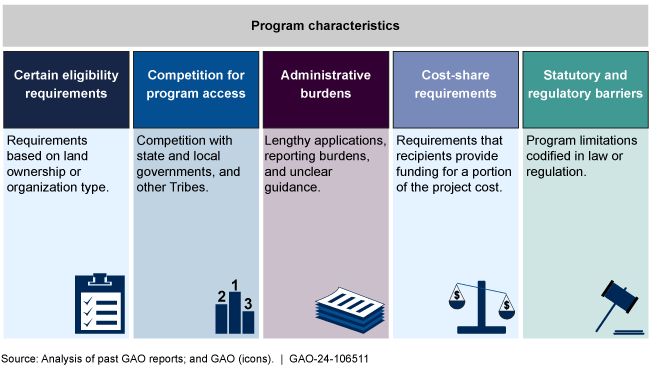
Examples of Historic Barriers to Tribal Participation in Federal Programs
Highlights
What GAO Found
The Justice40 Initiative is the administration's goal for 40 percent of the overall benefits of certain federal investments to flow to disadvantaged communities. GAO reviewed six Justice40 programs in three selected agencies—the Environmental Protection Agency (EPA), Federal Emergency Management Agency (FEMA), and U.S. Department of Agriculture (USDA). GAO found that each agency adjusted program mechanisms to increase access to funding for underserved communities, including Tribes and eligible Indigenous communities (tribal applicants), in response to the Justice40 Initiative as well as other agency initiatives.
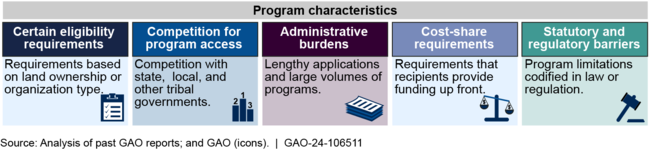
However, certain program characteristics create barriers to tribal applicants' ability to access selected covered Justice40 programs, including cost shares, administrative burdens, and certain statutory and regulatory requirements. For example, EPA has a mechanism to reduce administrative burdens for recipients by combining funds from multiple grants into a single budget. Agency officials told GAO that grants funded by the Infrastructure Investment and Jobs Act and Inflation Reduction Act are not eligible for this mechanism. Agencies have taken actions to identify statutory and regulatory barriers to access for tribal recipients. Additional actions to document and discuss these barriers with affected stakeholders to determine any additional statutory and regulatory changes needed could help tribal applicants more readily access covered programs, consistent with the Justice40 goal and executive orders.
Examples of Historic Barriers to Tribes' Access to Federal Programs
Selected agencies consulted with Tribes on new programs, funding opportunities, and related topics, such as equity assessments. However, the extent to which these efforts informed agency implementation of Justice40 is unclear because the agencies generally did not make related consultation results publicly available. Consistent with executive orders and presidential memoranda, considering publicly sharing high-level consultation summaries could help ensure Tribes have access to information about prior tribal input on federal programs. In turn, this information could inform Tribes' future input on Justice40 and reduce their administrative burdens. Additionally, GAO's review of the selected agencies' online consultation tracking systems and interviews with agency officials found that the agencies did not consult with Tribes specifically about the Justice40 Initiative. Interim implementation guidance directs agencies to consult with stakeholders, including Tribes, when determining Justice40 covered program benefits. Agencies have additional opportunities to consult with Tribes and conduct outreach on Justice40 implementation to ensure meaningful input.
Why GAO Did This Study
Underserved communities—including federally recognized Tribes and other historically marginalized people—experience a disproportionate share of adverse socioeconomic and environmental conditions, according to GAO's prior work. Executive Order 14008 established the Justice40 Initiative with the goal of delivering to disadvantaged communities 40 percent of the overall benefits of certain federal investments. In determining Justice40 benefits, guidance directed agencies to consult with Tribes and other stakeholders to ensure meaningful involvement.
GAO was asked to review agencies' implementation of the Justice40 Initiative with respect to tribal applicants. This report reviews the actions selected agencies took to (1) adjust programs to direct funding to tribal recipients, and (2) consult with Tribes and conduct outreach to Indigenous communities regarding the initiative. GAO examined laws, executive orders, presidential memoranda, guidance, and policies; and interviewed officials from three selected agencies, leadership from six Tribes, and representatives from seven tribal organizations. GAO selected a mix of agencies and programs based on tribal participation, funding mechanisms, and types of programs.
Recommendations
GAO is making a total of nine recommendations, including that EPA, FEMA, and USDA should document and address legislative and regulatory barriers, and conduct consultation and outreach about Justice40. The three agencies agreed with the recommendations.
Recommendations for Executive Action
| Agency Affected | Recommendation | Status |
|---|---|---|
| Environmental Protection Agency | The Administrator of EPA should ensure that the program offices of EPA Justice40 covered programs document previously identified statutory and regulatory barriers to access for tribal applicants informing their implementation of the Justice40 Initiative. As a part of this process, the agency should—with input from Tribes—identify any additional changes necessary to address remaining statutory and regulatory barriers, recommending legislative changes where the agency determines appropriate. The agency should make a summary of the results of this process publicly available. (Recommendation 1) |
As of December 2024, EPA had planned to take the following steps to implement this recommendation: (1) update its Equity Action Plan, to document significant barriers facing underserved communities, including Tribes, and actions to address them; (2) conduct tribal consultation on Justice40 covered programs to provide feedback on EPA-identified barriers; and (3) work with the White House Council on Native American Affairs in its implementation of E.O. 14112, "Reforming Federal Funding and Support for Tribal Nations To Better Embrace Our Trust Responsibilities and Promote the Next Era of Tribal Self-Determination," which has since been revoked. However, in January 2025, E.O. 14008, which established the Justice40 Initiative, was revoked, ending the initiative. Because the Justice40 Initiative was terminated, we are closing this recommendation as no longer valid.
|
| Federal Emergency Management Agency | The Administrator of FEMA should ensure that program offices of FEMA Justice40 covered programs document previously identified statutory and regulatory barriers to access for tribal applicants informing their implementation of the Justice40 Initiative. As a part of this process, the agency should—with input from Tribes—identify any additional changes necessary to address remaining statutory and regulatory barriers, recommending legislative changes where the agency determines appropriate. The agency should make a summary of the results of this process publicly available. (Recommendation 2) |
As of January 2025, FEMA had taken steps to implement this recommendation by developing a draft tribal engagement plan. Specifically, the plan called for a series of formal consultations to identify barriers that Tribal Nations face when trying to access FEMA's Justice40 programs. However, in May 2025, FEMA officials stated that they would not take further action on this recommendation because E.O. 14008, which established the Justice40 Initiative, had been revoked. Because the Justice40 Initiative was terminated, we are closing this recommendation as no longer valid.
|
| Department of Agriculture | The Secretary of Agriculture should ensure that program offices of USDA Justice40 covered programs document previously identified statutory and regulatory barriers to access for tribal applicants informing their implementation of the Justice40 Initiative. As a part of this process, the agency should—with input from Tribes—identify any additional changes necessary to address remaining statutory and regulatory barriers, recommending legislative changes where the agency determines appropriate. The agency should make a summary of the results of this process publicly available. (Recommendation 3) |
As of June 2024, USDA had taken the following actions to implement this recommendation. USDA held consultation sessions in April 2024 to obtain input on its Justice40 covered programs. For these consultation sessions, USDA documented previously identified statutory and regulatory barriers to accessing its Rural Energy in America (REAP) and Environmental Quality Incentive (EQIP) programs and solicited tribal input on additional barriers. For example, one tribal participant noted the importance of recognizing the full range of entities owned and operated by tribal governments as eligible applicants to USDA programs to the greatest extent possible. USDA also conducted follow-up after the consultation sessions, such as by meeting in person with Tribal Conservation Advisory Councils to develop strategies for addressing tribal input on barriers accessing EQIP, according to USDA officials. Lastly, USDA posted high-level summaries of the input received to its website. As a result of these actions, we believe USDA has met the intent of this recommendation and we are closing it as implemented.
|
| Environmental Protection Agency | The Administrator of EPA should ensure that program offices implementing Justice40 covered programs maintain records of related consultations with Tribes and consider—with tribal input—publicly sharing a high-level summary of consultation results, as appropriate, to improve tribal applicants' access to information about tribal input on federal programs and decrease the burden on Tribes and eligible Indigenous communities. (Recommendation 4) |
As of December 2024, EPA had stated that it would maintain records of its consultations in accordance with federal policy and guidance and would create a public, high-level summary of tribal input received during its planned Tribal consultations on Justice40 covered programs. However, in January 2025, E.O. 14008, which established the Justice40 Initiative, was revoked, ending the initiative. Because the Justice40 Initiative was terminated, we are closing this recommendation as no longer valid.
|
| Federal Emergency Management Agency | The Administrator of FEMA should ensure that program offices implementing Justice40 covered programs maintain records of related consultations with Tribes and consider—with tribal input—publicly sharing a high-level summary of consultation results, as appropriate, to improve tribal applicants' access to information about tribal input on federal programs and decrease the burden on Tribes and eligible Indigenous communities. (Recommendation 5) |
As of January 2025, FEMA officials had taken steps to implement this recommendation by developing a draft tribal engagement plan and committing to ensure feedback received during tribal consultations would be shared publicly, as appropriate. Specifically, FEMA's Hazard Mitigation Division was working with FEMA's Tribal Affairs Branch to determine what information should be shared, how it would be shared, and at what frequency. However, in May 2025, FEMA officials stated that they would not take further action on this recommendation because E.O. 14008, which established the Justice40 Initiative, had been revoked. Because the Justice40 Initiative was terminated, we are closing this recommendation as no longer valid.
|
| Department of Agriculture | The Secretary of the USDA should ensure that program offices implementing Justice40 covered programs maintain records of related consultations with Tribes and consider—with tribal input—publicly sharing a high-level summary of consultation results, as appropriate, to improve tribal applicants' access to information about tribal input on federal programs and decrease the burden on Tribes and eligible Indigenous communities. (Recommendation 6) |
As of June 2024, USDA had taken the following actions to implement this recommendation. USDA held tribal consultation sessions in April 2024 to obtain input on barriers to accessing its Justice40 covered programs. For these consultation sessions, USDA summarized prior tribal input and agency responses in framing papers and made them publicly available prior to the consultations. Additionally, following the consultation sessions, USDA posted high-level summaries of the input received to its public website. As a result of these actions, we believe USDA has met the intent of this recommendation and we are closing it as implemented.
|
| Environmental Protection Agency | The Administrator of EPA should ensure that program offices consult with federally recognized Tribes and conduct outreach to eligible Indigenous communities to ensure meaningful involvement when determining benefits for Justice40 covered programs in accordance with EOP guidance and determine how to incorporate the input into future Justice40 implementation efforts. (Recommendation 7) |
As of December 2024, EPA had planned to take the following actions to implement this recommendation. First, EPA planned to conduct a tribal consultation on Justice40 covered programs in 2025 to solicit feedback on the benefits and implementation of Justice40. EPA planned to retain records from the tribal consultation and publicly share a high-level summary of tribal input on EPA's website. Second, EPA agreed that program offices should continue to conduct outreach on Justice40 and planned to include additional outreach to Indigenous communities as appropriate. However, in January 2025, E.O. 14008, which established the Justice40 Initiative, was revoked, ending the initiative. Because the Justice40 Initiative was terminated, we are closing this recommendation as no longer valid.
|
| Federal Emergency Management Agency | The Administrator of FEMA should ensure that program offices consult with federally recognized Tribes and conduct outreach to eligible Indigenous communities to ensure meaningful involvement when determining benefits for Justice40 covered programs in accordance with EOP guidance and determine how to incorporate the input into future Justice40 implementation efforts. (Recommendation 8) |
As of January 2025, FEMA officials had taken steps to implement this recommendation by developing a draft tribal engagement plan to ensure that FEMA was consulting with Tribal Nations and conducting outreach to Indigenous communities. Specifically, FEMA planned to use feedback from its consultations and outreach to inform future Justice40 funding goals. However, in May 2025, FEMA officials stated that they would not take further action on this recommendation because E.O. 14008, which established the Justice40 Initiative, had been revoked. Because the Justice40 Initiative was terminated, we are closing this recommendation as no longer valid.
|
| Department of Agriculture | The Secretary of the USDA should ensure that program offices consult with federally recognized Tribes and conduct outreach to eligible Indigenous communities to ensure meaningful involvement when determining benefits for Justice40 covered programs in accordance with EOP guidance and determine how to incorporate the input into future Justice40 implementation efforts. (Recommendation 9) |
As of June 2024, USDA had held tribal consultations in April 2024 on barriers to accessing its Justice40-covered programs. USDA officials committed to continuing to engage and consult with Tribes to understand the benefits they derived from USDA's Justice40 covered programs, promote equitable access to these benefits, and determine how to incorporate tribal input into future Justice40 implementation efforts. However, in January 2025, E.O. 14008, which established the Justice40 Initiative, was revoked, ending the initiative. Because the Justice40 Initiative was terminated, we are closing this recommendation as no longer valid.
|