
Tribal Food Security: Opportunities Exist to Address Challenges in Federal Nutrition Programs
Fast Facts
Food insecurity—not having regular access to healthy food—among American Indian/Alaska Native households is much greater than for all U.S. households. Unemployment, distance to grocery stores, and high prices are some barriers tribal communities face.
USDA's nutrition programs have helped address food availability and quality, but USDA could help states improve outreach to Tribes. Additional outreach could help people living in tribal communities be more aware of the programs and better understand their eligibility.
We made recommendations for congressional consideration and to USDA to better support tribal food security.
Highlights
What GAO Found
Food insecurity among American Indian/Alaska Native (AI/AN) households is significantly greater than for all U.S. households, according to recent data (see figure). Tribal representatives reported multiple challenges to food security, including economic barriers such as unemployment, distance to grocery stores, limited access to transportation and healthy food, and environmental factors like weather. Representatives of six of nine Tribes said the high cost of food and inflation were barriers to food security.
Estimated Percentage of Households that Experienced Food Insecurity in the Past 12 Months
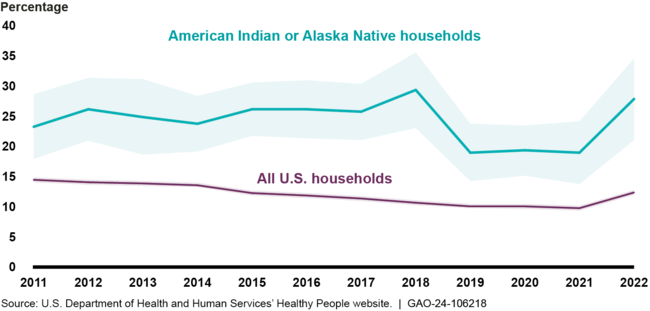
Note: Bold lines indicate estimates and shaded areas indicate their 95 percent confidence intervals. For more details, see fig. 2 in GAO-24-106218.
U.S. Department of Agriculture (USDA) nutrition programs have helped address tribal food security challenges such as food availability and quality, but obstacles remain. Implementing and overseeing programs can be challenging in tribal communities due to infrastructure challenges and staffing shortages. USDA offers flexibilities—such as allowing certain community members to certify households for food assistance, according to officials, or allowing waivers for certain program provisions—but selected Tribes continue to report challenges. Additional flexibilities such as streamlining administrative requirements could better position Tribes and states to meet the unique needs of tribal communities as they implement and oversee nutrition programs.
Among the USDA programs GAO reviewed, laws specifying Tribes' roles varied. Six of nine programs provide for tribal administration, but laws for three do not address a tribal role. Selected Tribes also reported challenges with state-administered programs, and laws for most of the nine programs do not require states to consult with Tribes on matters that affect them. Without addressing a tribal role, including requiring consultation, Tribes may lack the opportunity to provide input to states on nutrition programs that impact their citizens.
Why GAO Did This Study
AI/AN populations face significant challenges with food security—that is, having enough food at all times for an active, healthy life. Questions have been raised about whether federal nutrition programs meet tribal communities' unique needs.
GAO was asked to review issues related to tribal food security. This report examines AI/AN food insecurity rates and the food security challenges of tribal communities; the extent to which select federal nutrition programs address tribal communities' needs; and Tribes' role in administering the programs.
GAO interviewed a nongeneralizable group of Tribes and tribal organizations in seven states; state officials in three of these states; and relevant USDA officials. Tribes were selected to reflect regional diversity, food security factors such as rurality, and experience administering programs. GAO reported the most recent USDA data and reviewed relevant federal laws, regulations, and guidance.
Recommendations
Congress should consider addressing the role of Tribes in administering USDA nutrition programs, including specifying that states consult with Tribes when administering programs. GAO is also making six recommendations to USDA, including that it assess what additional flexibilities could support tribal food security for Tribes and states, and take steps to implement them.
USDA generally concurred with our recommendations, as discussed in the report.
Matter for Congressional Consideration
| Matter | Status | Comments |
|---|---|---|
| Congress should consider explicitly addressing in statute the role of Tribes in the administration of Food and Nutrition Service nutrition assistance programs, including specifying that states consult with Tribes when administering nutrition programs in tribal communities. (Matter for Consideration 1) | As of February 2026, Congress has not enacted legislation to address this matter. Congress introduced H.R. 8467 in the 118th Congress, which included provisions to permit Tribes to enter into self-determination contracts to administer SNAP, authorize a demonstration project where Tribes can enter into self-determination projects for the commodity supplemental food program (CSFP), and require the USDA Secretary to consult with Indian Tribes to determine the process and eligibility criteria. In addition, proposed bill (S.3236) - The Increasing Tribal Input on Nutrition Act of 2025 - establishes additional federal-tribe consultation requirements for FDPIR and CSFP, and it encourages state-tribal consultation for CSFP. |
Recommendations for Executive Action
| Agency Affected | Recommendation | Status |
|---|---|---|
| Department of Agriculture | The Secretary of Agriculture should ensure that ERS includes available national-level American Indian/Alaska Native food security data in its flagship annual report on household food security. (Recommendation 1) |
USDA agreed with this recommendation. The agency noted that any inclusion of food security statistics for the American Indian/Alaska Native population would be dependent upon sample sizes and ensuring the statistics remain statistically reliable. Our report notes that USDA officials considered these estimates to be reliable at the national level and these estimates are already published on the United States Department of Health and Human Services' Healthy People website. We will monitor the agency's progress to implement this recommendation
|
| Department of Agriculture | The Secretary of Agriculture should ensure that FNS eliminates the use of visual observation as an allowable means to determine participant race and ethnicity for the Food Distribution Program on Indian Reservations, Commodity Supplemental Food Program, and Special Supplemental Nutrition Program for Women, Infants, and Children. (Recommendation 2) |
USDA concurred with the recommendation and published the Final Rule: SNAP - Revision of Civil Rights Data Collection Methods | Food and Nutrition Service (usda.gov) (88 FR 86563) which removed visual observation as an allowable practice, effective February 12, 2024. However, as of May 2025, USDA proposed to rescind the rule and FNS stated that it can no longer implement this recommendation as originally intended. Our report notes, however, that there are data reliability concerns using visual observation. Without removing the use of visual observation as a means to collect race and ethnicity data in CSFP, FDPIR, and WIC, the data FNS maintains for individuals participating in these programs may not accurately reflect their race and ethnicity. As a result, USDA cannot assess whether programs are effectively reaching potentially eligible beneficiaries, including American Indians and Alaska Natives.
|
| Department of Agriculture | The Secretary of Agriculture should ensure that FNS improves the verification process for confirming that applicants are not dually participating in the Food Distribution Program on Indian Reservations and the Supplemental Nutrition Assistance Program, per program requirements, so applicants can be enrolled in a timely fashion. For example, FNS could identify ways to facilitate appropriate communication and information sharing among relevant entities. (Recommendation 3) |
On May 14, 2025, FNS released a memorandum, Coordination between Supplemental Nutrition Assistance Program (SNAP) State Agencies and Food Distribution Program on Indian Reservations (FDPIR) Administering Agencies, (https://www.fns.usda.gov/snap/fdpir-coordination) to all FDPIR and SNAP administering agencies. The memo is intended to improve the dual participation check process between the programs. For example, FNS recommended SNAP and FDPIR agencies work together to explore the following actions: grant read-only access to their systems/databases; run a same-day dual participation check whenever needed; develop a shared portal that both agencies can use to verify participation; or establish another process that allows for timely checks and is mutually agreed upon by both agencies.
|
| Department of Agriculture | The Secretary of Agriculture should ensure that FNS studies the impact of the prohibition against dual participation in the Food Distribution Program on Indian Reservations and the Supplemental Nutrition Assistance Program, including any obstacles to food security posed by the process for switching from one program to another, and shares the results of the study with Congress. (Recommendation 4) |
USDA concurred with the recommendation and stated it intended to add a subset of new questions to an upcoming national FDPIR study to better understand how the administrative processes associated with participants switching between programs may lead to a lapse in program benefits. However, the national FDPIR study was terminated on February 19, 2025, according to USDA. GAO continues to believe this is an important area to study and that USDA consider alternative means to do so.
|
| Department of Agriculture | The Secretary of Agriculture should ensure that FNS systematically identifies gaps in outreach to tribal communities about FNS programs, determines how to best address those gaps, and takes appropriate steps. (Recommendation 5) |
USDA agreed with this recommendation. We will monitor the agency's progress to implement this recommendation.
|
| Department of Agriculture | The Secretary of Agriculture should ensure that FNS assesses the need for any additional flexibilities in its programs' administrative requirements that could further support tribal food security and any necessary adjustments to support existing flexibilities, and then implements those changes. (Recommendation 6) |
In October 2024, USDA published its final rule, Food Distribution Programs: Improving Access and Parity, to make access and parity improvements in USDA's food distribution programs to support access for eligible populations and streamline requirements for program operators. According to USDA, FNS continues to work on the Child Nutrition Tribal Pilot Projects, including drafting the Request for Application (RFA). FNS is identifying statutory and regulatory changes, waivers, resources, a streamlined approach to oversight and program implementation, and special provisions that can be included in the RFA. However, as of January 15, 2026, this RFA has not yet been released.
|