
Defense Health Care: Improved Monitoring Could Help Ensure Completion of Mandated Reforms
Fast Facts
Over the past 10 years, the Department of Defense has addressed 115 of 158 legally-required military health system reforms. For example, DOD created the TRICARE Select health plan—allowing beneficiaries to seek specialty care without referrals.
But DOD hasn't created a process to monitor its actions. Such a process would help DOD better oversee completion of the remaining requirements. This includes, for example, consolidating all military services' medical research and development under one new organization.
We recommended that DOD address this and other issues.

Highlights
What GAO Found
The National Defense Authorization Acts (NDAA) for fiscal year 2012 through 2022 contained 158 requirements—actions required for Department of Defense (DOD) to take—that GAO identified as reforms of the military health system. GAO placed each requirement into one of five reform categories.
DOD completed actions to address the majority (approximately 73 percent) of the requirements across the five categories (see figure).
Status of DOD Actions to Address NDAA Requirements
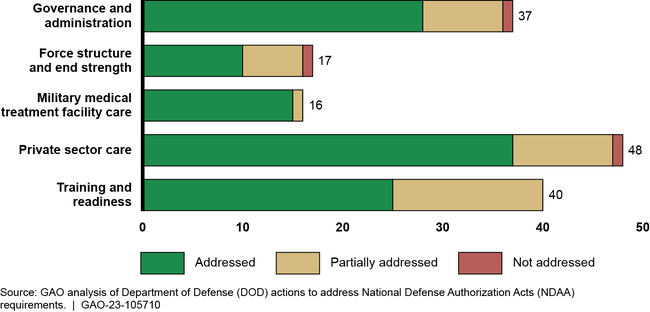
Note: GAO assigned each of the NDAAs' 158 requirements to a single category even when a requirement overlapped with another category. Four requirements were not counted because GAO could not determine DOD's past actions for various reasons, such as information posted online for a pilot program that ended.
Many of the requirements DOD addressed were from the NDAA for Fiscal Year 2017. For example, DOD established the TRICARE Select health plan (as required in section 701). Additional work remains for the department to complete actions to address the remaining requirements, which include several significant reforms. For example, GAO found that DOD partially addressed requirements from section 711 of the John S. McCain NDAA for Fiscal Year 2019 to establish public health and research and development organizations within the Defense Health Agency by September 30, 2022. As of April 2023, Defense Health Agency officials stated that the transfer of public health personnel was ongoing as DOD worked to complete Phase I of the transfer. Without finalizing implementation plans with timelines for completion and, although not required, providing them to Congress to improve oversight, DOD could be further delayed in addressing these requirements.
DOD has processes for delegating responsibility for addressing military health system reform requirements and identifying and tracking requirements for reports and briefings to Congress. However, DOD does not have a systematic process to comprehensively monitor actions to address reform requirements. By establishing such a process, DOD could improve oversight of its complex, multi-year reform initiatives, including performance of reforms in relation to the MHS goals of better health, better care, improved readiness, and lower costs.
Why GAO Did This Study
For the past decade, DOD has been taking actions to reform its health system. The military health system is a massive enterprise charged with maintaining a medically ready force and ready medical personnel. To achieve this mission, DOD estimated it will provide care to approximately 9.6 million beneficiaries at a cost of more than $55.8 billion in fiscal year 2023.
The NDAA for Fiscal Year 2022 includes a provision for GAO to study DOD's implementation of statutory requirements for military health system reform. This report examines (1) statutory requirements for reform of the military health system that GAO identified within each NDAA for fiscal years 2012 through 2022, and the extent to which DOD has (2) taken actions to address these requirements for military health system reform and assessed the effectiveness of certain reforms, and (3) monitored actions taken in response to the requirements. GAO analyzed NDAAs and DOD documentation, and interviewed DOD senior officials.
Recommendations
GAO is making four recommendations, including that DOD finalize implementation plans for the transfers of (1) public health and (2) research and development organizations, and establish a process to monitor actions taken to address statutory requirements for the military health system. DOD concurred with each of GAO's recommendations.
Recommendations for Executive Action
| Agency Affected | Recommendation | Status |
|---|---|---|
| Department of Defense | The Secretary of Defense should ensure that the Secretary of the Air Force, in coordination with the Surgeon General of the Air Force and the Director of the DHA, completes a briefing to the House and Senate Armed Services Committees regarding the previous elimination of inpatient capabilities from its MTF at Aviano Air Force Base. (Recommendation 1) |
DOD concurred with this recommendation. The Air Force transmitted a report to the congressional committees in June 2023 explaining its transition of the MTF at Aviano Air Force Base to an outpatient clinic.
|
| Department of Defense | The Secretary of Defense should ensure that the Director of the DHA, in coordination with the Surgeons General of the military departments, completes an implementation plan with related timelines for the remaining phases of the public health transfer and provides the plan to Congress. (Recommendation 2) |
DOD concurred with this recommendation. According to DOD, in November 2023, the department was in the process of determining remaining phases of the public health transfer, including what functions the military departments will retain. DOD expected to complete its implementation plan by the end of fiscal year 2024. In January 2025, the Deputy Secretary of Defense issued a memorandum for senior DOD leaders announcing that DHA established Public Health as a subordinate organization by transferring the authority, direction, and control from the military departments for elements of their public health centers and programs--that is, the Army Public Health Center, the Navy and Marine Corps Public Health Center, and Air Force public health programs. The memorandum also specified other public health functions of the military departments that would not transfer to DHA, and in February 2025 DOD provided a briefing to Congress outlining these decisions. As of May 2026, other than the memorandum and related briefing to Congress, DOD had not yet provided evidence of the steps taken in its implementation of public health transfers. Specifically, DOD had not provided evidence of when and if the transfers of all relevant personnel, property, and systems from military departments to DHA were completed. We will update the status of this recommendation when DOD provides additional information.
|
| Department of Defense | The Secretary of Defense should ensure that the Director of the DHA, in coordination with the Surgeons General of the military departments, completes an implementation plan with related timelines for the transfer of research and development, and provides the plan to Congress. (Recommendation 3) |
DOD concurred with this recommendation. As of January 2025, the department was finalizing an updated implementation plan and expected to complete it by April 2025. In a July 2025 update on the status of this recommendation, the department stated that its transition plan was rescinded and not briefed to Congress. Further, the update stated that DOD considered the transfer of research and development elements from the U.S. Army Medical Research and Development Command to DHA fully completed in December 2024. DOD provided evidence of steps taken to transfer functions, including associated civilian personnel, from the Army to DHA through 2024. DOD announced on February 28, 2025, through a memorandum from the Deputy Secretary of Defense to DOD leaders, that it would not transfer certain remaining research and development functions from the Army to DHA. Those functions included the U.S. Army Aeromedical Research Laboratory; the U.S. Army Research Institute of Environmental Medicine; the Program Management Office named Soldier Medical Devices; the U.S. Army Medical Research and Development Command Headquarters Key Enabler Support and Medical Research, Development, and Acquisition Integrator Cells; and operational medical logistics conducted by the U.S. Army Medical Logistics Command. As of May 2026, DOD had not provided evidence that information was provided to Congress about the research and development functions that have transferred to DHA and those functions that will not transfer to DHA from the Army. We will updated the status of this recommendation when additional information is available from DOD.
|
| Department of Defense | The Secretary of Defense should ensure that the Assistant Secretary of Defense for Health Affairs establishes a systematic process to comprehensively monitor the actions taken to address statutory requirements for the MHS, and incorporates the information in its MHS evaluation activities. The process could include consolidating in a single data source the responsible leaders, actions taken, and time frames. (Recommendation 4) |
DOD concurred with this recommendation. According to DOD, in November 2023, the department planned to create a repository of information about all reforms directed since fiscal year 2017. DOD expected to complete the repository by January 2024 and incorporate the information into its existing Military Health System Review and Analysis evaluation process by March 2024. As of DOD's last update in December 2025, it had extended its timeframes for completing these two steps. Specifically DOD expected to create its repository (or "dashboard") for statutory reforms actions and populate it with information by September 2026, and to begin incorporating statutory reforms actions into its Review and Analysis evaluation process by May 2026. We will update the status of this recommendation when additional information is available from DOD.
|