
Special Operations Forces: Actions Needed to Improve Monitoring of Acquisitions
Fast Facts
The Department of Defense has a civilian-led office that oversees and advocates for U.S. Special Operations Forces acquisitions programs and ensures that programs are within budget. But there are concerns about whether officials from this office can perform their oversight duties.
We found that these officials can't effectively carry out the office's oversight responsibilities as they can't always get access to relevant program information or meetings. This makes it harder for them to ensure that acquisition programs are aligned with DOD priorities on budget and capabilities.
Our recommendation addresses this issue and others we found.
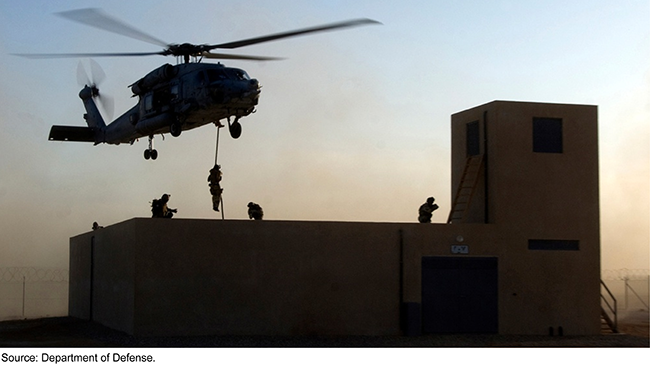
Special Operations Forces in the Levant Region, which includes Iraq, Syria, Egypt, and Lebanon
Highlights
What GAO Found
In 2016, Congress strengthened the role of an existing office within the Department of Defense (DOD) to oversee and advocate for training and equipping special operations forces assigned to the Special Operations Command (SOCOM). That office, the Assistant Secretary of Defense for Special Operations and Low-Intensity Conflict known as ASD(SO/LIC), is also responsible for determining whether acquisition programs are within budget.
ASD(SO/LIC) cannot effectively conduct program oversight, in part, because DOD policy has not fully enabled it to perform its acquisition-related responsibilities. For example, GAO found disagreement between ASD(SO/LIC) and SOCOM officials regarding the former’s access to some programs’ information and meetings. This resulted in ASD(SO/LIC) not getting information to help perform its responsibilities. Collaboration between ASD(SO/LIC) and SOCOM to document clear protocols for the former’s access to this information could enhance its ability to monitor acquisitions and fulfill its statutory role.
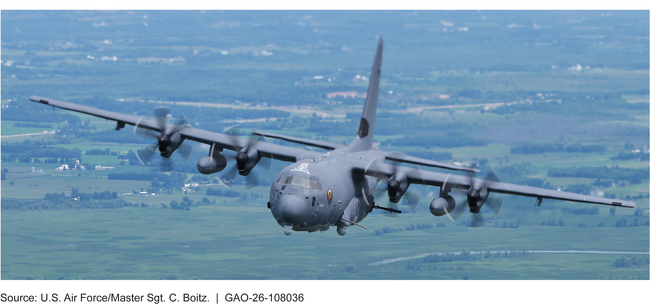
Example of a Special Operations Forces Acquisition: AC-130J
SOCOM reported mixed success meeting cost and schedule goals for its costliest acquisition programs. GAO found that, while one of nine selected programs reported cost growth, most reported delays, which can, over time, result in increased costs. SOCOM’s acquisition policy requires programs to report, in an online portal, current information—including cost estimates—relative to program goals. GAO found that officials for eight selected programs that must maintain such information did not do so, in part, because the command’s acquisition policy did not specify how frequently they needed to. Having ready access to current cost estimates in the portal could help support officials’ efforts to identify potential cost growth risks or opportunities to reallocate resources.
Most SOCOM programs GAO reviewed that experienced delays reported using fewer leading practices for iterative product development than programs not experiencing delays. Opportunities exist for programs to more consistently adopt these practices. By updating acquisition policy to reflect and encourage adoption of the practices, SOCOM could further improve its programs’ ability to achieve the speed and innovation needed to meet the needs of special operations forces.
Why GAO Did This Study
SOCOM is a relatively small organization within DOD, accounting for under 2 percent of the defense budget. SOCOM is responsible for preparing and equipping special operations forces.
A congressional committee report includes a provision for GAO to review ASD(SO/LIC)’s oversight of SOCOM acquisitions. This report examines (1) how ASD(SO/LIC) performs its acquisition oversight responsibilities and related challenges it faces, (2) the extent to which the costliest SOCOM weapons acquisition programs met cost and schedule goals, among other things, and (3) the extent to which these programs have taken steps to facilitate speed and innovation in product development.
GAO reviewed ASD(SO/LIC) responsibilities in statute and policy; analyzed documentation for nine, of over 80, of SOCOM’s costliest weapons acquisition programs, including cost and schedule data; assessed program efforts to adopt leading product development practices; and interviewed relevant officials.
Recommendations
GAO is making three recommendations, including that DOD ensure (1) ASD(SO/LIC) and SOCOM collaborate to document clear protocols that enable the performance of acquisition-related responsibilities; (2) SOCOM updates its acquisition policy to specify the frequency that program officials should update total cost estimates; and (3) SOCOM updates its acquisition policy to reflect and encourage adoption of leading product development practices. DOD concurred with the recommendations.
Recommendations for Executive Action
| Agency Affected | Recommendation | Status |
|---|---|---|
| Department of Defense | The Secretary of Defense should, as it fully institutionalizes the Assistant Secretary of Defense for Special Operations and Low-Intensity Conflict (ASD(SO/LIC)) in policy and guidance, ensure that ASD(SO/LIC) and the Commander of the U.S. Special Operations Command collaborate to document clear protocols that enable ASD(SO/LIC) to perform its acquisition-related responsibilities. Such protocols should address ASD(SO/LIC)'s participation in meetings and access to information related to acquisition programs. (Recommendation 1) |
When we confirm what actions the agency has taken in response to this recommendation, we will provide updated information.
|
| Department of Defense | The Secretary of Defense should ensure that the Commander of the U.S. Special Operations Command updates the Command's acquisition policy documents to specify the frequency and circumstances under which program officials should routinely update the total program cost estimates in the acquisition portal or equivalent systems. Such circumstances could include, for example, any time that cost estimates for an acquisition program have changed. (Recommendation 2) |
When we confirm what actions the agency has taken in response to this recommendation, we will provide updated information.
|
| Department of Defense | The Secretary of Defense should ensure that the Commander of U.S. Special Operations Command updates the Command's acquisition policy documents to reflect leading practices for iterative product development and encourage programs to more consistently adopt them to enhance speed and innovation. (Recommendation 3) |
When we confirm what actions the agency has taken in response to this recommendation, we will provide updated information.
|