
Supplemental Nutrition Assistance Program: Federal Actions Needed to Help Connect College Students with Benefits
Fast Facts
Nearly 25% of college students in 2020 reported limited or uncertain access to food. Despite being potentially eligible, most didn't receive Supplemental Nutritional Assistance Program (SNAP) benefits—formerly known as "food stamps"—which could help them pay for food.
A recent law gave the Department of Education authority to share students' Free Application for Federal Student Aid data with federal and state SNAP agencies to identify and help students who may be eligible for benefits.
But Education hasn't made a plan to start sharing this data—nor have states received guidance about this opportunity.
We recommended ways to address these issues.
Highlights
What GAO Found
The U.S. Department of Agriculture (USDA) and the Department of Education have taken some steps to connect college students with Supplemental Nutrition Assistance Program (SNAP) benefits to help them pay for food, but gaps in planning and execution remain. Effective July 2024, a new law gave Education authority to share students' Free Application for Federal Student Aid (FAFSA) data with USDA and state SNAP agencies to conduct student outreach and streamline benefit administration. However, according to officials, Education had not yet developed a plan to implement these complex data-sharing arrangements. This risks delays in students getting important information that could help them access benefits they are eligible for. Following the passage of this new law, Education began providing a notification about federal benefit programs for students who may be eligible for them. However, it has not evaluated its method for identifying potentially eligible students. According to GAO analysis of 2020 Education data, Education's method could miss an estimated 40 percent of potentially SNAP-eligible students.
USDA encouraged state SNAP agencies to enhance student outreach and enrollment assistance. However, USDA has not included important information about the use of SNAP data and other student data in its guidance to state SNAP agencies. These gaps in guidance have left states with questions about how to permissibly use and share students' data to help connect them with benefits.
Student Food Assistance at a College Basic Needs Center
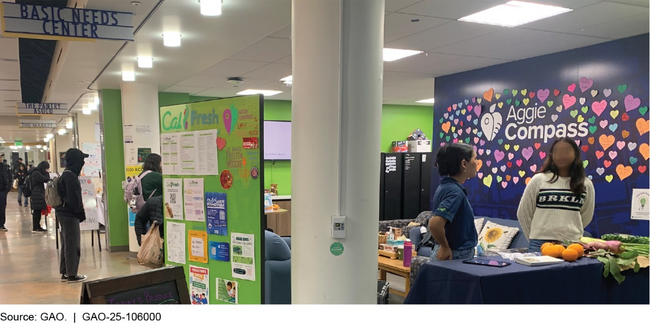
Officials from the three selected states and seven colleges GAO contacted described key strategies for communicating with students about their potential SNAP eligibility. These include using destigmatizing language, linking students directly to an application or support staff, and coordinating outreach efforts with SNAP agencies. Officials from the states and colleges GAO contacted said it is helpful to have staff available on campus to assist students with the SNAP application. Some colleges have found it helpful to partner with their respective SNAP agencies to obtain information on the status of students' applications.
Why GAO Did This Study
According to a national survey, almost one-quarter of college students were food insecure in 2020, yet GAO found many who were potentially eligible for SNAP had not received benefits. The substantial federal investment in higher education is at risk of not serving its intended purpose if students drop out because of limited or uncertain access to food. Studies have found using data to direct outreach to those potentially eligible can increase benefit uptake.
GAO was asked to review college student food insecurity. This report addresses (1) the extent to which Education and USDA have supported data use to help college students access SNAP benefits, and (2) how selected states and colleges have used student data to help connect students with SNAP benefits.
GAO reviewed relevant federal laws and agency documents. GAO also interviewed officials from Education, USDA, and national higher education and SNAP associations. GAO selected three states and interviewed officials from state SNAP and higher education agencies and seven colleges in these states. GAO visited one selected state in person and interviewed two virtually. States were selected based on actions to support food insecure students and stakeholder recommendations.
Recommendations
GAO is making five recommendations, including that Education develop a plan to implement FAFSA data-sharing and assess its benefit notification approach; and that USDA improve its SNAP agency guidance. The agencies neither agreed nor disagreed with these recommendations.
Recommendations for Executive Action
| Agency Affected | Recommendation | Status |
|---|---|---|
| Department of Education | The Secretary of Education should develop a written plan for implementing provisions in the FAFSA Simplification Act related to sharing FAFSA data with SNAP administrators, to aid in benefit outreach and enrollment assistance. (Recommendation 1) |
Education disagreed with this recommendation. In February 2026, Education stated that outreach efforts it and state agencies have taken to inform students of their potential SNAP eligibility exclusive of sharing FAFSA data are sufficient. Our report stated that Education officials intended to move forward with FAFSA data-sharing provisions included in the FAFSA Simplification Act but lacked a plan for doing so. Establishing a plan that defines objectives, includes what is to be achieved, who is to achieve it, how it is to be done, and the time frames for doing so, are particularly important given the complex, multi-step nature of this work. To close this recommendation Education should provide us with its plan for implementing FAFSA Simplification Act provisions related to sharing student's FAFSA data with SNAP administrators to aid in benefit outreach and enrollment assistance for potentially eligible college students.
|
| Department of Education | The Secretary of Education should, in consultation with USDA, evaluate its approach to identifying and notifying FAFSA applicants who are potentially eligible for SNAP benefits and adjust its approach as needed. (Recommendation 2) |
Education neither agreed nor disagreed with this recommendation. In February 2026, Education indicated that it had already taken action to email students about their potential SNAP eligibility. Our report acknowledged that Education and USDA's September 2024 memorandum of understanding included an agreement for Education to send annual emails to students who may be potentially eligible for SNAP benefits. However, Education has not taken action to evaluate its approach to identifying and notifying students of their potential eligibility for SNAP benefits that appear on students' FAFSA submission summary reports and the records that go to colleges and state higher education agencies. We continue to believe that Education should evaluate its approach for identifying students who receive this FAFSA notification and adjust their targeting of this notice, as needed. Once Education demonstrates that it has evaluated and potentially refined its approach, we will consider closing this recommendation.
|
| Department of Education | The Secretary of Education should inform colleges and state higher education agencies that FAFSA notifications are being sent to applicants who are potentially eligible for SNAP benefits. (Recommendation 3) |
Education neither agreed nor disagreed with this recommendation. In February 2026, Education stated that its existing student outreach efforts are sufficient to close this recommendation. Specifically, Education reported that it issued updated guidance in January 2025 that provides additional details about college student SNAP eligibility and colleges' use of FAFSA data to assist students in applying for benefits. However, this January 2025 guidance does not inform colleges and state higher education agencies that Education is sending notifications regarding potential SNAP eligibility directly to applicants on their FAFSA. While the actions outlined in Education's January 2025 guidance are related to the purpose of this recommendation, it has not yet specifically communicated information to colleges and state higher education agencies about the new SNAP eligibility notifications it provides to students. We will consider closing this recommendation once Education provides documentation confirming that such communication has taken place.
|
| Department of Agriculture | The Administrator of USDA's Food and Nutrition Service should, in consultation with Education, issue guidance to state SNAP agencies—such as in its SNAP outreach priority memo—to clarify permissible uses of student data, including FAFSA data, for SNAP outreach and enrollment assistance. (Recommendation 4) |
USDA did not comment on this recommendation. We will monitor the agency's efforts to address it.
|
| Department of Agriculture | The Administrator of USDA's Food and Nutrition Service should issue guidance to state SNAP agencies—such as in its SNAP outreach priority memo—to clarify the permissible uses and disclosure of SNAP data to support SNAP student outreach and enrollment assistance. (Recommendation 5) |
USDA did not comment on this recommendation. We will monitor the agency's efforts to address it.
|