
Human Trafficking: Agencies Need to Adopt a Systematic Approach to Manage Risks in Contracts
Fast Facts
Contractors that work with the government are prohibited from engaging in human trafficking. But allegations of trafficking persist, and the U.S. has said it's more pervasive than previously thought.
We looked at 4 agencies—DOD, State, DHS, and USAID—that spend a lot on contracts or may be at increased risk of using contractors who engage in human trafficking. These agencies have taken some steps to manage trafficking risks in their contracts, but none use a systematic approach that identifies, responds to, and communicates about risks and needed responses.
We recommended doing so to help ensure the government doesn't fund human trafficking.

Highlights
What GAO Found
Since 2000, Congress has increased requirements to prevent trafficking in federal contracting, but related trafficking allegations continue.
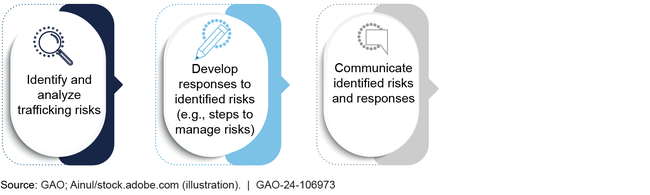
In response to a 2019 memorandum from the Office of Management and Budget (OMB), three of the four agencies in GAO's review—the Departments of Homeland Security (DHS), Defense (DOD), and State—have taken initial steps to identify trafficking risks in their contract spending. The U.S. Agency for International Development (USAID) did not conduct the analysis that OMB recommended. Further, none have taken a systematic approach to managing trafficking risks in contracting. This approach would include identifying and analyzing, developing responses to, and communicating the risks to contracting officials. Such an approach would better position agencies to support the U.S. policy of zero-tolerance for human trafficking.
Systematic Approach to Managing Trafficking Risks in Contracts
All four agencies communicated federal anti-trafficking requirements to contracting officials through training and guidance. Most contracting officials GAO spoke with had completed the training and were aware of how they should report trafficking violations. However, compliance with requirements was inconsistent. Nine of the 12 contracts in GAO's review did not meet one or more of the anti-trafficking requirements, such as obtaining a required anti-trafficking certification from contractors.
Further, agencies require certain contractors to develop an anti-trafficking compliance plan, but contracting officials are not required to request the plans. GAO found that four of the six plans provided by contractors did not meet all federal requirements for what must be included in a compliance plan. Reviewing implementation of, and compliance with, federal anti-trafficking requirements in contracts would help to assure agencies that contracting officials and contractors are fulfilling their responsibilities to prevent trafficking in federal contracts.
Suspension and debarment offices at all four agencies said they received no referrals of Inspector General-investigated trafficking allegations against recipients of contracts, grants, and cooperative agreements for fiscal years 2022 and 2023. The DOD Inspector General reported conducting investigations into trafficking allegations during this time. Contractors also reported taking actions against subcontractors that violated their anti-trafficking policies.
Why GAO Did This Study
U.S. laws prohibit federal contractors, subcontractors, grantees, and subgrantees from engaging in severe forms of human trafficking and trafficking-related activities.
Congress included a provision in statute for GAO to assess federal oversight of efforts to prevent trafficking for federally funded awards and to report violations. This report examines the extent to which DHS, DOD, State, and USAID (1) used a systematic approach to managing trafficking risks in contracting, and (2) communicated and met federal anti-trafficking requirements, as well as (3) how many referrals agency suspension and debarment officials received.
GAO reviewed a nongeneralizable sample of 12 contracts awarded in fiscal years 2022 and 2023 by the four agencies identified by OMB as having significant contract spending or heightened risk of trafficking. GAO reviewed the contract files for documentation related to federal and agency anti-trafficking requirements. GAO also reviewed relevant statutes, federal and agency regulations, guidance, and training, and interviewed OMB and agency officials.
Recommendations
GAO is making nine recommendations, including that the four agencies should each take continued actions to manage trafficking risks in government procurements, and review contracting officials' compliance with federal anti-trafficking requirements in contracts. The four agencies concurred with the recommendations.
Recommendations for Executive Action
| Agency Affected | Recommendation | Status |
|---|---|---|
| Department of Homeland Security | The Secretary of Homeland Security should ensure that the Chief Procurement Official, in consultation with agency trafficking experts, establishes a timeline for and implements a systematic approach to managing trafficking risks in procurements. This approach should include
(Recommendation 1) |
DHS agreed with our recommendation. DHS plans to assess a subset of high-risk contracts to inform its approach to managing trafficking risks in procurements. To support this effort, in June 2025, DHS developed a checklist with trafficking risk indicators that is to be used by contracting officers who have recently awarded or who are in the process of awarding contracts that meet the criteria for federal anti-trafficking requirements, which include performance outside the United States. If any items are checked, the contract or prospective contract should be referred to the DHS Contract Labor Advisor for additional review. However, as of August 2026, officials said there have not been any high-risk contracts. In the meantime, DHS's Office of the Chief Procurement Officer routinely reviews proposed contracting actions to help ensure that anti-trafficking requirements are addressed and, in July 2025 reached out to ensure that a contracting officer planned to incorporate the certification provision in the solicitation. We will continue to track DHS's implementation of this recommendation.
|
| Department of Defense | The Secretary of Defense should ensure that the Under Secretary of Defense for Acquisition and Sustainment, in consultation with agency trafficking experts, prioritizes developing and implementing a systematic approach to managing trafficking risks in procurements. This approach should include
(Recommendation 2) |
DOD agreed with our recommendation. In August 2026, DOD reported that it is evaluating the feasibility of using a pilot project with construction contracts to implement a systematic approach to address human trafficking risks. We will continue to track DOD's implementation of this recommendation.
|
| Department of State | The Secretary of State should ensure that the Deputy Assistant Secretary and Senior Procurement Executive, in consultation with agency trafficking experts, identifies a time frame to reevaluate whether the agency's responses to contracting-related trafficking risks are working and if the agency needs to do a broader risk assessment. (Recommendation 3) |
State agreed with our recommendation and has taken some actions to implement it. As of December 2025, State developed tools to help contracting officials identify and manage potential trafficking risks. In June 2026, State reported completing an initial review of contract files for adherence to anti-trafficking contracting requirements. State expects to complete another review in the third quarter for fiscal year 2026. State also plans to stand-up a team to assess its approach to managing trafficking risks in contracts and provide recommendations to leadership in the first quarter of fiscal year 2027. We will continue to track State's implementation of this recommendation.
|
| U.S. Agency for International Development | The Administrator of USAID should ensure that the Senior Procurement Executive, in consultation with agency trafficking experts, develops and implements a systematic approach to managing trafficking risks in procurements. This approach should include
(Recommendation 4) |
USAID agreed with our recommendation. In June 2024, the agency identified contract place of performance in "Tier 3" countries as at higher risk of trafficking activities and reported plans to update its guidance to contracting officials. For example, USAID said that it would require contracting officials to obtain anti-trafficking compliance plans if work is performed in Tier 3 countries. As of December 2025, USAID has not provided further information.
|
| Department of Homeland Security | The Secretary of Homeland Security should ensure that the Chief Procurement Officer ensures components conduct reviews of a subset of contracts to determine whether contracting officials implemented federal anti-trafficking requirements, including incorporating the certification provision in covered solicitations and obtaining contractor anti-trafficking certifications prior to award and annually thereafter. (Recommendation 5) |
DHS agreed with our recommendation. In September 2024, DHS revised its oversight checklist to incorporate anti-trafficking federal requirements for its fiscal year 2025 contract review. During fiscal year 2025, DHS reviewed a subset of contracts for three of its components and found that most selected contracts incorporated the required federal anti-trafficking requirements. However, similar to our reported findings, DHS found that some contracts did not include the anti-trafficking clause or documentation of the certification-related requirements. In August 2026, the agency reported communicating results of their review to components for awareness and to take appropriate action for missing requirements. In addition, DHS officials said they plan to include anti-trafficking requirements in their fiscal year 2027 component oversight reviews. These reviews provide DHS with important information about components' adherence to anti-trafficking requirements and whether additional actions are needed.
|
| Department of Defense | The Secretary of Defense should ensure that the Under Secretary of Defense for Acquisition and Sustainment ensures components conduct reviews of a subset of contracts to determine whether contracting officials have implemented federal anti-trafficking requirements, including incorporating the certification provision in covered solicitations and obtaining contractor anti-trafficking certifications prior to award and annually thereafter. (Recommendation 6) |
DOD agreed with our recommendation. In August 2026, the department reported that it plans to identify and review a set of contracts at high-risk of trafficking in persons to confirm whether anti-trafficking requirements, such as the inclusion of relevant contract clauses and submission of anti-trafficking certifications, have been completed. We will continue to track DOD's implementation of this recommendation.
|
| Department of State | The Secretary of State should ensure that the Deputy Assistant Secretary and Senior Procurement Executive assesses whether contracting officials obtained applicable annual contractor anti-trafficking certifications as part of the agency's review of its awarded contracts. (Recommendation 7) |
State agreed with our recommendation. As of June 2026, State completed an initial contract review and found continued gaps in adherence to anti-trafficking contract requirements. State plans to complete another review in the third quarter of fiscal year 2026 and determine whether existing policies and procedures should be updated. We will continue to track State's implementation of this recommendation.
|
| U.S. Agency for International Development | The Administrator of USAID should ensure that the Senior Procurement Executive reviews a subset of contracts to determine whether contracting officials have implemented federal anti-trafficking requirements, including incorporating the certification provision in covered solicitations and obtaining contractor anti-trafficking certifications prior to award and annually thereafter. (Recommendation 8) |
USAID agreed with our recommendation. In June 2024, the agency reported plans to review a subset of contracts for anti-trafficking requirements, such as contractor anti-trafficking certifications, and is considering additional monitoring efforts. As of December 2025, USAID has not provided further information.
|
| Office of Management and Budget | The Director of OMB, in coordination with other agencies as appropriate, should clarify to agencies whether an entity's annual Representations and Certifications in SAM.gov are sufficient to document contractor certifications related to combating trafficking in persons and determine whether there are any changes needed to SAM.gov. (Recommendation 9) |
As of Sept 2025, OMB reported that it is reviewing the report and recommendation to determine its next steps.
|