
Workplace Safety and Health: OSHA Should Take Steps to Better Identify and Address Ergonomic Hazards at Warehouses and Delivery Companies
Fast Facts
E-commerce retail sales depend on workers in warehouses to pack and ship items and on workers who take items from distribution centers to people's doors. As these sales have risen, so has the number of injuries among these workers.
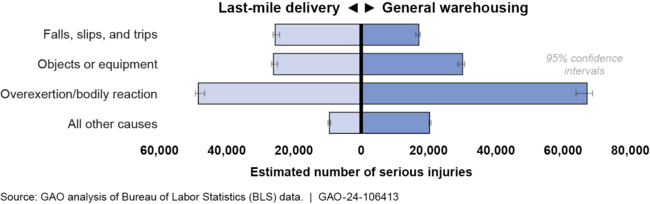
Federal data shows that the most common injuries are from overexertion—e.g., working while fatigued or moving unsafely while lifting or bending.
The Occupational Safety and Health Administration has increased its efforts to prevent overexertion, but can do more. For example, OSHA inspectors need updated guidance to use when identifying and assessing overexertion hazards.
Our recommendations address this and more.
Wearable devices can help monitor worker fatigue.

Highlights
What GAO Found
Three major hazards caused most of the injuries and illnesses in general warehousing (which includes e-commerce warehouses) and the companies that deliver these orders to consumers (“last-mile delivery”), according to Bureau of Statistics (BLS) data. Overexertion and bodily reaction, the most common hazard (see figure), can cause musculoskeletal disorders, such as tendonitis or back pain. The transportation and warehousing sector (which includes e-commerce warehouses and last-mile delivery) had the highest serious injury and illness rate of all 19 sectors in 2022, with an estimated 3.8 cases per 100 workers, according to BLS data.
Estimated Serious Injuries and Illnesses by Cause, 2021 and 2022
Although the Occupational Safety and Health Administration (OSHA) cited warehouse and last-mile delivery employers for more than 2,500 workplace violations from fiscal years 2018 through 2023, 11 included ergonomic hazards, according to OSHA data. Because OSHA does not have an ergonomic standard it must use the general duty clause of the Occupational Safety and Health Act of 1970 to cite these hazards. General duty clause citations require a high level of evidence that can make issuing them a challenge, according to OSHA officials. OSHA staff described other challenges to identifying, assessing, and addressing ergonomic hazards, including compliance officers (1) having difficulty determining if ergonomic hazards caused injuries reported on forms, (2) receiving little training on ergonomic hazards, and (3) relying on unclear ergonomic guidance. By addressing these issues OSHA may be better able to identify and address ergonomic hazards and more fully protect workers from harm.
In fiscal year 2024, OSHA implemented an inspection program to better protect workers from hazards at warehouses and other worksites, including general warehouses and last-mile delivery companies. The program requires compliance officers to determine if ergonomic hazards exist and, if so, to take appropriate enforcement action. According to officials, OSHA will review this program annually, focusing on quantitative outcomes like the number of establishments inspected and hazards identified. Once OSHA has taken steps to improve how it identifies and addresses ergonomic hazards, it should evaluate if this program is more fully protecting workers from such hazards. Such an evaluation will allow OSHA to assess: (1) the efficacy of its efforts in identifying and addressing ergonomic hazards and (2) if and how it may improve these efforts to better protect warehouse and delivery workers from ergonomic hazards.
Why GAO Did This Study
To quickly fill orders, e-commerce warehouses and companies that deliver these orders to consumers (last-mile delivery), use technology to increase productivity and monitor worker performance. Worker safety advocates, employees, and researchers have raised questions about whether employers' use of technology, along with performance expectations, may increase the risk of injuries in this rapidly growing sector.
GAO was asked to review how technology affects worker safety at e-commerce warehouses and last-mile delivery companies. This report examines the types and causes of injuries at these workplaces, and the extent to which OSHA identifies and addresses ergonomic hazards, among other objectives.
GAO reviewed relevant federal laws, regulations, and guidance. GAO analyzed BLS data from 2018 through 2022 on injuries (the most recent available). GAO also analyzed OSHA inspection data and interviewed headquarters officials and staff (compliance officers and managers) at six area offices. GAO conducted nongeneralizable surveys of workers and interviewed 15 stakeholder groups and five employers knowledgeable about safety issues and technology in these industries.
Recommendations
GAO is making five recommendations, including that OSHA improve its injury data, training, and guidance on ergonomic hazards, and evaluate its inspection program. OSHA generally agreed but raised some concerns discussed in the report.
Recommendations for Executive Action
| Agency Affected | Recommendation | Status |
|---|---|---|
| Department of Labor |
Priority Rec.
The Secretary of Labor should ensure that the Assistant Secretary of Labor for Occupational Safety and Health ensures that OSHA compliance officers can easily obtain data during inspections on when musculoskeletal disorders occurred. This could include adding a column for musculoskeletal injuries to OSHA recordkeeping forms. (Recommendation 1) |
In December 2025, OSHA added Occupational Injury and Illness Classification System (OIICS) codes to the calendar year 2023 case-level injury and illness data that certain employers are required to electronically submit to OSHA annually. OSHA attached these codes to each record of electronically submitted data. These codes cover standardized categories of injuries and illnesses, such as the type of injury, the body part affected, and the event that contributed to the injury (e.g., repetitive motion). According to OSHA, these codes will allow the agency and the general public to more easily identify and evaluate musculoskeletal disorders (MSDs) from these data than was previously possible. For example, the codes will allow an individual to filter the data to identify potential MSDs. Once such potential injuries are identified, individuals can determine other relevant information, such as the contributing events, the names and industries of the workplace establishments where the events occurred, and the job titles of the injured employees. OSHA said that the agency plans to continue to assign OICCS codes to the electronically submitted employer data annually as resources allow.
|
| Department of Labor | The Secretary of Labor should ensure that the Assistant Secretary of Labor for Occupational Safety and Health increases training on identifying and assessing ergonomic hazards for compliance officers who inspect worksites under OSHA's National Warehouse and Distribution Center Emphasis Program. This may include making elective ergonomic courses required courses for some officers; adding new courses or ergonomic components to existing courses; or making existing courses more accessible, for example, by increasing their frequency or offering them online. (Recommendation 2) |
In fiscal year 2025, OSHA's Training Institute offered its in-person course on ergonomics twice, which doubled the number of available seats and allowed for more scheduling flexibility for those taking this course. OSHA developed and launched a self-paced, three-hour, on-line ergonomics inspection course for warehousing that is available to all compliance officers through its on-line learning system. Lastly, OSHA said that it will continue to assess whether there is a need for additional ergonomic training content and may develop supplemental training if a need is identified in the future.
|
| Department of Labor | The Secretary of Labor should ensure that the Assistant Secretary of Labor for Occupational Safety and Health review and make needed changes to OSHA's internal and publicly available guidance that compliance officers and employers use to identify, assess, and address ergonomic hazards. This may include clarifying existing guidance and providing more current, industry-specific guidance. (Recommendation 3) |
In FY 2025, OSHA continued to review and update its publicly available and internal ergonomic guidance and improved employer and OSHA compliance officer access to it. For example, OSHA has developed a webpage specific to ergonomic issues in warehouses (Safety and Health Topics Page on ergonomics in warehousing) and is leveraging National Institute of Safety and Health (NIOSH) guidance entitled Ergonomic Guidelines for Manual Material Handling. In March 2025, OSHA began serving as a non-voting member on a technical committee that develops and maintains standards for exoskeletons and exosuits. This will help the agency stay well informed of technological advancements in these areas and, if needed, develop future guidance on ergonomic safety.
|
| Department of Labor | The Secretary of Labor should ensure that the Assistant Secretary of Labor for Occupational Safety and Health conducts timely follow-up with establishments that were issued an ergonomic hazard alert letter, as required by OSHA policy, to determine if establishments have taken corrective actions. This may include regional offices developing formal procedures for tracking ergonomic hazard alert letters. (Recommendation 4) |
As of April 2026, OSHA updated its policies and provided refresher training on follow-up to Ergonomic Hazard Alert Letters (EHALS). The agency also continues to discuss such follow-up at its monthly Regional Ergonomic Coordinator(REC) meetings. We will close it when OSHA provides information that the RECs are conducting EHAL follow-up with OSHA regional offices.
|
| Department of Labor |
Priority Rec.
The Secretary of Labor should ensure that the Assistant Secretary of Labor for Occupational Safety and Health: (1) formally evaluates how well OSHA's national emphasis program for warehouses and distribution centers helps compliance officers identify, assess, and address ergonomic hazards; and (2) determines and documents next steps to correct any deficiencies detected. (Recommendation 5) |
As of April 2026, OSHA was in the process of evaluating options in alignment with this recommendation and will determine how to address it once they complete this process. We will close it when the agency formally evaluates its national emphasis program for warehouses and distribution centers in relation to identifying and addressing ergonomic hazards, including determining and documenting next steps to correct any deficiencies.
|