
Environmental Protection: Additional Action Needed to Improve EPA Data on Informal Enforcement and Compliance Assistance Activities
Fast Facts
EPA’s mission includes ensuring factories, local governments, sewage treatment plants, and others follow environmental laws and regulations, but it doesn’t consistently track all of its efforts. EPA regional offices informally help entities comply (e.g., training), and they conduct informal enforcement actions after violations (e.g., warning letters).
Although EPA’s strategic goals call for increasing use of these two types of informal activities, it hasn’t given regional offices clear and complete guidance on how to track and monitor them. We recommended EPA create guidelines to ensure it has data it needs to track these activities.
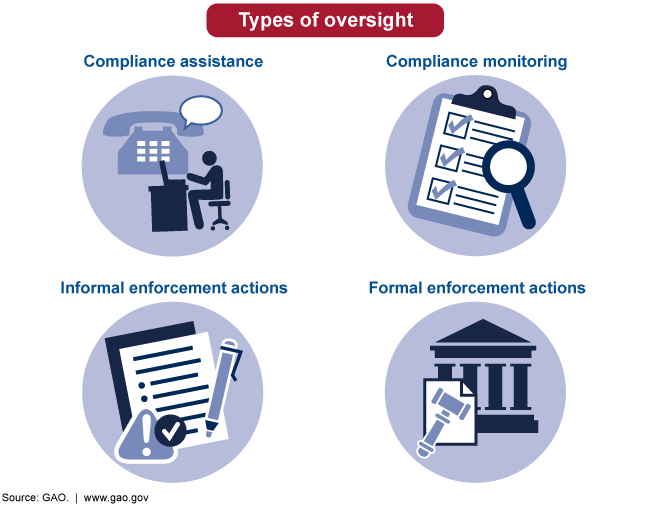
Graphic showing 4 types of oversight: compliance assistance, compliance monitoring, informal enforcement actions, formal enforcement actions
Highlights
What GAO Found
The Environmental Protection Agency (EPA) collects a range of information on compliance and enforcement such as data on inspections, violations, and enforcement actions. The agency uses these data to manage its efforts and assess progress in meeting the agency's strategic objectives. In an August 2018 memorandum, EPA's Office of Enforcement and Compliance Assurance (OECA) reported a key strategic change to increase compliance assistance activities (e.g., training) and informal enforcement actions (e.g., warning letters). However, the agency does not consistently collect or maintain data on either type of action (see figure). Specifically, OECA has not directed regional offices to collect or report data on compliance assistance activities since 2012 and, consequently, does not have guidance instructing regional offices to collect such data and specifying which mechanism offices should use to maintain these data. Also, the agency did not provide guidance to those offices defining informal enforcement actions or how to maintain data on them until September 30, 2019, but the guidance does not specify how to collect data on such actions. By clearly documenting in guidance how the offices should use the definition to collect data on such actions, EPA could more consistently collect these data.
Types of Oversight and Status of Data Collection of Such Oversight by EPA's Office of Enforcement and Compliance Assurance
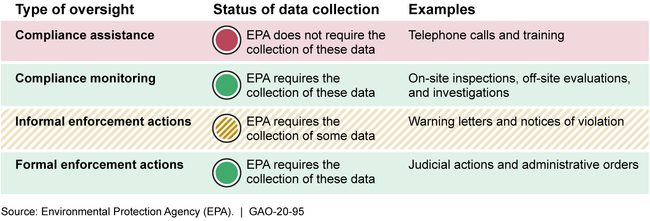
Note: The collection of informal enforcement data varied across different EPA programs due to differing definitions of informal enforcement actions until EPA's September 30, 2019, guidance providing a single definition.
As the figure shows, OECA does not require regional offices to collect data on compliance assistance or complete data on informal enforcement actions. Having complete information about its compliance assistance activities and informal enforcement is essential because EPA has elevated the role of such activities in its overall enforcement efforts. However, because EPA is not consistently collecting these data, the agency cannot be sure it is achieving its strategic objectives. EPA would have better assurance it has the information it needs by clearly documenting in guidance to the regional offices that they should:
collect data on compliance assistance activities and informal enforcement actions and
specify which mechanism to use to maintain compliance assistance data.
By doing so, EPA would have better assurance that the regional offices consistently collect and maintain these data in order to track progress toward the agency's strategic objective of increasing the use of such activities and actions.
Why GAO Did This Study
Enforcing environmental laws and regulations, including those governing water, air, and hazardous waste, is a central part of EPA's mission. In partnership with states, EPA oversees compliance with these requirements for about 800,000 regulated entities, such as refineries and sewage treatment plants. OECA carries out much of EPA's compliance and enforcement responsibilities through the agency's 10 regional offices. OECA has a range of compliance assistance, compliance monitoring, and enforcement tools available to elicit compliance with laws and regulations from regulated entities. These tools include conducting on-site inspection, training staff and providing technical assistance, developing cases, and issuing warning letters.
GAO was asked to review EPA's enforcement efforts. This report examines, among other objectives, the types of information EPA collects on its compliance assistance, compliance monitoring, and enforcement actions. GAO analyzed written responses to its questions from all 10 regional offices, reviewed agency documents and databases, and interviewed EPA officials in headquarters and regional offices.
Recommendations
GAO is making three recommendations to EPA, including that it should clearly document in guidance to its regional offices that they should collect data on compliance assistance activities and informal enforcement actions and specify which mechanism to use to maintain compliance assistance data. EPA agreed with GAO's recommendations and stated that the agency has either begun to or plans to implement them.
Recommendations for Executive Action
| Agency Affected | Recommendation | Status |
|---|---|---|
| Environmental Protection Agency | The Assistant Administrator for EPA's Office of Enforcement and Compliance Assurance should clearly document in guidance to the regional offices how they should use the definition of informal enforcement actions to collect data on these actions. (Recommendation 1) |
In December 2022, EPA's Office of Enforcement and Compliance Assurance sent a memorandum to the regional offices with revised guidance on the definitions for key terms for the agency's enforcement program tools, including informal actions. The memorandum states that the purpose of defining the terms is to promote national consistency and clarity in their use across civil enforcement programs. It also states that this will assist in categorizing tools, regardless of program, and that it will facilitate consistency, appropriate use, and reporting of the use of these tools. In addition, the memorandum provides guidance on how enforcement staff should use the definitions, in conjunction with EPA's enforcement response policies. We reviewed the revised guidance and consider this recommendation implemented.
|
| Environmental Protection Agency | The Assistant Administrator for EPA's Office of Enforcement and Compliance Assurance should clearly document in guidance to the regional offices that they should collect data on compliance assistance activities and specify which mechanism to use to maintain the data, such as ICIS. (Recommendation 2) |
In July 2020, EPA stated that, to further its compliance assistance efforts, the Office of Enforcement and Compliance Assistance (OECA) is including a compliance assistance tool as an important part of each of EPA's National Compliance Initiatives (NCI). According to EPA, data on compliance assistance efforts that are part of the NCIs will be collected and tracked for management review in the Integrated Compliance Information System (ICIS). In July 2022, EPA stated that OECA requires the compliance assistance tool as part of each NCI. EPA stated that, to collect and track the implementation of the compliance assistance efforts, all ten EPA regions, as well as each NCI Steering Committee, completes both a mid-year and end-of-year NCI progress report template. According to EPA, these completed progress reports are consolidated and provided to upper management for their review and reference. We reviewed the NCI reporting template and consider this recommendation implemented.
|
| Environmental Protection Agency | The Assistant Administrator for EPA's Office of Enforcement and Compliance Assurance should include the known limitations of data in its annual reports and provide information on the intended use of EPA's data. (Recommendation 3) |
In July 2020, EPA stated that it would create a webpage to describe how best to interpret the data presented in its "Fiscal Year EPA Enforcement and Compliance Annual Results" report and include a reference to that webpage in the report itself. In June 2021, EPA provided a link to a webpage describing the agency's intended use of data presented in its annual report. The webpage includes a document, last updated in January 2022, that lists identified limitations with analyzing and interpreting the Office of Enforcement and Compliance Assurance annual results data and charts. It also includes a link to a webpage with information about known data problems. In June 2022, EPA provided a copy of its Data and Trends table of contents, which includes a link to this information. This meets the intent of our recommendation, and we consider it implemented.
|