
Poverty Reduction: HHS Can Improve Information to Assist States and Localities in Adopting Approaches That Serve Whole Families
Fast Facts
Poverty can cause problems for both parents and children. Some state and local agencies are working to address this issue by combining multiple services to meet the needs of the whole family. Doing so could help reduce poverty and move families toward self-sufficiency.
However, the agencies we spoke with wanted more federal assistance to help with this approach. For instance, they wanted more examples of successful whole-family strategies and information on how federal funding can be used to implement them.
We recommended that the Department of Health and Human Services make this information readily available.
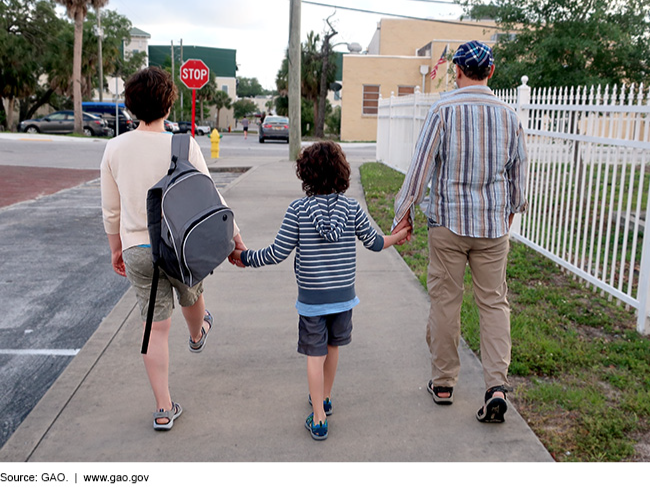
Parents holding their child's hands as they walk on a sidewalk
Highlights
What GAO Found
To reduce poverty through a two-generation approach, which involves working simultaneously with adults and children in a family, selected state and local entities most commonly reported leveraging resources from 10 federal programs. Among the 10 programs were the Department of Health and Human Services' (HHS) Temporary Assistance for Needy Families and Head Start; the Department of Agriculture's Supplemental Nutrition Assistance Program; and three Department of Labor Workforce Innovation and Opportunity Act core programs. Some of these entities also reported using state, local, and/or philanthropic resources to enhance their flexibility to provide services.
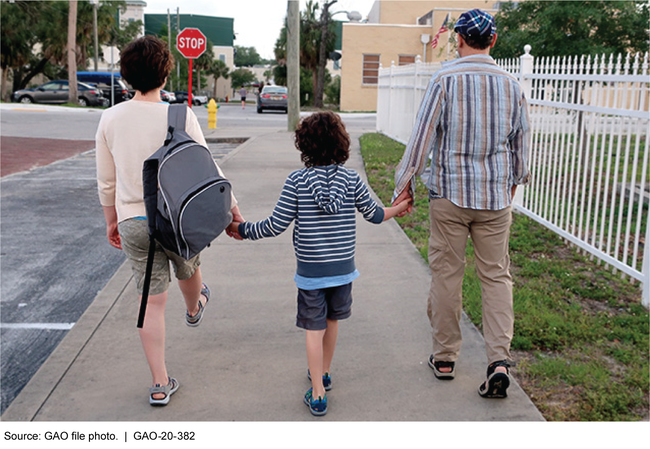
Families Living in Poverty May Benefit from Supports to Both Parents and Children
State and local officials told GAO that difficulties with data sharing and limited information on successful two-generation approaches made it challenging to implement them, and some federal agencies have taken steps to address these challenges. State and local officials said that data sharing is difficult due to various concerns, including protecting participant privacy. Multiple federal agencies have resources on data sharing that may be useful to entities implementing two-generation approaches. State and local officials also said they wanted more examples of successful two-generation approaches and information on federal funding to implement them. To help address this challenge, various federal offices provided information and technical assistance, but the information is distributed via separate email lists and websites, thereby limiting cross-programmatic access and availability. HHS officials said the interagency Council on Economic Mobility—led by HHS—may help address information sharing. Given its recent establishment, related efforts are yet to be seen. Without readily available information, state and local entities may lack useful resources when designing programs to serve families.
Why GAO Did This Study
In 2018, nearly one in six children in the United States lived in families with incomes below the federal poverty thresholds, or about $26,000 annually for a family of four. Research has shown that poverty is associated with negative outcomes for the entire family. State and local entities are currently using two-generation, or whole family, approaches to reduce poverty and move families towards economic self-sufficiency. Senate Committee Report 115-150 included a provision for GAO to review two-generation approaches.
GAO examined (1) the primary federal programs that support two-generation approaches and how these programs were leveraged by selected state and local entities, and (2) the challenges selected state and local entities faced implementing two-generation approaches and steps federal agencies have taken to address those challenges. GAO reviewed relevant federal, state, and local agency documentation; and interviewed officials from five federal agencies, and from 23 state and local entities in five states. States were selected to achieve variation in approaches used and percentage of families with children in poverty, among other factors.
Recommendations
GAO recommends that HHS, in consultation with the Council on Economic Mobility, make information on two-generation approaches readily available. HHS agreed with GAO's recommendation.
Recommendations for Executive Action
| Agency Affected | Recommendation | Status |
|---|---|---|
| Department of Health and Human Services | The Secretary of HHS, in consultation with the Council on Economic Mobility, should make information that would assist state and local entities in developing and implementing two-generation poverty reduction approaches readily available across federal programs and offices. (Recommendation 1) |
HHS agreed with this recommendation. In November 2020, HHS, in consultation with the Council on Economic Mobility, published a webpage that provides information about two-generation poverty reduction approaches for human services practitioners, service provides, and state and local entities. The webpage consolidates information that previously existed in multiple locations and provides links to research, evaluations, federal guidance, and webinars. The webpage also includes links to a federal programs from the Departments of Agriculture, Education, Health and Human Services, Housing and Urban Development, Labor, and the Treasury that are commonly used in implementing two-generation approaches.
|