
Juvenile Justice Grants: DOJ Should Take Additional Actions to Strengthen Performance and Fraud Risk Management
Fast Facts
The Department of Justice’s Office of Juvenile Justice and Delinquency Prevention awarded over $290 million through 16 grant programs in FY 2018 to help juveniles in the justice system.
We found that this office only has numeric goals (targets) for what it hopes to achieve across its programs collectively. For instance, the office has a target for the percent of youth who offend and reoffend across all applicable grant programs. However, it doesn’t have similar targets for its individual grant programs.
We recommended (among other things) that this office set targets for individual grant programs to assess their performance.

A hand writing on a clipboard in the foreground and a young woman sitting on a chair in the background
Highlights
What GAO Found
The Department of Justice's (DOJ) Office of Juvenile Justice and Delinquency Prevention (OJJDP) has goal statements and performance measures for each of its programs, but has not established corresponding program-level targets (specific numeric goals). Rather, OJJDP has established several office-level targets to help assess progress across OJJDP grant programs collectively. For example, OJJDP has a target for the percent of youth who offend and reoffend across all applicable grant programs. Such office-level targets, while useful, might obscure the results of individual programs. Setting program-level targets would help OJJDP assess the progress of each program and reach its goal of increasing accountability for achieving results in individual programs.
Performance Measurement and Fraud Risk Management Definitions
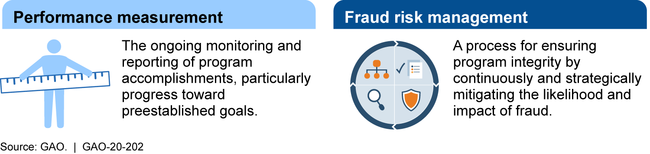
DOJ's Office of Justice Programs (OJP) and DOJ's Justice Management Division (JMD) have taken steps to consider fraud risk affecting OJJDP programs. Specifically, OJP—the grant-making component in which OJJDP resides—has tools it uses to monitor grantee performance and compliance with award terms and conditions. According to OJP, these tools—such as checklists used during desk reviews and site visit audits—provide insight into grant fraud risks. Additionally, JMD—the component that manages fraud risk assessment across all components within DOJ—has taken steps to assess fraud risks affecting OJJDP grant programs. Specifically, JMD conducted department-wide fraud risk assessments in fiscal years 2017, 2018, and 2019. These assessments addressed all DOJ grants, including OJJDP's.
DOJ's 2017 assessment identified fraud risk scenarios and assessed their likelihood and impact—leading practices in GAO's Fraud Risk Framework. Building on the 2017 assessment, the 2018 assessment identified key fraud risk management activities, and the 2019 assessment resulted in a fraud risk profile. However, these assessments did not determine a fraud risk tolerance—i.e. managers' willingness to accept a specific level of risk—as it relates to OJJDP grant programs. JMD officials said they view this as the next step in the maturation of DOJ's fraud risk assessment processes, but did not have details or documentation of plans to do so. Determining a fraud risk tolerance—and assessing fraud risks against that tolerance to prioritize them—would help OJP calibrate resources to address grant fraud risk for OJJDP programs, helping ensure that resources are not under- or over-allocated.
Why GAO Did This Study
OJJDP administers grant programs to improve positive outcomes for juveniles in the justice system. In fiscal year 2018, OJJDP made 295 awards across 16 programs totaling over $290 million.
The Juvenile Justice Reform Act of 2018 included a provision for GAO to review OJJDP performance and internal controls intended to prevent fraud, waste, and abuse of grant funds.
This report examines the extent to which (1) OJJDP has goals and measures to assess the performance of its programs, and (2) DOJ has considered fraud risks for OJJDP grant programs. GAO reviewed DOJ documentation, such as OJJDP's Performance Measures Manual and OJP's risk management policy. GAO also reviewed performance data from selected OJJDP programs from October 2015 through December 2018, and interviewed DOJ officials.
Recommendations
GAO recommends that (1) OJJDP set performance targets for individual grant programs, and (2) DOJ determine the agency's fraud risk tolerance for all grants—which include OJJDP grant programs—and prioritize fraud risks based on an assessment against that tolerance. DOJ concurred with both recommendations.
Recommendations for Executive Action
| Agency Affected | Recommendation | Status |
|---|---|---|
| Office of Juvenile Justice and Delinquency Prevention | The OJJDP Administrator should set performance targets for individual grant programs. (Recommendation 1) |
In December 2019, we reported on the Department of Justice's (DOJ) juvenile justice grants. We found that DOJ's Office of Juvenile Justice and Delinquency Prevention (OJJDP) had not set numeric targets by which it could assess progress for individual grant programs. We recommended that the OJJDP Administrator set performance targets for individual grant programs. In October 2022, the OJJDP Administrator approved initial fiscal year 2023 performance targets for all 26 of OJJDP's grant programs. As of December 2022, these targets were posted on a publicly available OJJDP website. As a result, this recommendation is closed as implemented.
|
| Office of the Assistant Attorney General for Administration | The Assistant Attorney General for Administration should ensure that future department-level fraud risk profiles (1) determine the department's fraud risk tolerance for DOJ grants—which include OJJDP grant programs, and (2) prioritize residual fraud risks based on an assessment against that tolerance, consistent with leading practices in GAO's Fraud Risk Framework. (Recommendation 2) |
In December 2019, we reported on the Department of Justice's (DOJ) management of fraud risks for its juvenile justice grants. We found that DOJ's Justice Management Division (JMD) had taken steps to consider fraud risk affecting juvenile justice grant programs, but had not determined a fraud risk tolerance (a specific level of fraud risk managers are willing to accept). We recommended that JMD ensure that future department-level fraud risk profiles: (1) determine the department's fraud risk tolerance for DOJ grants-which include juvenile justice grants; and (2) prioritize residual fraud risks (risks remaining risks after control activities are applied) based on an assessment against that tolerance. In May 2021, JMD provided a portion of its fiscal year 2020 fraud risk profile. This profile, in combination with associated documentation, showed that the department had determined specific tolerances for various grant fraud risks. Further, this documentation showed that the department prioritized residual fraud risks based on its analysis of fraud risks and associated tolerances. These actions will help ensure DOJ's juvenile justice grants are not vulnerable to greater risks than DOJ is willing to tolerate. These actions will also help ensure DOJ does not unintentionally over-allocate limited funding to address fraud risks the department is willing to tolerate. As a result, this recommendation is closed as implemented.
|