
Department of Justice: ATF and U.S. Marshals Service Can Further Strengthen Controls over Employee Misconduct Processes
Fast Facts
The Bureau of Alcohol, Tobacco, Firearms and Explosives and the U.S. Marshals Service collectively investigated about 3,900 allegations of employee misconduct in FY 2014-2018. About half of the investigations found that the allegations were unsubstantiated. In the others, the most common offenses included poor judgment at ATF and general violations of policy or procedure at the Marshals Service.
Both agencies could strengthen the management of their employee misconduct processes. Our 7 recommendations to the agencies include better monitoring of their misconduct processes and ensuring that supervisory reviews of investigations are documented.
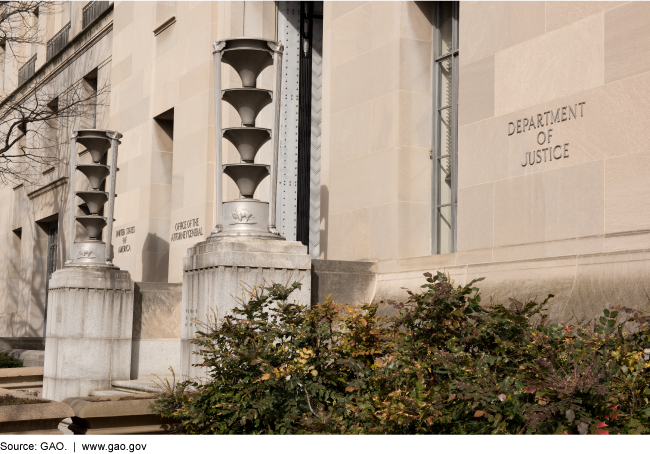
Department of Justice building
Highlights
What GAO Found
From fiscal years 2014 through 2018, the Bureau of Alcohol, Tobacco, Firearms and Explosives (ATF) and U.S. Marshals Service (USMS) collectively investigated about 3,900 allegations of employee misconduct, as shown in the table below. About one-half of these investigations were closed with no disciplinary action because the components found that the allegations were unsubstantiated. For allegations that were substantiated by an investigation, the most common ATF offenses were poor judgment and failure to adequately secure property, while the most common USMS offenses were general violations of policy or procedure and failure to follow instruction. The most common outcomes for both ATF and USMS substantiated investigations were discipline including suspensions of up to 14 days and lesser penalties such as verbal or written warnings. During this period, ATF and USMS investigated over 300 allegations of management retaliation, with few resulting in discipline.
Table: Number of ATF and USMS Employee Misconduct Investigations, Fiscal Years (FY) 2014 through 2018
|
FY 2014 |
FY 2015 |
FY 2016 |
FY 2017 |
FY 2018 |
FY 14-18 |
|
|
ATF |
267 |
312 |
326 |
336 |
340 |
1,581 |
|
USMS |
480 |
541 |
555 |
435 |
336 |
2,347 |
Source: GAO analysis of Bureau of Alcohol, Tobacco, Firearms and Explosives (ATF) and U.S. Marshals Service (USMS) data. | GAO-20-200.
ATF and USMS have developed some internal controls for managing their employee misconduct investigation and disciplinary processes, but have not consistently documented or monitored key control activities. For example:
- USMS policy requires supervisory review of district and division investigations, but the agency has not consistently documented this control in accordance with policy. ATF and USMS also lack policy for verifing the accuracy and completeness of information in employee misconduct systems. Ensuring supervisory review is documented as required and developing policy for verifying information in misconduct systems would provide greater assurance that controls are operating as intended.
- ATF and USMS have established policies and goals related to timeliness in completing various types of employee misconduct investigations (e.g., within 120 days). However, ATF has not established performance measures to monitor progress toward meeting the goals. USMS has measures to monitor timeliness for some types of investigations, but not for others. Establishing measures to monitor timeliness of investigations would provide more complete information to ATF and USMS managers responsible for oversight.
- ATF and USMS have established oversight mechanisms, such as internal management reviews, to monitor certain aspects of the components' operations, such as financial operations. However, ATF and USMS have not fully used these mechanisms to monitor internal controls related to employee misconduct processes, which would help ATF and USMS management ensure that controls are implemented as required by policy.
Why GAO Did This Study
Within the Department of Justice, ATF and USMS employ more than 10,000 staff responsible for protecting communities from violent criminals, investigating the illegal use of firearms, and apprehending wanted persons, among other things. Our recent studies of employee misconduct processes have highlighted the importance of internal controls to help ensure the quality and independence of these processes. We have also reported on employee misconduct investigations being used to retaliate against individuals who report wrongdoing.
GAO was asked to review ATF and USMS employee misconduct investigation and disciplinary processes. This report (1) summarizes data on the number, characteristics, and outcomes of ATF and USMS misconduct investigations that were opened from fiscal years 2014 through 2018 and were closed by the time of GAO's review, and (2) examines the extent to which ATF and USMS have developed, implemented, and monitored internal controls for their employee misconduct processes. For each component, GAO reviewed policies, guidance, and performance reports; analyzed case management system data; analyzed random samples of misconduct cases; and interviewed officials involved in investigation and discipline processes.
Recommendations
GAO is making seven recommendations, including that USMS ensure supervisory review is documented; and that ATF and USMS develop policy for verifying system information, establish measures to monitor the timeliness of investigations, and improve monitoring of employee misconduct processes. DOJ concurred with our recommendations.
Recommendations for Executive Action
| Agency Affected | Recommendation | Status |
|---|---|---|
| United States Marshals Service | The Director of the U.S. Marshals Service should take steps to ensure that supervisory review of division and district investigations is documented in accordance with USMS policy. (Recommendation 1) |
In April 2021, the U.S. Marshals Services (USMS) updated its standard operating procedures to reflect that supervisory reviews are to be conducted and documented for misconduct cases that are referred to USMS districts and divisions. GAO considers this recommendation closed as implemented.
|
| Bureau of Alcohol, Tobacco, Firearms and Explosives | The Director of ATF should develop policy for verifying the accuracy and completeness of information in ATF employee misconduct systems. (Recommendation 2) |
In December 2020, ATF provided a template with instructions for completion and review of case file information for the hard copy file and the electronic case file system. The instructions describe the necessary information to be included by the duty agent when the case is opened and the case agent as the case is conducted. In addition, information is to be reviewed by a management analyst for accuracy and inclusion in the case management system. Based on the creation and use of this template and instructions, and the multiple reviews performed, GAO is closing this recommendation as implemented.
|
| United States Marshals Service | The Director of the U.S. Marshals Service should develop policy for verifying the accuracy and completeness of information in USMS employee misconduct systems. (Recommendation 3) |
U.S. Marshals Service officials stated that they began conducting quarterly audits of the employee misconduct case management system for data accuracy and completeness in fiscal year 2021. In April 2021, the U.S. Marshals Service issued its revised Disciplinary and Adverse Action Standard Operating Procedure that documented this policy. GAO considers this recommendation closed as implemented.
|
| Bureau of Alcohol, Tobacco, Firearms and Explosives | The Director of ATF should develop a performance measure to monitor the timeliness of misconduct investigations, according to policy requirements. (Recommendation 4) |
In September 2020, ATF stated that its Internal Affairs Division developed and deployed a performance measure system to monitor the timeliness of misconduct investigations. In December 2020, ATF provided evidence of notices sent to field offices that management referrals were due for completion. These documents include a report to the Internal Affairs Division that management referrals are late; an email from the Internal Affairs Division to a field office containing a management referral, along with a reminder of the time frames for completion; and a list provided to the head of investigations for investigations that are running late. On April 15 and May 26, 2021, ATF provided additional documentation to address this recommendation to demonstrate that ATF had established goals for the closure of cases, was tracking closure rates, was informing staff of the need to close cases in a timely manner, and that management was reviewing case files. These documents included spreadsheets that tracked the status of management referrals showing that ATF exceeded its goal of a 60 percent closure rate of management referrals for action within 60 days and spreadsheets of internal investigations showing the closure rate of internal affairs cases within 180 days. ATF also provided a record that demonstrated supervisory review of the investigation case file by the Assistant Special Agent in Charge and Special Agent in Charge of the Internal Affairs Division, and a copy of an email that reminds case agents of ATF policy to request additional time to complete an internal investigation, accompanied with a justification for the extension, when it becomes clear that the investigation will not be completed within the 180-day standard for completion of internal investigations. ATF also provided screenshots of reminders provided to the investigator when the investigation hits 120 days, 60 days before the 180 day standard. Taken together, these documents show that ATF has established performance metrics for the completion of internal investigations and management referrals, is measuring these completion rates, and has taken steps to inform case agents of these standards and remind them of their responsibilities if they foresee being unable to meet the standards and complete investigations in a timely manner. GAO considers this recommendation closed as implemented.
|
| United States Marshals Service | The Director of the U.S. Marshals Service should develop a performance measure to monitor the timeliness of district and division misconduct investigations, according to policy requirements. (Recommendation 5) |
In February 2021, the U.S. Marshals Service (USMS) revised its standard operating procedures to reflect a timeliness performance target for completing district and division investigations within 30 days. Beginning in the final quarter of fiscal year 2021, USMS is now monitoring and reporting the percentage of district and division investigations completed within 30 days.
|
| Bureau of Alcohol, Tobacco, Firearms and Explosives | The Director of ATF should modify existing oversight mechanisms to include the monitoring of key internal controls related to employee misconduct investigations. (Recommendation 6) |
In September 2020, ATF stated that beginning in fiscal year 2022, its Inspection Division will conduct regular inspections of its Internal Affairs Division's Professional Review Board and Bureau Deciding Official. In December 2020, ATF provided a copy of the Inspection Division's plan for 2021 and 2022 inspections. However, the inspection schedule does not detail that the examination of case file conformity and management referral and investigation timeliness are included as part of these inspections. We will continue to follow-up on ATF's actions to implement this recommendation. On August 30, 2020, ATF provided documentation of the instructions for inspections of misconduct investigations and adjudications, as well as a spreadsheet displaying checklists for planned inspections of case files for the investigation and adjudication of employee misconduct cases. These documents display the steps to be taken in these inspections to ensure administrative compliance with internal policies (e.g., were deadlines met, were required approvals received, were notifications made, was counsel's input recorded, was all relevant information recorded in the database, etc.). The workbook includes separate tabs for each part/player of the misconduct process. Combined with documentation received earlier showing the 2021 and 2022 inspection division plan, ATF has addressed this recommendation and it should be closed, implemented.
|
| United States Marshals Service | The Director of the U.S. Marshals Service should modify existing oversight mechanisms to fully monitor key internal controls related to employee misconduct investigations. (Recommendation 7) |
The U.S. Marshals Service's self-assessment guide for fiscal year 2021 includes evaluating and testing internal controls related to the employee misconduct process, including legal sufficiency review. GAO considers this recommendation closed as implemented.
|