
Social Security Disability: Action Needed to Help Agency Staff Understand and Follow Policies Related to Prescription Opioid Misuse
Fast Facts
People whose disabilities keep them from working can apply for Social Security Disability Insurance. People who claim these benefits may also be on prescription opioids for chronic pain. Opioids are addictive and can be misused.
Social Security staff must deny claims if claimants who stopped using drugs or alcohol would be employable. Staff in 5 of 6 offices we visited were confused about when to evaluate a claimant’s substance use.
In more than half the cases we reviewed, the evaluations weren’t fully documented.
Our recommendations are to help staff improve the evaluation process.
Counties with the Highest Rates of Opioid Prescriptions and Disability Insurance Claims (Top Third), 2017
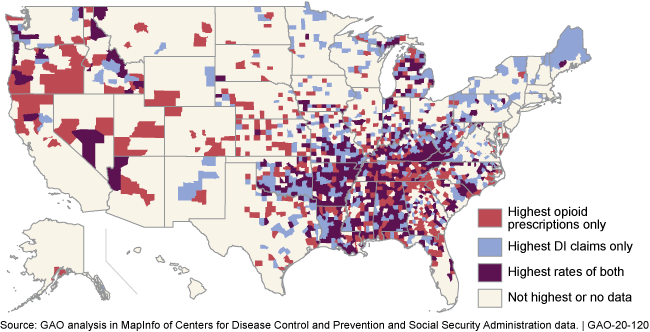
U.S. map showing highest rates concentrated in the southeast with other clusters across the U.S.
Highlights
What GAO Found
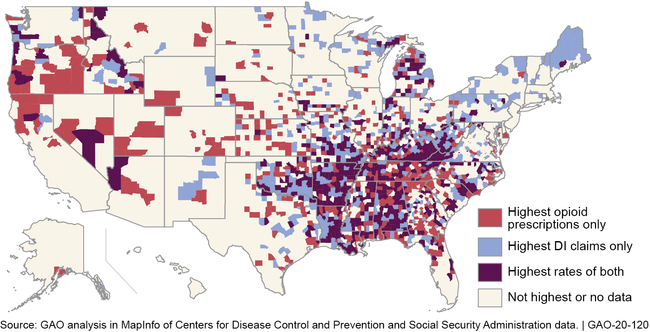
The numbers of opioid prescriptions and claims for the Social Security Administration's (SSA) Disability Insurance (DI) program have each declined nationally in recent years, but rates vary widely across the country. National trends show both peaking between 2010 and 2014 and then declining. GAO's analysis shows counties with the highest rates of both were concentrated in the Southeast (see figure). After accounting for economic, demographic, and other factors, GAO found that counties with higher rates of opioid prescriptions tended to have higher rates of DI claims from 2010 through 2017. These rates were also correlated with other factors. For example, counties with higher rates of each tended to have higher poverty rates. However, GAO was unable to determine whether there is a causal relationship between rates of opioid prescriptions and DI claims or other factors, given readily available data.
Counties with the Highest Rates of Opioid Prescriptions and Disability Insurance (DI) Claims (In the Top Third of the Distribution for Each Rate), 2017
Program staff are required to evaluate and document substance use disorders (including opioids not taken as prescribed) when making certain DI eligibility decisions. Specifically, staff are required to evaluate potential substance use disorders for certain DI claims and deny benefits, for example, if the claimant would not be considered disabled if they stopped using drugs or alcohol. In addition, staff are generally required to document the rationale for their decision so that another reviewer can understand how they made the decision. However, staff in five of the six offices GAO visited in three states were confused about when to evaluate substance use disorders, and nine of 15 case files that GAO reviewed in which an evaluation was conducted did not have a documented rationale. SSA officials acknowledged the need to clarify policies on when to evaluate substance use disorders, and that a poorly documented rationale could lead to reversals or remands of decisions. Without ensuring that SSA's policies are understood and that staff document their rationale, the agency may expend resources re-working cases and, in turn, delay benefits to individuals eligible for assistance.
Why GAO Did This Study
The United States is in the midst of an unprecedented opioid epidemic. Opioids are prescribed to treat conditions such as chronic pain. However, opioid misuse can lead to addiction, disability, overdose, and death. Prior GAO and other reports have discussed the use of prescription opioids within federal programs, particularly Medicare. Less is known about the use of opioids in relation to SSA's DI program. GAO was asked to review any correlation between prescription opioids and rates of DI claims, and any related challenges for SSA.
This report examines (1) what is known about the relationship between trends in prescription opioids and DI claims, and (2) how SSA considers potential prescription opioid misuse in its DI eligibility decisions. GAO analyzed county-level data on opioid prescriptions and DI claims from 2006 through 2017; interviewed program staff involved in DI eligibility decisions in Alabama, Kentucky, and West Virginia, selected because of their high rates of opioid prescriptions and percentage of the adult population on DI; and reviewed case files for DI beneficiaries identified by the Centers for Medicare & Medicaid Services as being at risk for prescription opioid misuse or abuse.
Recommendations
GAO recommends that SSA 1) clarify policies and procedures to help staff better evaluate substance use disorders, and 2) ensure staff document their rationale. SSA agreed with GAO's recommendations.
Recommendations for Executive Action
| Agency Affected | Recommendation | Status |
|---|---|---|
| Social Security Administration | The Commissioner of the Social Security Administration should clarify policies and procedures to remind staff that a diagnosis of a substance use disorder is not necessary to conduct a Drug Addiction and Alcoholism evaluation. (Recommendation 1) |
SSA agreed with and implemented this recommendation. Specifically, SSA reported that it clarified its policy in February 2020 on when to evaluate substance use disorders by removing the term "diagnosed" from its Program Operations Manual System. In addition, the agency published a revised Administrative Message in August 2021 that clarifies SSA's medically determinable impairment policy with regard to drug addiction and alcoholism. The Administrative Message reminds staff that they may establish a medically determinable impairment for substance use disorder based on evidence from an acceptable medical source or sources. It also includes examples of what evidence is sufficient for establishing a medically determinable impairment and how a diagnosis is not necessary to conduct a Drug Addiction and Alcoholism evaluation.
|
| Social Security Administration | The Commissioner of the Social Security Administration should ensure that staff document their rationale for decisions involving the Drug Addiction and Alcoholism evaluation process. (Recommendation 2) |
SSA agreed with and implemented this recommendation. Specifically, SSA published an Administrative Message in August 2021 that reinforces its policy on properly documenting cases involving drug addiction and alcoholism, particularly when two sequential evaluations are required. The Administrative Message also includes examples that illustrate how to appropriately document a rationale under different situations depending on the evidence available in the claim file.
|