
Defense Science and Technology: Adopting Best Practices Can Improve Innovation Investments and Management
Fast Facts
Defense Science and Technology: Adopting Best Practices Can Improve Innovation Investments and Management
DOD plans to invest $12.5 billion on innovative technology in fiscal year 2017. We compared DOD's approach with how leading technology companies like Amazon and Dow manage their science and technology investments.
We found that DOD's ability to innovate is limited by its funding policies, as projects are planned up to 2 years in advance, which can slow innovation and limit lab directors’ autonomy. Additionally, DOD’s culture prioritizes developing technologies only for programs that already have the needed funding.
We recommended that DOD define a science and technology management framework that uses leading commercial practices.
Department of Defense Technology Management Process
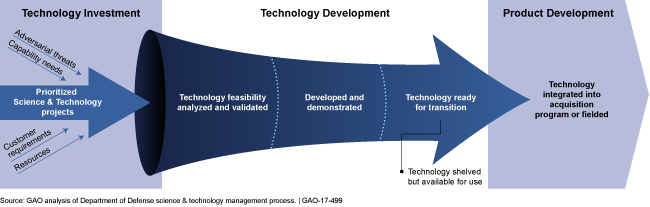
Graphic showing progression from technology investment, through development, then deployment.
Highlights
What GAO Found
The eight leading companies whose practices GAO assessed take a disciplined approach to organizing and executing their technology development activities by grouping them into two portfolios: incremental and disruptive, as shown in the figure. Incremental development improves product lines whereas disruptive development is for riskier innovative and potentially market-shifting technologies.
Commercial Model Ensures Investments in Incremental and Disruptive Innovation
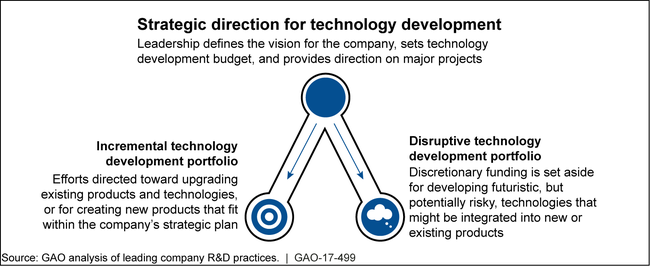
By separating these two portfolios, companies reported that they could promote existing product lines in the short term while exploring opportunities to remain competitive in the long term, and mitigate the financial risk associated with disruptive technology development. Moreover, GAO found that leading companies also ensure technologies will be relevant in the marketplace by engaging a wide range of internal stakeholders. These companies also reported that they gain leadership buy-in by prototyping technologies before committing to further development and product integration.
While some Department of Defense (DOD) practices closely mirror those of the companies GAO reviewed, DOD's ability to adopt leading commercial practices in its approach to managing science and technology (S&T) investments is limited by its funding policies and culture. Unlike the companies GAO reviewed, DOD leadership does not provide guidance on or assess the mix of incremental and disruptive innovation. As a result, officials reported that DOD labs struggle to find the right balance between these investment areas. Under DOD's budget policy, projects are planned up to 2 years in advance, which can slow innovation and limit lab directors' autonomy as compared to companies. Congress has provided a means for lab directors to initiate work outside of this lengthy process, but it has not been fully utilized. Additionally, responsibilities for technology versus product development also contribute to a culture that discourages collaboration and limits labs' ability to prototype. Yet these issues are not insurmountable, as pockets of each military department have demonstrated, such as through recent efforts to expand advanced prototyping in the labs. Further, Congress has required that by February 2018 DOD create a new Under Secretary of Defense for Research and Engineering (USD(R&E)), which will be charged with developing policies to improve innovation. This position creates an opportunity to develop policies that further promote adoption of leading commercial practices.
Why GAO Did This Study
DOD relies on innovative technologies to ensure the superiority of its weapon systems and planned to invest about $12.5 billion in fiscal year 2017 to achieve this aim. Recently, DOD's leadership role in fostering innovation has been supplanted by the commercial sector. This has changed DOD's approach to technology development by relying more on commercial innovation.
Conference Report 112-329 included a provision for GAO to review DOD's S&T enterprise. This report assesses (1) the practices leading companies employ to manage technology development and (2) the extent to which DOD can incorporate these practices into its own. GAO interviewed eight large, profitable, leading technology companies (Amazon, Dow Chemical, Honeywell, General Motors, IBM, Qualcomm, Siemens AG, and Valvoline) to identify practices they used to manage, prioritize, and assess their technology portfolios. GAO also met with DOD organizations that manage and execute S&T funds to identify their practices.
Recommendations
GAO recommends that DOD annually define and assess the mix of innovation investments and define, in policy or guidance, an S&T management framework that comprehensively employs leading commercial practices. DOD did not agree with the recommendations, citing its ongoing deliberations on the new USD R&E's role, but did identify some planned actions. GAO believes its recommendations are valid as discussed in the report.
Recommendations for Executive Action
| Agency Affected | Recommendation | Status |
|---|---|---|
| Department of Defense |
Priority Rec.
To ensure that DOD is positioned to counter both near and far term threats, consistent with its S&T framework, the Secretary of Defense should direct the new Under Secretary of Defense for Research and Engineering to annually define the mix of incremental and disruptive innovation investments for each military department. |
As of April 2026, DOD continues to partially agree with this recommendation. DOD previously reported it intended to fund a study in fiscal year 2025-to be completed by July 31, 2025-conducted by a Federal Funded Research & Development Center (FFRDC) or University Affiliated Research Center (UARC) to evaluate the advantages and risks associated with defining a mix of incremental and disruptive innovation investments. However, that study was not completed, and DOD now asserts that actions it has taken demonstrates how it established the need for both incremental and disruptive investments. These actions include the periodic realignment of the National Defense Science and Technology Strategy and completion of the annual science and technology strategic overview, as well as mandated minimum science and technology investments required by Congress. Although, the actions DOD has taken may help the department identify technologies in which it needs to invest, DOD continues to disagree that, consistent with commercial best practices identified in our report, it should define the mix of incremental and disruptive innovations investments for each military department. Instead, DOD stated that defining a specific proportion target is subjective and could vary across military department, mission, technology, and application areas. However, by not taking steps to identify an appropriate mix of near-term and far-term investments and assess whether that mix is achieved, the department risks making investments that do not align with the current and future needs of the warfighter.
|
| Department of Defense | To ensure that DOD is positioned to counter both near and far term threats, consistent with its S&T framework, the Secretary of Defense should direct the new Under Secretary of Defense for Research and Engineering to annually assess whether that mix is achieved. |
As of April 2026, DOD continues to partially agree with this recommendation. DOD previously reported it intended to fund a study in fiscal year 2025-to be completed by July 31, 2025-conducted by a Federal Funded Research & Development Center (FFRDC) or University Affiliated Research Center (UARC) to evaluate the advantages and risks associated with defining a mix of incremental and disruptive innovation investments. However, that study was not completed, and DOD now asserts that actions it has taken demonstrates how it established the need for both incremental and disruptive investments. These actions include the periodic realignment of the National Defense Science and Technology Strategy and completion of the annual science and technology strategic overview, as well as mandated minimum science and technology investments required by Congress. Although, the actions DOD has taken may help the department identify technologies in which it needs to invest, DOD continues to disagree that, consistent with commercial best practices identified in our report, it should define the mix of incremental and disruptive innovations investments for each military department. Instead, DOD stated that defining a specific proportion target is subjective and could vary across military department, mission, technology, and application areas. However, by not taking steps to identify an appropriate mix of near-term and far-term investments and assess whether that mix is achieved, the department risks making investments that do not align with the current and future needs of the warfighter.
|
| Department of Defense |
Priority Rec.
To ensure that DOD is positioned to more comprehensively implement leading practices for managing science and technology programs, the Secretary of Defense should direct the new Under Secretary of Defense for Research and Engineering to define, in policy or guidance, an S&T management framework that includes emphasizing greater use of existing flexibilities to more quickly initiate and discontinue projects to respond to the rapid pace of innovation. |
As of April 2026, DOD continues to agree with this recommendation. DOD previously reported it intended to fund a study in fiscal year 2025-to be completed by July 31, 2025-conducted by a Federal Funded Research & Development Center (FFRDC) or University Affiliated Research Center (UARC) to evaluate the advantages and risks associated with defining a mix of incremental and disruptive innovation investments. OUSD(R&E) officials communicated that this study would also include a section on recommended policies for an S&T management framework using existing flexibilities to more quickly initiate and discontinue projects. However, that study was not completed, and DOD now asserts that actions it has taken demonstrates how it emphasizes the greater use of existing flexibilities to quickly initiate and discontinue projects to respond to the rapid pace of innovation. These actions include the periodic realignment of the National Defense Science and Technology Strategy and DOD Critical Technology Areas, and completion of the annual S&T strategic overview. However, the actions identified do not demonstrate how DOD S&T personnel are able to use existing authorities or flexibilities to quickly initiate or discontinue projects. Although these actions are a step in the right direction, until DOD implements our recommendation it risks missing opportunities to quickly pivot its innovation investments from less promising research efforts to more promising ones -- in support of DOD's acquisition goal to develop and deliver new and essential warfighting capabilities at the speed of relevance
|
| Department of Defense |
Priority Rec.
To ensure that DOD is positioned to more comprehensively implement leading practices for managing science and technology programs, the Secretary of Defense should direct the new Under Secretary of Defense for Research and Engineering to define, in policy or guidance, an S&T management framework that includes incorporating acquisition stakeholders into technology development programs to ensure they are relevant to customers. |
In June 2017, the Department of Defense (DOD) disagreed with our recommendation, stating that it would be premature to get ahead of the Secretary of Defense's final decisions on the role of the new Under Secretary of Defense for Research and Engineering (USD(R&E)) until that position is established, as required by law. In July 2018, the Department issued a memorandum finalizing the organizational structures, roles, and responsibilities for USD(R&E), but did not require that office to define, in policy or guidance, a science and technology framework that includes incorporating acquisition stakeholders into technology development programs. In December 2019, a senior official within the Office of the USD(R&E) reported that USD(R&E) actively partners with acquisition stakeholders to ensure technology development programs are relevant to customers. The official cited Rapid Prototyping Programs (RPPs), Joint Capability Technology Demonstrations (JCTDs), and Emerging Capability Technology Development (ECTD) programs as examples where management frameworks in which technology managers actively partner with (1) operational managers from the Combatant Commands or military departments and (2) technology transition managers from the military departments to ensure programs are relevant to customers. In March 2021, a senior official with the Office of the USD(R&E) provided documentation showing that the ECTD and Quick Reaction Special Projects (QRSPs) programs have convened quarterly small group review meetings that include approximately 200 customer representatives who provide input on proposed projects as part of the funding approval process. These customers include representatives from across DOD, including the Combatant Commands and the military departments. Further, RPPs and other rapid prototyping efforts obtain customer feedback prior to funding decisions through the use of a prototyping senior steering group.
|
| Department of Defense |
Priority Rec.
To ensure that DOD is positioned to more comprehensively implement leading practices for managing science and technology programs, the Secretary of Defense should direct the new Under Secretary of Defense for Research and Engineering to define, in policy or guidance, an S&T management framework that includes promoting advanced prototyping of disruptive technologies within the labs so the S&T community can prove these technologies work to generate demand from future acquisition programs. |
In June 2017, the Department of Defense disagreed with our recommendation, stating that it would be premature to get ahead of the Secretary of Defense's final decisions on the role of the new Under Secretary of Defense for Research and Engineering (USD(R&E)) until that position is established, as required by law. In July 2018, the Department issued a memorandum finalizing the organizational structures, and roles and responsibilities for USD(R&E), but did not require it to define, in policy or guidance, a science and technology framework that includes promoting advanced prototyping of disruptive technologies within the labs. In December 2019, a senior official within the Office of the USD(R&E) reported that the Emerging Capability Technology Development (ECTD) program is one framework USD(R&E) uses to promote the prototyping of disruptive technologies within the labs. Under this framework, USD(R&E) co-funds and co-sponsors projects with Federally Funded Research and Development Centers (FFRDCs), University Affiliated Research Centers (UARCs), and the military department laboratories. An integrated management team leads the evaluation and demonstration of technologies and connects technology managers with acquisition programs in the Combatant Commands and the military departments. The senior official further reported that USD(R&E) leverages Rapid Prototyping Funds (RPFs) and Rapid Prototyping Programs (RPPs) to promote and prove advanced demonstrations in military department laboratories. In March 2021, a senior official with the Office of the USD(R&E) provided documentation showing that the Office, through its Rapid Reaction Technology Office (RRTO), manages Quick Reaction Special Projects (QRSPs), RPP, RPF and ECTD programs. The primary tenet of RRTO is to promote emerging and disruptive innovation. In addition to the prototyping efforts funded directly by the RRTO, the office accepts proposals from across DOD--to include the military department laboratories--and assists in maturing the technologies and acting as an advocate to ensure transition to a customer in the acquisition community.
|