
State Marijuana Legalization: DOJ Should Document Its Approach to Monitoring the Effects of Legalization
Highlights
What GAO Found
Officials from the Department of Justice's (DOJ) Office of the Deputy Attorney General (ODAG) reported monitoring the effects of state marijuana legalization relative to DOJ policy, generally in two ways. First, officials reported that U.S. Attorneys prosecute cases that threaten federal marijuana enforcement priorities (see fig. below) and consult with state officials about areas of federal concern, such as the potential impact on enforcement priorities of edible marijuana products. Second, officials reported they collaborate with DOJ components, including the Drug Enforcement Administration (DEA) and other federal agencies, including the Office of National Drug Control Policy, and assess various marijuana enforcement-related data these agencies provide. However, DOJ has not documented its monitoring process, as called for in Standards for Internal Control in the Federal Government . Documenting a plan specifying its monitoring process would provide DOJ with greater assurance that its monitoring activities relative to DOJ marijuana enforcement guidance are occurring as intended. Further, making this plan available to appropriate DOJ components can provide ODAG with an opportunity to gain institutional knowledge with respect to its monitoring plan, including the utility of the data ODAG is using. This can better position ODAG to identify state systems that are not effectively protecting federal enforcement priorities and, if necessary, take steps to challenge these systems in accordance with DOJ marijuana enforcement guidance.
DOJ Marijuana Enforcement Priorities
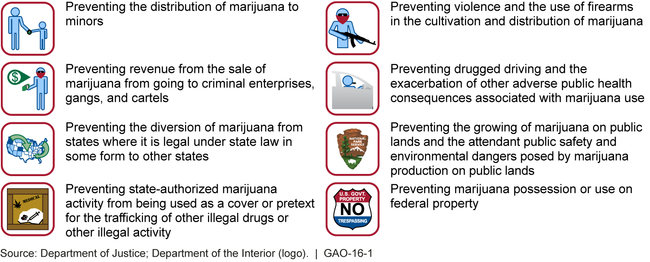
U.S. Attorneys and DEA officials in six states with medical marijuana laws reported their perspectives on various factors that had affected their marijuana enforcement actions. These include
- applying resources to target the most significant public health and safety threats, such as violence associated with drug-trafficking organizations;
- addressing local concerns regarding the growth of the commercial medical marijuana industry; and
- implementing DOJ's updated marijuana enforcement policy guidance.
Why GAO Did This Study
An increasing number of states have adopted laws that legalize marijuana for medical or recreational purposes under state law, yet federal penalties remain. In 2012, Colorado and Washington became the first states to legalize marijuana for recreational purposes. In 2013, DOJ updated its marijuana enforcement policy by issuing guidance clarifying federal marijuana enforcement priorities and stating that DOJ may challenge those state marijuana legalization systems that threaten these priorities. GAO was asked to review issues related to Colorado's and Washington's actions to regulate recreational marijuana and DOJ's mechanisms to monitor the effects of state legalization.
This report examines, among other issues, (1) DOJ's efforts to monitor the effects of state marijuana legalization relative to DOJ's 2013 guidance and (2) factors DOJ field officials reported affecting their marijuana enforcement in selected states with medical marijuana laws. GAO analyzed DOJ marijuana enforcement guidance and drug threat assessments, and evaluated DOJ's monitoring efforts against internal control standards. GAO also interviewed cognizant DOJ officials, including U.S. Attorneys and DEA officials in six states.
Recommendations
GAO recommends that DOJ document a plan specifying its process for monitoring the effects of state marijuana legalization, and share the plan with DOJ components. DOJ concurred with GAO's recommendations.
Recommendations for Executive Action
| Agency Affected | Recommendation | Status |
|---|---|---|
| Department of Justice | The Attorney General should direct ODAG to document a plan specifying DOJ's process for monitoring the effects of marijuana legalization under state law, in accordance with DOJ's 2013 marijuana enforcement policy guidance, to include the identification of the various data ODAG will use and their potential limitations for monitoring the effects of state marijuana legalization, and how ODAG will use the information sources in its monitoring efforts to help inform decisions on whether state systems are effectively protecting federal marijuana enforcement priorities. |
On January 4, 2018, in a memorandum for all United States Attorneys, the Attorney General rescinded the Department of Justice's 2013 marijuana enforcement policy guidance. In light of this development, we are closing this recommendation as not implemented.
|
| Department of Justice | The Attorney General should direct ODAG to use existing mechanisms to share DOJ's monitoring plan with appropriate officials from DOJ components responsible for providing information DOJ reports using regarding the effects of state legalization to ODAG, obtain feedback, and incorporate the feedback into its plan. |
On January 4, 2018, in a memorandum for all United States Attorneys, the Attorney General rescinded the Department of Justice's 2013 marijuana enforcement policy guidance. In light of this development, we are closing this recommendation as not implemented.
|