
Pretrial Supervision: Actions Needed to Enhance Management of the Location Monitoring Program
Fast Facts
About a quarter of people released by the court before their federal trials are required to use location monitoring devices. These devices often use GPS and radio frequency to transmit their location data to court officers.
Officers investigate immediately when devices send them "key alerts," which can indicate noncompliance. Key alerts often come in after hours and can be caused by GPS or cellular connection failures. But courts aren't collecting or using data to understand how key alerts affect officers' workloads. Courts could use this data to make better workforce decisions.
Our recommendations address this and other issues.

Highlights
What GAO Found
To implement its location monitoring program, the Administrative Office of the U.S. Courts (Administrative Office) contracts with a single provider to supply location monitoring equipment, train officers, and assist with alert response. Further, the Administrative Office reviews each of the 93 district offices with pretrial services every 5 years, in part to ensure they adhere to location monitoring policies.
GAO's data analysis showed similar characteristics among individuals with court-ordered location monitoring. Generally, they were male (85 percent) and had zero new criminal charges while under supervision (92 percent). Nevertheless, these individuals faced obstacles. For example, according to federal defenders GAO interviewed, some companies may not hire these individuals because of monitoring-related scheduling restrictions or the visibility of the location monitoring device.
Location monitoring poses challenges for officers due to the demands of alert response 24 hours per day, 7 days per week. According to a GAO survey, this includes challenges related to equipment connection errors (see figure). The Administrative Office has initiatives to address some challenges, such as developing an emergency response team to help in the case of natural disasters. However, the Administrative Office does not fully collect and analyze data on the underlying causes of certain location monitoring alerts. In addition, the Administrative Office does not track the length of time it takes officers to respond to and investigate certain alerts. With this data, the Administrative Office could better understand workload demands, potentially reduce them, and use this information when making staffing decisions.
Number of Chiefs Reporting that Equipment Related Challenges were Moderately or Extremely Challenging in their Districts within the Past Year
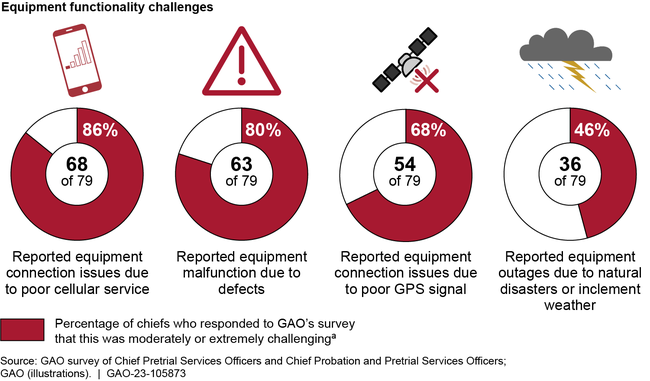
aThe survey asked chiefs “In the past year, how challenging, if at all, have each of the following been for location monitoring in your district?”
Why GAO Did This Study
From calendar years 2018-2022, about 25 percent of individuals released while awaiting trial were required to use a monitoring device as a condition of their release. When an individual fails to adhere to location monitoring restrictions, the monitoring device will signal an alert.
GAO was asked to examine the Administrative Office's management of pretrial release location monitoring. This report describes (1) how the Administrative Office manages its location monitoring program and assesses its districts' adherence to policies, (2) characteristics of individuals with court-ordered location monitoring and obstacles they face, and (3) challenges pretrial services officers encounter with alert response and the extent to which the Administrative Office has initiatives to address challenges.
Among other methods, GAO analyzed the Administrative Office's pretrial population data and surveyed chiefs in each of 93 district offices—receiving 79 responses. GAO also interviewed officials and a variety of personnel from six districts to obtain perspectives and analyzed the Administrative Office's initiatives to address challenges against its own guidance, internal controls, and human capital standards.
Recommendations
GAO is making four recommendations to the Administrative Office, including that it develop a method to collect and analyze data on the underlying cause of alerts and the length of time it takes officers to investigate certain alerts. The Administrative Office said it will consider these recommendations as it replaces its current data system.
Recommendations for Executive Action
| Agency Affected | Recommendation | Status |
|---|---|---|
| Administrative Office of the United States Courts | The Director of the Administrative Office of the U.S. Courts should ensure that the Probation and Pretrial Services Office, as it replaces its current PACTS data system, create a sortable field in its new data system that tracks the underlying cause of key alerts across districts. (Recommendation 1) |
As of December 2025, the Administrative Office said it is working to implement the next generation case management system in 2027. The transition to the new system began in December 2025 with a handful of pilot districts. Implementation of the new system across all districts is phased over the next two years, with full implementation projected to occur in 2027. The AO anticipates advanced technology and efficiencies gained with the new system (e.g. improved data tracking and reporting capabilities) will make implementation of the GAO's recommendations more feasible in the new system compared to the legacy system. The logic created in the new system will help track the underlying cause of location monitoring key alerts. This new programming logic will first be tested on tamper-related key alerts before expanding the system to cover all key alert types. Districts migrated to the new case management system will now be required to document the findings of their investigation for all tamper-related key alerts, selecting a category from a defined list. These findings categories include tampering, which is when officers find verified equipment tampering, and unintentional participant driven alerts, which are associated with participant behaviors but are not violations such as unintentional equipment damage, approved relocation, and medical needs. Other categories include officer driven alerts, environmental related alerts, and non-compliance other than tampering such as relocating equipment without permission. As AO continues to implement and replace its new system, it anticipates that it will be better positioned to implement additional data tracking, such as the underlying cause of location monitoring key alerts, while minimizing the increased burden of capturing new data on officers.
|
| Administrative Office of the United States Courts | The Director of the Administrative Office of the U.S. Courts should ensure that the Probation and Pretrial Services Office analyzes the data in its newly created PACTS data system field for commonalities in the underlying causes of key alerts to inform corrective actions, as necessary to address them. (Recommendation 2) |
As of December 2025, the Administrative Office said it is working to implement the next generation case management system in 2027. The transition to the new system began in December 2025 with a handful of pilot districts. Implementation of the new system across all districts is phased over the next two years, with full implementation projected to occur in 2027. The AO anticipates advanced technology and efficiencies gained with the new system (e.g. improved data tracking and reporting capabilities) will make implementation of the GAO's recommendations more feasible in the new system compared to the legacy system. The logic created in the new system will help track the underlying cause of location monitoring key alerts. This new programming logic will first be tested on tamper-related key alerts before expanding the system to cover all key alert types. Districts migrated to the new case management system will now be required to document the findings of their investigation for all tamper-related key alerts, selecting a category from a defined list. As the new system will track the underlying cause of the location monitoring key alerts, AO will be able to use this data to perform analysis to identify commonalities in underlying causes and inform corrective actions, as necessary.
|
| Administrative Office of the United States Courts | The Director of the Administrative Office of the U.S. Courts should ensure that the Probation and Pretrial Services Office, as it replaces its current PACTS data system, develops a method in its new data system to track the length of time that it takes location monitoring officers to respond to and investigate key alerts and analyze these data. (Recommendation 3) |
As of December 2025, the Administrative Office said it is working to implement the next generation case management system in 2027. The transition to the new system began in December 2025 with a handful of pilot districts. Implementation of the new system across all districts is phased over the next two years, with full implementation projected to occur in 2027. The AO anticipates advanced technology and efficiencies gained with the new system (e.g. improved data tracking and reporting capabilities) will make implementation of the GAO's recommendations more feasible in the new system compared to the legacy system. Historically the AO tracks officer response time to key alerts through national monthly "Time to Close" oversight reports and takes corrective actions (e.g. national and district level training) as needed. The AO continues to encourage district management to utilize this oversight report to monitor officer response times and the volume of key alerts received by individual officers. The AO is currently exploring with developers of the new case management system how to integrate tracking the total length of time officers spend investigating key alerts within the PACTS 360 system while avoiding the need for additional data entry given the existing concerns about officer workload. The AO anticipates gathering this information will assist with workload analysis for location monitoring as the length of a key alert investigations varies significantly based on key alert type and whether it necessitates a physical inspection or equipment exchange.
|
| Administrative Office of the United States Courts | The Director of the Administrative Office of the U.S. Courts should ensure that the Probation and Pretrial Services Office takes steps to incorporate what it learns about the length of time location monitoring officers take to respond to and investigate key alerts into its workload analysis and use this information when making staffing decisions. (Recommendation 4) |
As of December 2025, the Administrative Office said it is working to implement the next generation case management system in 2027. The transition to the new system began in December 2025 with a handful of pilot districts. Implementation of the new system across all districts is phased over the next two years, with full implementation projected to occur in 2027. The AO anticipates advanced technology and efficiencies gained with the new system (e.g. improved data tracking and reporting capabilities) will make implementation of the GAO's recommendations more feasible in the new system compared to the legacy system. Historically the AO tracks officer response time to key alerts through national monthly "Time to Close" oversight reports and takes corrective actions (e.g. national and district level training) as needed. The AO continues to encourage district management to utilize this oversight report to monitor officer response times and the volume of key alerts received by individual officers. The AO is currently exploring with developers of the new case management system how to integrate tracking the total length of time officers spend investigating key alerts within the PACTS 360 system while avoiding the need for additional data entry given the existing concerns about officer workload. The AO anticipates gathering this information will assist with workload analysis for location monitoring as the length of a key alert investigations varies significantly based on key alert type and whether it necessitates a physical inspection or equipment exchange.
|