
The Value of Caregiving and Domestic Work We Do Every Day
We've all spent time at home on chores like cooking, cleaning, and maybe some yard work. And some of us are caregivers, too. You may not realize this, but your household chores contribute to the U.S. economy. And knowing how they do is important.
Having this knowledge improves our understanding of economic changes and can help inform policymakers’ decisions about how the federal government supports families and caregivers.
Today’s WatchBlog post looks at our new report about the time we spend on caregiving and household chores and its monetary value.
Image
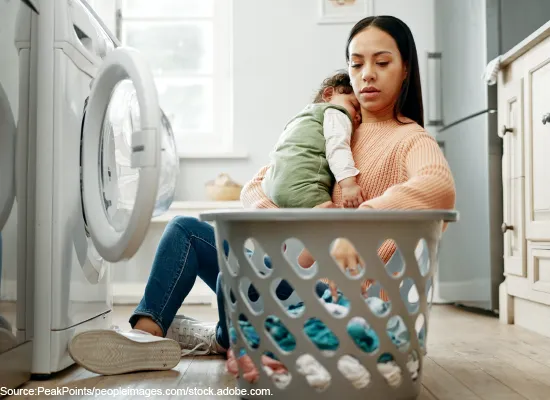
Who is doing all this unpaid housework?
Unpaid household work is considered work you do that someone else could be paid to do, such as fixing a leaky faucet instead of hiring a plumber.
On average, most of us spend at least 3.72 hours on unpaid household work in a typical day. That’s nearly a quarter of our waking hours spent taking care of our homes and/or loved ones.
Who did the most household work? Women, married people, those who were unemployed, and people ages 55 and older spent the most time doing unpaid domestic tasks. For example, those not working spent about 1 hour more per day on domestic tasks than working folks.
We looked at data on time use for unpaid household work from 2021 to 2024. And we found some other trends. For example,
- Women made up about 54% of those engaged in these tasks
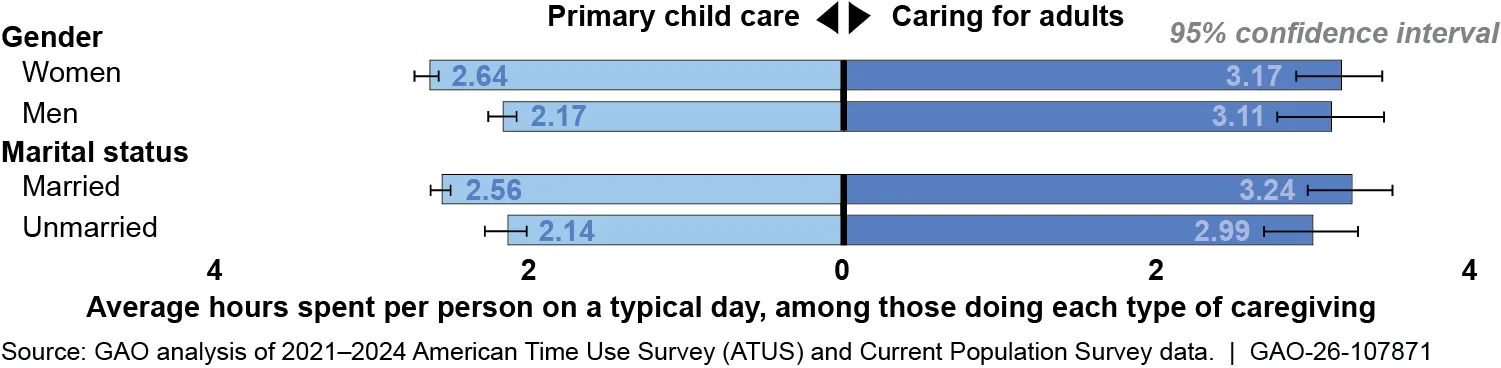
- Women and married people spent more time on child care than men and singles
- Women and men spent similar amounts of time caring for older adults, as did both married and unmarried people
Income also played a role in the amount of time people spent on household work. People with incomes of over $150,000 spent less time doing household chores themselves.
Time Spent on Unpaid Caregiving, 2021 to 2024
Image
How does knowing more about household work help us better understand the economy?
In the rush of our busy lives, unpaid chores and caregiving can go unnoticed. It’s just part of the routine. But looking closer at time spent on household tasks can be useful for understanding the value of this work and how caregivers might be compensated.
Monetary value. Your unpaid household work does have a value. After all, if we weren’t doing it, we might pay someone else to do it, which puts a price tag on this work.
The estimated national market value of unpaid household work was about $6 trillion in 2024. That’s equivalent to about 20% of the Gross Domestic Product (GDP) that year.
- Unpaid household chores made up more than $4 trillion
- Caregiving (as a primary activity—not just keeping an eye on the kids while doing something else) made up as much as $1.4 trillion
Valuable insights into our economy. When people are more willing to do household work themselves instead of pay for it, this could be a sign of changes in the economy. For example, during the COVID-19 recession, people did more work for themselves—like child care or yardwork—instead of paying others to do it.
But, while we’ve so far compared unpaid household work to GDP, it’s not actually included in GDP calculations. We made the comparison because estimating the value of this work provides a better understanding of the economy than GDP alone.
Informing policy. Economists we interviewed for our report suggested that valuing unpaid work can also help inform policymakers’ decision making on issues like supports for caregivers. For example, estimating the value of unpaid caregiving can help determine appropriate stipend amounts for family members who care for disabled veterans. It could also inform policies on child care, caregivers’ retirement security, workplace flexibility, and more.
For a more detailed look at how unpaid household work contributes to the economy and how it could inform policies that affect caregivers, read our full report.
- GAO’s fact-based, nonpartisan information helps Congress and federal agencies improve government. The WatchBlog lets us contextualize GAO’s work a little more for the public. Check out more of our posts at GAO.gov/blog.
- Got a comment, question? Email us at blog@gao.gov.
GAO Contacts
Image

Image



Related Products
GAO's mission is to provide Congress with fact-based, nonpartisan information that can help improve federal government performance and ensure accountability for the benefit of the American people. GAO launched its WatchBlog in January, 2014, as part of its continuing effort to reach its audiences—Congress and the American people—where they are currently looking for information.
The blog format allows GAO to provide a little more context about its work than it can offer on its other social media platforms. Posts will tie GAO work to current events and the news; show how GAO’s work is affecting agencies or legislation; highlight reports, testimonies, and issue areas where GAO does work; and provide information about GAO itself, among other things.
Please send any feedback on GAO's WatchBlog to blog@gao.gov.