
The U.S. Postal Service is Losing Money. What Can Be Done to Help It?
Millions of Americans rely on the U.S. Postal Service to send and deliver mail and packages—sometimes to locations that other delivery companies won’t service. But for nearly 20 years, the world’s largest mail carrier has been losing money. This puts its mission to serve the public, as well as its financial future, at risk.
Today’s WatchBlog post looks at our recent Q&A report highlighting USPS’s financial issues and efforts to reform it.
Image
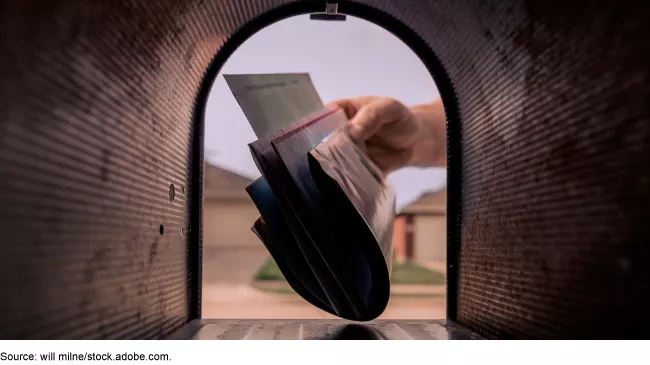
Decades of trouble plague the mail system
Postal service predates America itself, having been founded in 1775. Fast forward to 1970, when reforms reimagined the postal delivery system as an independent, business-like entity. The goal was that USPS would cover its own operating costs—primarily with revenues generated through the sales of postage and postal-related products and services.
But was that vision too lofty? Maybe—unless there is additional reform.
USPS continues to operate its universal delivery network, visiting 168 million addresses, 6 days a week. But now it is delivering a lot less mail, with First Class Mail volumes less than half what they used to be. As a result, USPS has lost money almost every fiscal year since 2007. Net losses have totaled approximately $109 billion from fiscal years 2007 through 2024.
For such reasons, USPS’s financial viability has been on our High Risk List since 2009.
We recently sat down with GAO's David Marroni to discuss the longstanding financial challenges facing USPS. Listen to our podcast below.
Escalating expenses. Some mail service’s financial woes include:
- Increasing compensation and benefits costs for workers
- Large unfunded liabilities and debt
- Operational costs that continue to rise faster than revenues
Declining mail volumes. While USPS remains the biggest mail service in the world—delivering nearly 40% of mail sent globally— it’s losing volume in areas that typically have resulted in more profits. For example, First-Class mail volume—its most profitable product—has seen massive declines.
The U.S. Postal Service’s Mail Revenue and Volume, Fiscal Years 2007 through 2024
Image

Delivery dilemmas. As part of its massive operation, USPS is also the only provider of “universal postal service”—meaning it is required by law to deliver to every address across the country, including rural areas. And that can be very expensive. USPS doesn’t have the authority to make many of the changes that could reduce delivery costs. Specifically, it generally must provide 6-day-a-week delivery and operate postal facilities across the country.
Federal law also limits its ability to close retail facilities. For example, no small post office can be closed solely for operating at a deficit.
Image
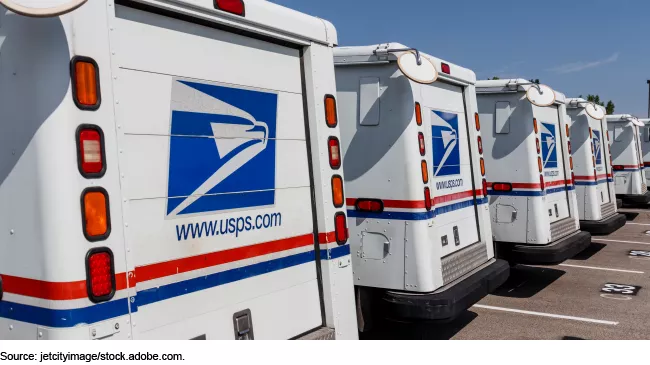
Addressing financial woes and looking to the future
In March 2021, USPS introduced a 10-year strategic plan to modernize its network and products in an effort to increase financial sustainability. The plan included significant changes to processing operations, transportation, and delivery networks. Specifically, it has worked to:
- Modernize and streamline its mail and package delivery network
- Improve the career development and retention of its workforce
- Reduce unfunded liabilities—including pension benefits, retiree health benefits, and workers’ compensation—and debts
- Reduce transportation expenses, which were about $1.3 billion during the last two fiscal years.
While USPS needs to cut costs, congressional action is likely needed to restore it to financial viability. In our prior work on this issue, we have recommended that Congress consider reassessing the level of universal postal service the nation requires. This is just one action that could help.
Otherwise, if expenses continue to exceed revenues, taxpayers risk bearing the cost of postal operations and unfunded liabilities. For more on USPS, see our latest Q&A report.
- GAO’s fact-based, nonpartisan information helps Congress and federal agencies improve government. The WatchBlog lets us contextualize GAO’s work a little more for the public. Check out more of our posts at GAO.gov/blog.
- Got a comment, question? Email us at blog@gao.gov.
GAO Contacts
Image



Related Products

GAO's mission is to provide Congress with fact-based, nonpartisan information that can help improve federal government performance and ensure accountability for the benefit of the American people. GAO launched its WatchBlog in January, 2014, as part of its continuing effort to reach its audiences—Congress and the American people—where they are currently looking for information.
The blog format allows GAO to provide a little more context about its work than it can offer on its other social media platforms. Posts will tie GAO work to current events and the news; show how GAO’s work is affecting agencies or legislation; highlight reports, testimonies, and issue areas where GAO does work; and provide information about GAO itself, among other things.
Please send any feedback on GAO's WatchBlog to blog@gao.gov.