
Reliance on Imported Critical Minerals Leaves the U.S. Exposed. How Can Emerging Technologies Help?
From the humble AA battery to most advanced semiconductors—modern electronics depend on minerals. The U.S. has designated 60 minerals as “critical” to economic or national security.
For batteries and semiconductors, which are key to our economy, the U.S. relies heavily on importing critical minerals like lithium, gallium, and germanium. In many cases, the source for these minerals is China.
Today’s WatchBlog post looks at our new report on technologies that could help reduce reliance on critical mineral imports in two key industries—batteries and semiconductors.
Image

What technologies could reduce our reliance on imported minerals?
Both batteries and semiconductors are central to the economy and rely on imported critical minerals. For example, China owns 99% of the gallium production worldwide. Gallium is a key mineral used in semiconductors that power microchips. And China has been known to manipulate mineral prices, which leaves the U.S. vulnerable to supply disruptions.
We looked at two technologies—recycling and substitution—that could be used to help reduce our reliance on imports.
We found that recycling and substitution technologies for batteries hold promise in the near term. However, it will take longer for any investments in semiconductor recycling and substitution technologies to reduce critical mineral imports.
Potential for technologies to reduce critical mineral import reliance
Image
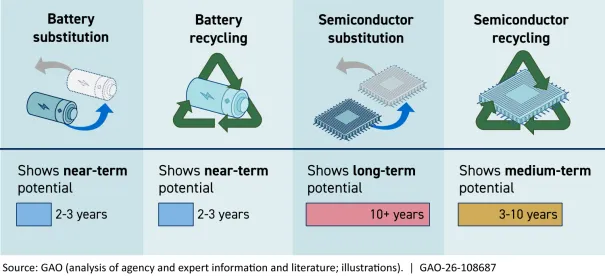
Battery recycling. The technology to extract and refine critical minerals from old batteries is mature. But the U.S. doesn’t have the infrastructure needed to collect large quantities of batteries and recycle them. In fact, we mostly send this kind of recycling abroad.
Battery substitution technologies. New battery technologies that would use substitute minerals won’t replace lithium in the short term. But they may replace other required critical minerals, like cobalt and nickel.
With further development, both of these technologies could make a significant contribution in 2 to 3 years.
Semiconductor recycling and substitution. The minerals found in semiconductors are hard to recycle at scale because only a tiny amount is recoverable from a typical electronic device. And experts told us that semiconductors with substitute minerals are not yet up to snuff in terms of performance. Both of these technologies are likely years away from the maturity needed to reduce import reliance.
What policy options would reduce reliance on imported critical minerals?
Policymakers are taking some steps to reduce reliance on critical mineral imports. For example, the U.S. plans to increase its domestic mining projects.
Our report looked at policy options for reducing imports, like accelerating recycling and substitution technologies. To do this, policymakers could:
- Support research, development, and testing of substitution and recycling technologies. This could help identify the most promising technologies and get them ready for full-scale production.
- Establish domestic manufacturing capacity to produce substitute technologies for batteries and semiconductors.
- Establish domestic recycling capacity by building infrastructure and eliminating the need to export this industry.
- Secure inputs for recycling by supporting efforts to collect, sort, transport, and store old electronics.
For more details on these technologies and the policy options that could help reduce U.S. reliance on imported critical minerals, read our new report.
- GAO’s fact-based, nonpartisan information helps Congress and federal agencies improve government. The WatchBlog lets us contextualize GAO’s work a little more for the public. Check out more of our posts at GAO.gov/blog.
- Got a comment, question? Email us at blog@gao.gov.
GAO Contacts
Image



Related Products

GAO's mission is to provide Congress with fact-based, nonpartisan information that can help improve federal government performance and ensure accountability for the benefit of the American people. GAO launched its WatchBlog in January, 2014, as part of its continuing effort to reach its audiences—Congress and the American people—where they are currently looking for information.
The blog format allows GAO to provide a little more context about its work than it can offer on its other social media platforms. Posts will tie GAO work to current events and the news; show how GAO’s work is affecting agencies or legislation; highlight reports, testimonies, and issue areas where GAO does work; and provide information about GAO itself, among other things.
Please send any feedback on GAO's WatchBlog to blog@gao.gov.