
Older Americans Are Working Longer—How Do We Support Them?
People are working later in life for many reasons. And as a result, older workers represent a growing share of the U.S. workforce. But despite this growing representation, older workers may be struggling to compete in today’s workforce.
Today’s WatchBlog post looks at our report on some reasons why people are working later into life and the federal programs meant to help them find and retain jobs.
Image

Why are people working later in life, and what challenges do they face?
The U.S. workforce is changing. In fact, the percentage of older workers (55 and up) increased from 15% to 23% of the workforce in the last 20 years.
So why are so many older people working later into life? There are a number of reasons—some based on necessity and others on choice. Longer life expectancy, higher educational degrees, and increases to the age for receiving full Social Security benefits may play a role.
We also interviewed some older workers who told us that they needed to save more for retirement before quitting work. Others said they kept working to maintain health insurance coverage. And some older workers simply wanted the social engagement within their communities.
When seeking new employment, older workers told us they preferred jobs that addressed their financial needs and gave them a sense of purpose and community connection. They also said they sought jobs that offered medical benefits, flexible work arrangements, and work that was less physically demanding.
For example, one woman said, “Neither my husband nor myself are old enough for Medicare yet. I’m going through … the [health insurance marketplace] right now, and it’s expensive.”
Another woman told us, “I have a mortgage, and my son … started at [a] university … So I’d like to support him if he needs extra money.”
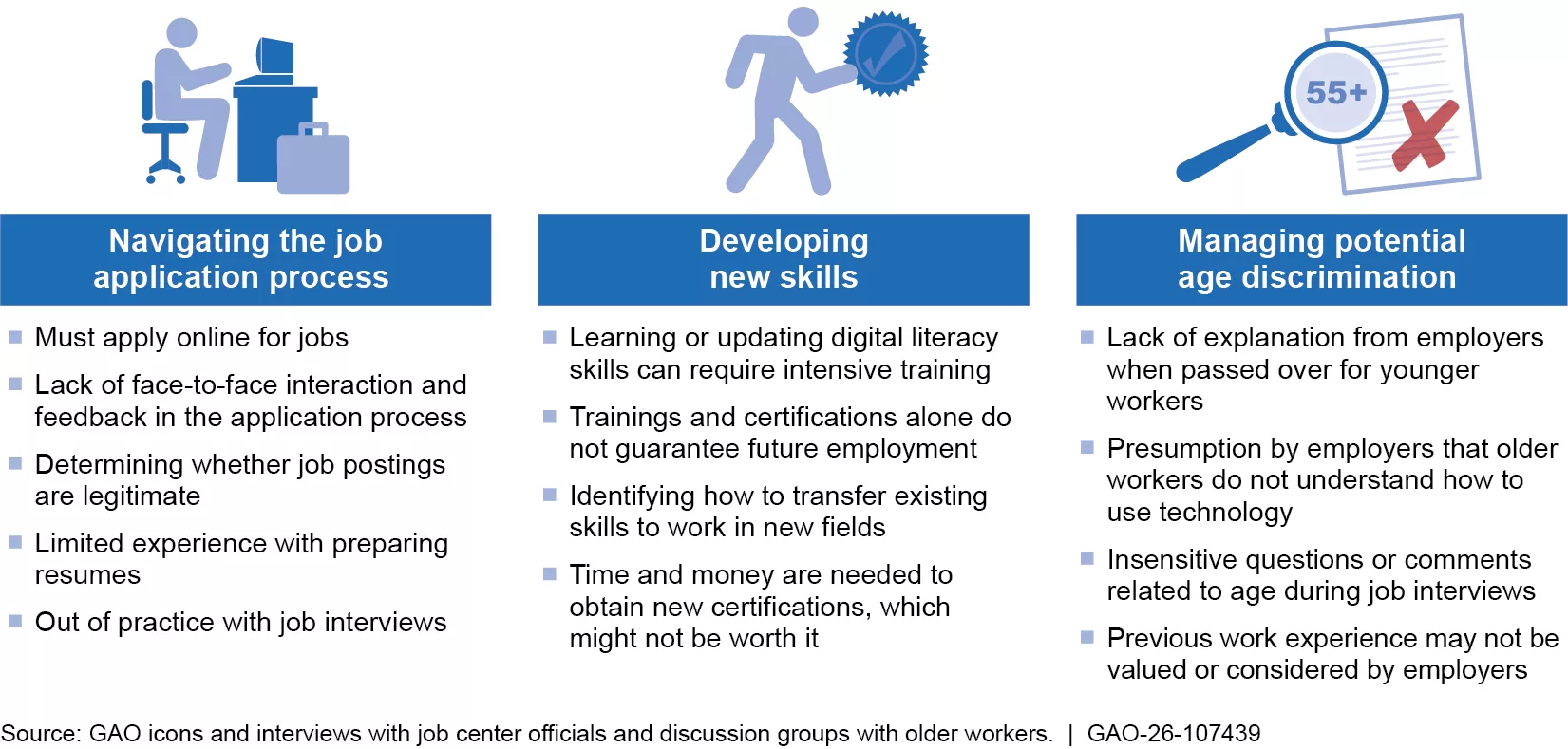
But despite the need for continued employment, many workers we spoke with noted obstacles to securing and keeping their dream jobs. Older workers also described challenges searching for and obtaining a job. These challenges included navigating the job search and application processes, developing new skills (particularly with technology), and potential age discrimination by employers.
Challenges Older Workers Face as Identified by Job Center Officials and Worker Discussion Groups
Image
What supports are available to help older workers?
The federal government has ways it helps older workers manage the challenges that could affect their ability to find and retain jobs. For example, the Departments of Labor and Education administer several programs through a network of state and local partners. These programs provide career counseling, job search help, skill training, and more. The Labor Department also supports older workers by funding research and providing online tools and resources for them.
Some programs are offered through job centers. Officials at these centers told us that older workers had unique employment needs. For example, some older workers have never owned a computer or rarely used them. Some job center officials also told us that when older workers transition from physically demanding jobs into other work, they may need computer skills training to be competitive in the job market.
Some officials also told us that part of their role is helping people transfer their existing skills to new job fields. For example, officials at one job center told us about a former sewing machine repair technician who got a job as a manager for a small engine repair company. They did so by emphasizing their existing skills and taking some basic computer classes to broaden their computer literacy skills.
Many older workers we spoke with said that job center staff gave them strategies for creating resumes and preparing for job interviews—increasing their chances of being hired. And three older workers with disabilities said workforce programs helped them find jobs they could perform or helped them arrange necessary accommodations with their employer.
We also learned about initiatives at the state and local level to support older workers. For example, one state offered online career-building seminars in which older workers could network with one another and learn strategies to become more competitive in the job market. In other states, job centers offered hands-on digital literacy classes for people 55 and older.
Older workers told us these opportunities were important to them. However, we found that the Labor Department has not helped state and local partners share information on the results of these initiatives. Sharing lessons learned could help all partners improve their strategies for serving older workers and better address the challenges many older workers face. In turn, the Labor Department would be helping these older workers support themselves financially, maintain a sense of purpose, and prepare for retirement while contributing their knowledge and experience to the workplace.
For more information on workforce development programs for older workers, be sure to read our full Q&A report.
- GAO’s fact-based, nonpartisan information helps Congress and federal agencies improve government. The WatchBlog lets us contextualize GAO’s work a little more for the public. Check out more of our posts at GAO.gov/blog.
- Got a comment, question? Email us at blog@gao.gov.
GAO Contacts
Image

Related Products

GAO's mission is to provide Congress with fact-based, nonpartisan information that can help improve federal government performance and ensure accountability for the benefit of the American people. GAO launched its WatchBlog in January, 2014, as part of its continuing effort to reach its audiences—Congress and the American people—where they are currently looking for information.
The blog format allows GAO to provide a little more context about its work than it can offer on its other social media platforms. Posts will tie GAO work to current events and the news; show how GAO’s work is affecting agencies or legislation; highlight reports, testimonies, and issue areas where GAO does work; and provide information about GAO itself, among other things.
Please send any feedback on GAO's WatchBlog to blog@gao.gov.